
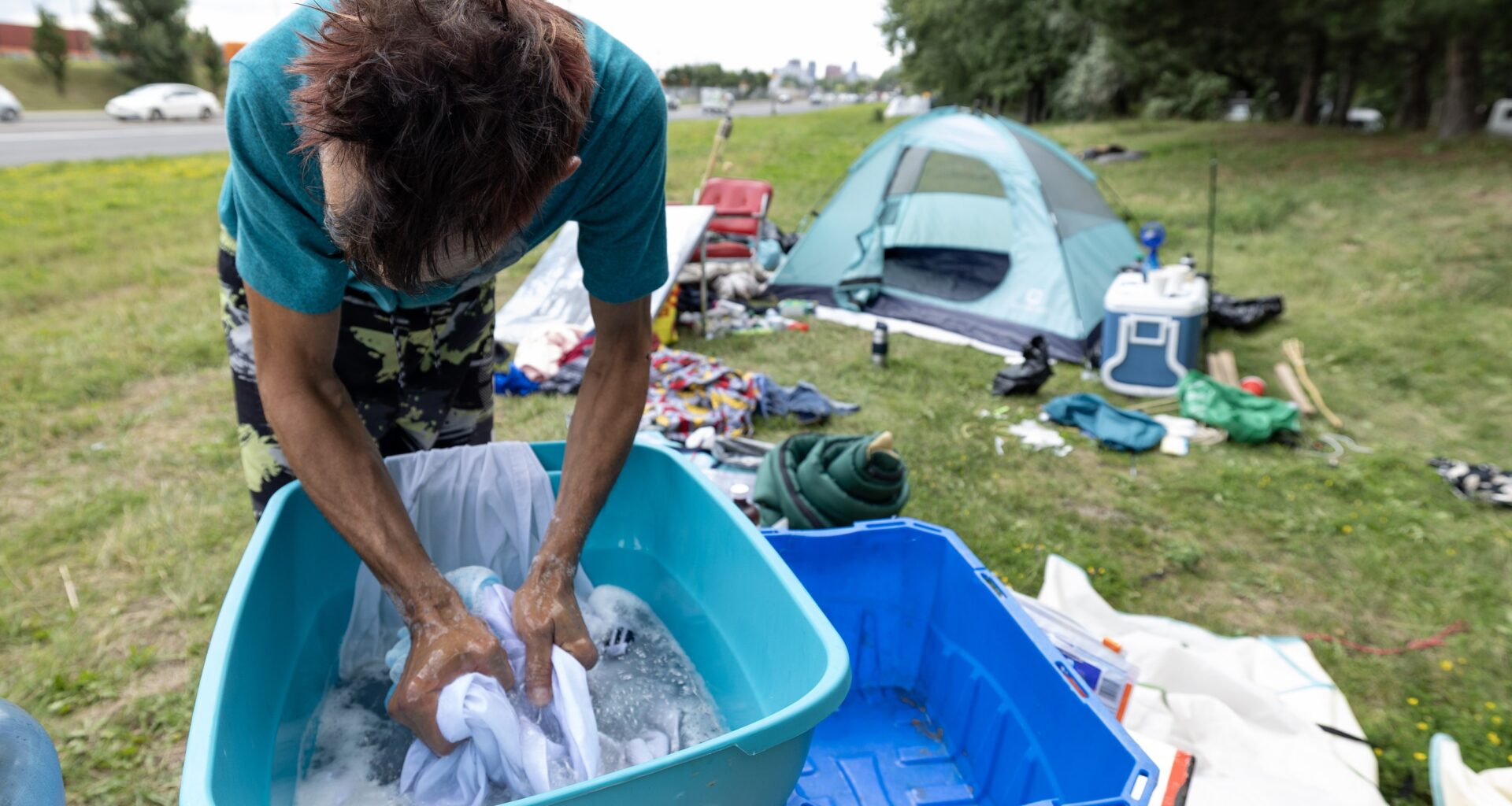
After Jean-Pierre Robin pitched his tent next to Montreal’s Notre-Dame St. E. in the spring, he was so focused on day-to-day survival that it took a week for him to realize he didn’t know where to shower.
He remembers the embarrassment of then trying to wash himself down in a fountain in a city square and the glares he received as people walked by.
“I’m sorry, but what else was I supposed to do?” Robin, 57, said last week while washing his clothes outside his tent.
Six months after announcing its first-ever protocol on encampments, the City of Montreal is still grappling with how to best address the issue. Heralded as the first of its kind, the protocol calls for a more tolerant approach and the addition of basic services where appropriate.
The Notre-Dame St. encampment, the largest in Montreal, exemplifies both the city’s efforts and their limits.
The city has added services throughout the summer while working on more long-term solutions. But the encampment has continued to swell — now hosting 150 people and 200 tents — straining an already fragile cohabitation with residents in the area.
“Homelessness continues to increase, and encampments are a reflection of that increase,” said Julien Montreuil, director of L’Anonyme, which offers services at the encampment.
Last winter, the city helped fund a warming centre L’Anonyme runs from a trailer. The service was extended through the summer, allowing people to get a coffee and bowl of soup and speak with intervention workers. Two portable toilets have been added next to the trailer, with one reserved for people living in the camp.
Montreuil commended the city on its approach but believes more services are needed, including mobile showers and additional toilets. He noted visits to the trailer have surged from 60 per day earlier this summer to more than 200.
He also acknowledged concerns from nearby residents, who have reported instances of open drug use, mental health crises and public nudity as the camp has grown.
“Our goal is to strike a balance between residents’ sense of insecurity and the needs of people experiencing homelessness,” Montreuil said. “It’s far from perfect, but if we weren’t here, I do think things would be worse.”
To push beyond emergency services, the city also recently awarded a 16-week contract to the Old Brewery Mission to help move people from the encampment into housing.
In documents related to the contract, the city notes the encampment’s growth raises “significant issues regarding social cohabitation, public health and safety” for people in the encampment and those living nearby.
Émilie Fortier, the mission’s vice-president of services, sees the effort as a way to help tackle the encampment issue.
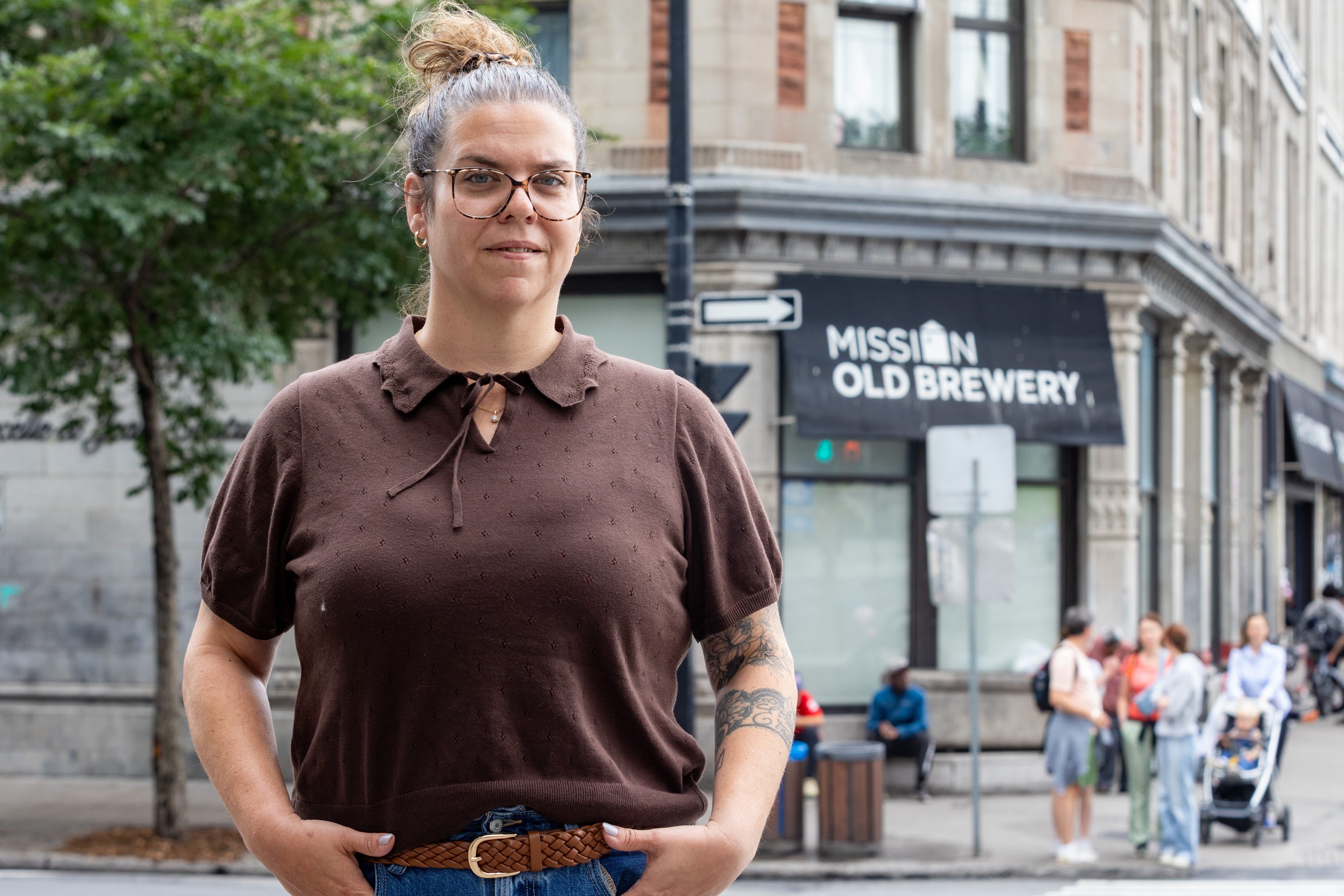 “We have to find a way to not only offer support at encampments but also find a solution to encampments themselves,” says Émilie Fortier, vice-president of services at the Old Brewery Mission, seen on Monday, Aug. 17, 2026. Evan Buhler / Montreal Gazette
“Montreal is at a bit of a crossroads, where we have to find a way to not only offer support at encampments but also find a solution to encampments themselves,” Fortier said.
Fortier noted the mission’s employees have already been on site in recent weeks, building connections and helping people get their paperwork in order. They will now work out of L’Anonyme’s trailer, matching people to available housing.
“It’s going to be a long process, but I think it’s possible by taking it one step at a time,” she added.
Under the previous administration, the city attempted to clear out the Notre-Dame St. encampment before a legal clinic obtained a court order halting the process.
The dismantling of a smaller Plateau-Mont-Royal encampment this summer was also blocked by the courts. In that case, under its new protocol, the city had proposed different locations for the people living there.
Asked about the city’s new approach this week, Mayor Soraya Martinez Ferrada acknowledged it has been a “difficult” transition.
“We adopted a protocol that did not exist before, and there is a period where you have to test it,” the mayor said, noting the court challenge and residents’ concerns.
“But I think there are many things in the protocol that are the right thing to do, combined with accelerating the offer on transitional housing and a real intervention plan,” she added.
A city spokesperson said decisions on adding services to encampments are made case by case, depending on what’s already available nearby.
For the Notre-Dame St. encampment, the city noted two parks in the area have water access and washrooms, though the city is still considering “other options for improving access to services.”
Editor’s Picks
For people like Robin, the services are welcomed but fall short.
Between looking for nearby water sources — to wash his dishes or clothes, for instance — and travelling to food banks to eat, he said, he’s left with little time to get his affairs in order or search for housing.
He’s also aware of the tension caused by people wandering around the neighbourhood in search of basic needs.
“There are residents who are sick of seeing us. And I understand,” he said. “But we’re here, we exist.”