
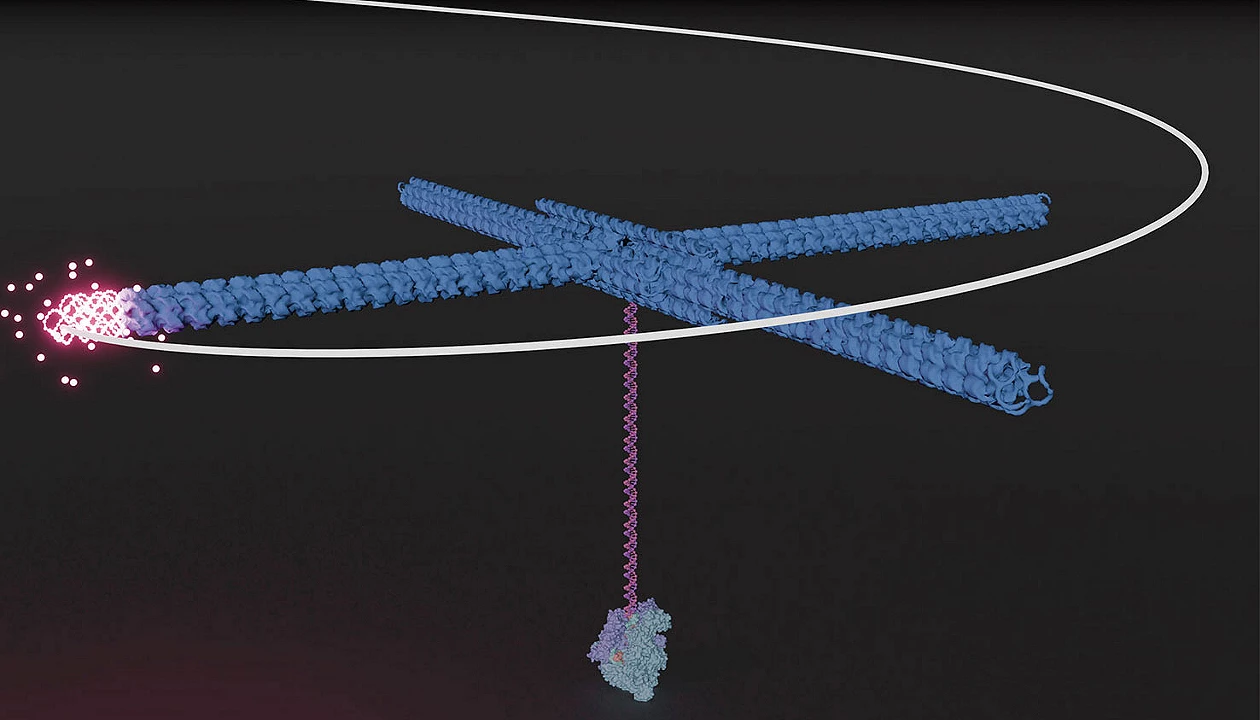
In our cells, countless RNA polymerase (RNAP) enzymes zip along our DNA, rotating and twirling in an elaborate molecular dance that takes place at a nanometer scale. Few have observed this dance, but Pallav Kosuri, a biophysicist at the Salk Institute for Biological Studies, is one of those lucky few.
Kosuri helped pioneer a technique called origami-rotor-based imaging and tracking (ORBIT) that uses fluorescent dyes to track the rotation of DNA and RNAP at a base-pair resolution (Nature 2019, DOI: 10.1038/s41586-019-1397-7). One caveat of ORBIT is that the fluorescent dyes quickly photobleach, limiting observation times to only a couple of minutes at best. “No matter how many [fluorophores] I added, they would eventually go dark,” he says.
Now Kosuri’s lab has improved the technique with dye-cycling ORBIT, allowing molecular motion to be observed over much longer periods of time (Cell Rep. Methods 2026, DOI: 10.1016/j.crmeth.2026.101550).
Like the original ORBIT, dye-cycling ORBIT is based on DNA origami, a technique where researchers engineer DNA sequences that fold in on themselves to create complex structures. In this case, the DNA structure is a four-armed rotor connected to a shaft that can be ligated to an enzyme of choice. “The rotor itself consists of about 200 separate strands of DNA,” Kosuri says. “We just order them, and then we mix them together in right proportions, heat them up, cool them down. And over a couple of days, we have trillions of rotors that we can use.”
The improvement to ORBIT is really simple, Kosuri says. Rather than fixing the fluorescent dyes covalently to the rotor arms, the new rotors have “landing pads” of single-stranded DNA where dyes, tagged with a complementary strand, can transiently bind.
With multiple binding sites on each arm, oligo-dye molecules can continually join and leave the rotor arms. This allows the researchers to track the new dye-cycling ORBIT rotors for much longer compared with the original ORBIT rotors. In one experiment, Kosuri’s team could track transcription for 10 min.
“I dream of doing it for hours on end to see if [enzymes] go through moods and personality changes over time, or if they kind of stay the same,” Kosuri says.
And Kosuri hopes that other researchers will apply this technique to visualize the movement of the proteins they’re most interested in. “I think a lot of the answers to how biology works lies in mechanical motions, not just in the chemical reactions,” he says.

Max Barnhart is an assistant editor and life sciences reporter at C&EN.