
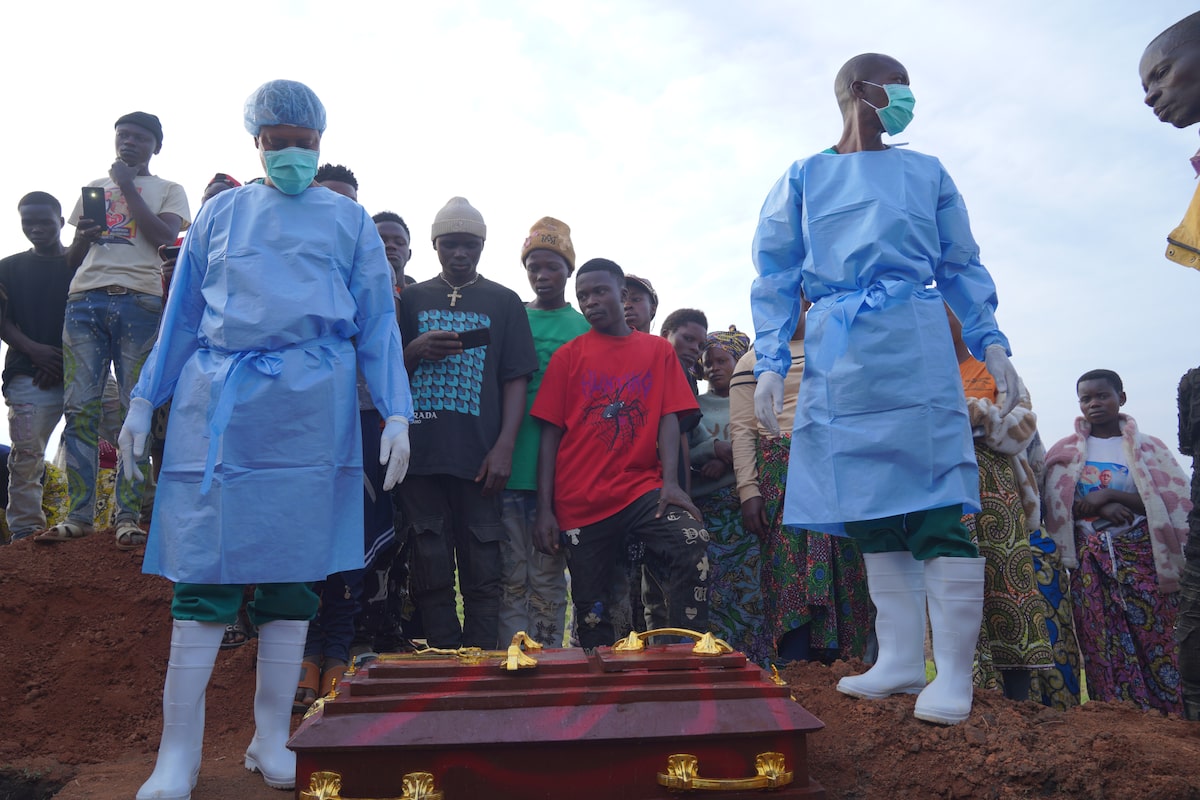
People dressed in protective gear prepare to lower into a grave a coffin containing the remains of a three-year-old who died of Ebola, in Bunia, Congo, on Tuesday.Dieudonne Dirole/The Associated Press
A leading humanitarian agency is calling for greater Canadian support to fight Congo’s rapidly escalating Ebola epidemic, after Ottawa’s $8-million response fell far behind the contributions of other donors.
Médecins Sans Frontières (MSF), one of the main agencies combating the Ebola outbreak, which has killed more than 2,400 people so far, says the federal government’s financial assistance has been drastically less than what it provided for the previous big outbreak, in 2014.
More than 5,100 Ebola cases have been recorded in the current outbreak – nearly 10 times more than in the 2014 West Africa outbreak at the same stage, according to a briefing Thursday by the Africa Centres for Disease Control (Africa CDC). And because many cases are believed to be undetected, the true scale of this outbreak could be three times bigger than the official count, it said.
Twelve years ago, Ottawa announced more than $110-million in aid to battle the Ebola outbreak in West Africa. But this time, despite signs that this outbreak is the fastest-growing in history and likely to become the biggest ever, it has announced only $8-million, MSF noted.
The United States, meanwhile, has pledged the equivalent of more than $700-million in aid, while African countries have promised $150-million.
The fastest-growing Ebola outbreak in history, through the eyes of Canadians on the ground
The outbreak in the Democratic Republic of the Congo has been compounded by other crises in the region, including military conflicts and deadly diseases such as cholera, measles and malaria.
“In the face of these interlocking health and humanitarian crises, Canada needs to step up, rather than step back,” said Adam Houston, medical policy and advocacy adviser at MSF Canada.
“One of the lessons of past outbreaks is that the most effective time to provide resources is early in the outbreak,” he told The Globe and Mail. “The more it spreads, the more difficult it will be to get it under control.”
Global Affairs Canada, asked why the Canadian contribution has been relatively small and whether it would be increased, did not reply directly. “We continue to closely monitor the situation and engage with key partners to assess evolving needs, and to support response efforts,” departmental spokesperson Samantha Lafleur told The Globe.
Ottawa has also reacted to the Ebola outbreak by imposing severe restrictions on travellers from Congo, Uganda and South Sudan, requiring 21-day quarantines for Canadians who return from those countries. Those rules expire Aug. 29 but are widely expected to be renewed in some form.
Ebola kills more than 1,700 in eastern Congo in fastest-growing outbreak
The government further tightened the rules last month by banning the entry of any foreign nationals who have been to Congo in the past 21 days.
The travel restrictions have complicated MSF’s ability to help fight the outbreak, Mr. Houston said. At least 11 of its Canadian staff had to cancel their planned assignments in African countries because of the mandatory quarantines they would have faced.
“Canada’s current measures are considerably more restrictive than it has imposed for any prior Ebola outbreak,” Mr. Houston said. “They also go far beyond the measures imposed by the majority of countries around the world, including jurisdictions like the European Union.”
Mark Johnson, a spokesperson for the Public Health Agency of Canada, said the travel restrictions were tightened because of “significant ongoing uncertainties regarding the true number of infected persons, geographic spread, and epidemiological links among cases in the DRC.”
The new rules are aligned with U.S. measures, “facilitating a North American perimeter and regional response,” Mr. Johnson told The Globe.
Health Canada gives Moderna vaccine trial clearance for Ebola species tied to Congo outbreak
Asked whether the travel restrictions will be renewed when they expire next week, he said: “The Government of Canada is continually reviewing the measures alongside the latest evidence with international partners and will determine next steps before the existing measures are set to expire.”
The current Ebola outbreak is now the second-deadliest on record, exceeded only by the West Africa outbreak, which killed more than 11,300 people in Liberia, Sierra Leone and Guinea from 2014 to 2016.
The virus has a case fatality rate of 47 per cent, according to Africa CDC, which noted that it has reached 70 per cent in North Kivu, a province in eastern Congo largely occupied by the Rwanda-backed M23 rebel militia.
Health agencies have struggled to raise enough money to tackle the epidemic. In one example of the budget shortages, hundreds of Congolese health workers in the Ebola zone have gone for weeks without pay. Some have gone on strike in protest.