

Listen to this article
Estimated 4 minutes
The audio version of this article is generated by AI-based technology. Mispronunciations can occur. We are working with our partners to continually review and improve the results.
About 40 whooping crane chicks have hatched in Wood Buffalo National Park following a still-burning wildfire that threatened their habitat and nesting grounds.
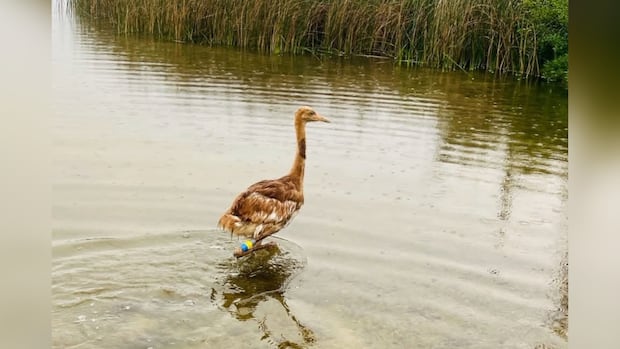
Parks Canada staff recently caught about 20 of the chicks and tagged them with bands and tracking devices.
The season started off on a positive note, said Nicolas Comerford, an ecologist with Parks Canada. But conditions quickly changed.
“We had a record number of nests this year, 119 nests were counted in May,” Comerford said. “Of course, since then, we actually saw the fire start in May while we were doing the surveys, and the fires grew over the summer.”
Whooping cranes are an endangered species, with only about 550 found in the wild.
Tense nesting season
Comerford said the ongoing drought has also posed a threat to the birds, as it means lower water levels, leaving the nests more exposed to predators, and forcing them to travel further from their nests to find food, leaving their eggs and hatchlings at risk.
He said Ernie Kuyt, a leading biologist credited with saving whooping cranes from extinction, made an observation about the birds and how low water levels can impact their nesting season.
“He identified this correlation that when there are low water levels, we tend to see lower productivity,” Comerford said.
Out of the 119 nests, Comerford said the 40 hatchlings represent a productivity of about 34 per cent.
“That’s a bit on the lower end,” Comerford said. “The whooping crane breeding productivity is quite variable.”
Comerford said they had recorded productivity rates ranging from 25 per cent to 80 per cent over the years, and it mainly depends on the amount of water on the land during the season.
This year’s threat from wildfires didn’t help — some nests were established far enough away that they weren’t impacted at all, while others were later found abandoned or burned.
“The drought is really the source of these issues,” Comerford said.
As part of his work, Comerford was part of the group who captured some of the birds for banding. He said they had to catch one of the chicks in less than 12 minutes, quickly put the band on and assess its health, before releasing it back.
“You’re on a timer and you want to make sure that you’re doing this job well, you’re not hurting the animal,” Comerford said.
A bird with a special name
Ronnie Schaefer, who lives in Fort Smith, spends a lot of time with the whooping cranes in the park. Over the years, he’d often go out and monitor the nests with his wife Cindy, who died in 2025.
 ‘She would have laughed,’ Schaefer said of what his wife Cindy might say if she were to learn a whooping crane chick had been given the name ‘Chickie’ (her nickname) in her memory. (Submitted by Carla Ulrich)
“People know my commitment and my love of these birds, and my wife being out there with me doing that,” Ronnie Schaefer said.
Thanks to the couple’s commitment to the endangered species, one of the juvenile cranes, who is working on preparing for a long migration south in mid-September, will carry the name “Chickie,” Cindy’s nickname, throughout its life.
Once he found out about the name, Schaefer said he thought it was “amazing”.
For Schaefer, he’s eager to keep tabs on Chickie’s progress as the cranes migrate south.
“I went to see the guys that did the banding of the bird, and shook their hands,” Schaefer said.
Now, people can report sightings of Chickie using the unique colour band (gray, yellow and blue).
“I was so happy that they did this in honour of [Cindy],” Schaefer said.
“I just love them to death for doing that for her.”
LISTEN | The Trailbreaker’s interview with Schaefer and Comerford:
The Trailbreaker12:27A whooping crane chick with a special name
After their nesting season was threatened by wildfire and drought, about 40 whooping crane chicks hatched in Wood Buffalo National Park this year. One of them has a very special name. Ronnie Schaefer has the story of why that chick got that name, and Nicolas Comerford with Parks Canada spoke with the CBC’s Shannon Scott with details on the threats the whooping cranes faced this season.