
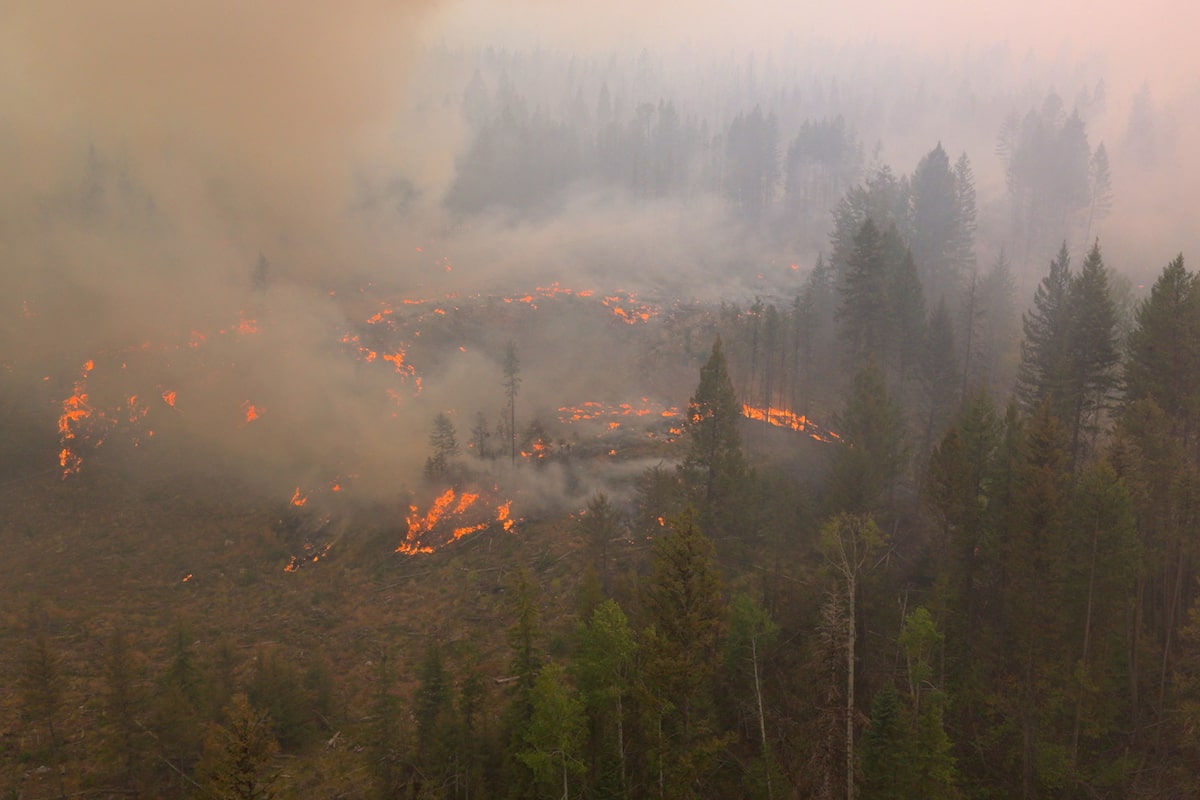
Smoke rises over the western flank of the Bald Range wildfire near Summerland, B.C., on Aug. 16.BC Wildfire Service/Reuters
Thick of it
Re “Inside the early battle against the ferocious Bald Range wildfire” (Aug. 15): I live in British Columbia, where smoke season has become a grim reality.
As a counsellor, I’ve witnessed my clients’ mental health rattled by wildfires choking off the skies. My partner drives past a smouldering wreckage on his way to work. My daughter is in a vulnerable persons database because she has no transportation in case of evacuation.
Officially or otherwise, we are all on evacuation alert. If our towns are untouched, it is dumb luck that spares us.
Most of us understand that climate change contributes to these conditions, though many feel helpless facing something bigger than any one person. Divesting from fossil fuel infrastructure and investing in greener solutions helps create a hopeful and abundant future.
This is the message I want to share with my clients and with young people in the B.C. Interior with no memory of a time before there was a smoke season.
Deirdre McLaughlin Nelson, B.C.
We are living in a state of emergency.
The air here is thick with smoke, and my town is full of Summerland evacuees. Community and local government efforts to support them are comprehensive and heartwarming. Firefighting efforts are extraordinary. Regular emergency briefings are impressive.
But these are emergency responses and not sustainable long-term. We should address definitively the root causes of these disasters. If we don’t stop burning fossil fuels, we will not have a livable future.
Wildfires are resulting in tragedies and profound losses. At the peak of a bountiful harvest, farmers can’t work. Already we know one organic farm has burned, along with the homes of the two families who worked for years to develop it.
Something is wrong with society when people who grow our food and make our world a healthier place lose everything, while those producing and selling fossil fuels prosper, supported by our governments.
Elizabeth Lominska Johnson Penticton, B.C.
Your report demonstrates the naïveté of those who argue we can adapt to climate change without fundamentally changing our lifestyles and society. We should decarbonize.
The power and speed of the supercharged Bald Range wildfire overwhelmed even experienced, well-prepared responders. Meanwhile, our leaders seem intent on pouring more oil and gas into the climate inferno.
James Worrall Ottawa
Head off
Re “Quebec’s oath of allegiance dodge could end in legal chaos” (Opinion, Aug. 15): In our democracy, I see nothing wrong in the Quebec National Assembly or any other legislature, especially if unanimous, wishing to remove the requirement for the oath to the King. The purpose of “repatriating” the Constitution in 1982 was to end the involvement of Britain in amending it (which still largely consists of British legislation).
Under Section 41 of the 1982 Constitution Act, amendments in relation to the monarchy require resolutions of the Senate, House of Commons and legislative assemblies of each province. In practice, the politicians of the time made it almost impossible to replace the British monarch as our head of state with whoever a majority of Quebeckers or other Canadians may wish.
Jim Reynolds Author, Canada and Colonialism: An Unfinished History; Vancouver
Reading into it
Re “Carney shares what’s on his summer reading list” (Aug. 15): Knowing what someone has on their summer reading list can offer insight into them. Mark Carney has some interesting choices lined up.
It’s a shame that Avi Lewis and Pierre Poilievre did not provide their lists. I suspect Mr. Lewis is busy plotting by-election strategy, assuming he wants to enter the House.
As for Mr. Poilievre, I recommend How to Win Friends and Influence People. He might find that useful.
Peter McNulty Halifax
Cleared for takeoff
Re “God made toddlers smaller than adults for a reason” (Opinion, Aug. 15): On a recent trip to Europe, my wife and I decided to splurge on business class seats.
As other passengers boarded, I was gripped with consternation as a young family with a baby set up camp in the seats across our shared aisle. It has been 50 years since we had our babies, so I knew my tolerance would be limited. Maybe our own kids screamed or even vomited on an airplane once or twice, but those memories have conveniently faded.
As it turns out, these parents were very attentive and their baby did not make a substantial peep for six hours. The lesson? With responsible parents, children can do well in any airplane seat.
There may even be no need to buy noise-cancelling earphones or have the flight cancelled. Let that be a lesson for me.
Irv Salit Toronto
Better nature
Re “We must remember: We are all a part of nature” (Opinion, Aug. 15): The message here is profound by any measure.
Once we understand that the human role in the natural world is not hierarchical but symbiotic, we reach a greater understanding of who we are as a race and our role here on Earth. We have a power to think, laugh and reason that is superior to other life, but that does not make us superior to it.
“Life is a collaborative process, not just a competitive one; and we are very much part of nature, not separate from it.” These words resonate with me, as I hope they do for a new generation looking for a future of hope that transcends the value of material things.
The more people who join this train of understanding, the more mature we become as the human race.
Mark Cullen CM; founding chair, Trees For Life; Markham, Ont.
I worry this analysis short-circuits a deep understanding of the problems we face with regard to the environmental crisis.
Summing up the root of the problem by blaming Descartes assumes there is a conversation across the centuries between philosophers that is outside of history. Environmental problems are embedded in the material relations of history and the deep momentum of those relations.
To think that we just need to get our definitions right to solve these problems profoundly underestimates the reality.
Ray Rogers Pictou County, N.S.
Reverent routine
Re “Rituals are central to our evolutionary story. So why did I refuse to practise them in my own life?” (Opinion, Aug. 15): I’d say a ritual is part of a shared ceremony that may touch the sacred, if that is how an individual participant experiences it. But the sacred can also be apprehended by individuals without reference to ritual.
To me, the sacred is not only the awesome mystery of our existence, but also what holds us. In my opinion, it deserves our reverence – at minimum, our respect.
Patrick Wolfe Victoria
Letters to the Editor should be exclusive to The Globe and Mail. Include your name, address and daytime phone number. Keep letters to 150 words or fewer. Letters may be edited for length and clarity. To submit a letter by e-mail, click here: letters@globeandmail.com