
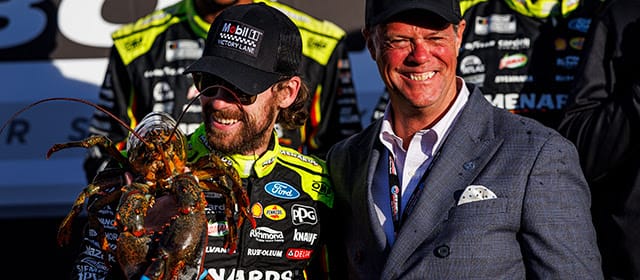
LOUDON, N.H. — With just two races remaining before NASCAR’s postseason begins, New Hampshire Motor Speedway has become the center of a championship battle defined by momentum, consistency and an entirely new playoff format that has drivers paying attention to every point available.
Few drivers understand that better than Christopher Bell, who arrives at Loudon in the midst of one of the most unusual seasons of his Cup Series career. Despite not winning as often as he would like, Bell has remained firmly in the championship conversation through relentless consistency, piling up seven runner-up finishes and climbing into a tight battle for a top-five position in the standings.
“Every single stage, every race, every position, all those points matter,” Bell said Saturday.
Under NASCAR’s revised championship format, Bell says those second-place finishes are finally being rewarded. In previous years, race wins largely dictated postseason positioning. Now, every point earned throughout the season carries more significance, creating pressure that Bell says is felt every weekend.
“The previous format was very much win or bust,” Bell said. “Now, these races we’ve done since February matter.”
Bell enters the weekend tied for sixth in points and just 20 markers behind fifth-place Chase Briscoe. While Daytona looms as a chaotic season finale, Bell views New Hampshire as a race where contenders can largely control their own destiny.
Adding to his confidence is a remarkable history at the one-mile oval. Across NASCAR’s three national touring series, Bell has won seven times in 12 starts at Loudon. He credits much of that success to extra seat time he received early in his career through Kyle Busch Motorsports, which tested and raced extensively at the track before many of today’s younger drivers ever arrived.
“I’ve had great cars every time that I’ve come here,” Bell said. “I was fortunate enough to get that seat time before I got into the Cup Series.”
While Bell and Toyota have enjoyed success on larger, higher-speed tracks this season, he acknowledged that New Hampshire falls squarely into a category where Team Penske has become the benchmark.
“I think they’re going to be the cars to beat again,” Bell said. “This is definitely their strength right now.”
The numbers back him up.
As the playoffs approach, Penske drivers Ryan Blaney and Joey Logano appear to be building momentum at exactly the right time. Both drivers believe the organization has steadily improved throughout the summer, particularly on the shorter, flatter tracks that make up a critical portion of the playoff schedule.
“I think we’re in a good spot at Team Penske and hitting some really good momentum right before we get going in the Chase,” Blaney said.
Logano agreed, noting that consistency has returned to the No. 22 team after an uneven start to the year.
“It seems like we’ve been able to scratch and claw and get some speed back in it,” Logano said. “Short tracks, obviously, are still our bread and butter.”
For Penske, New Hampshire represents one of the best opportunities remaining before the postseason begins. Blaney won at Loudon last season, while Logano called the track perhaps the most technical oval on the Cup schedule.
Unlike many modern speedways, New Hampshire rewards precision over aggression. Drivers constantly fight changing banking, multiple grooves and unforgiving corner entries that can ruin a lap in an instant.
“You’ve just got to be so precise around this racetrack,” Logano said. “It’s hard to ever feel like you just nailed the lap perfect.”
Both drivers believe momentum matters entering the playoffs, but neither views it as a guarantee of success.
“You can have all the momentum in the world and it can break pretty easy,” Blaney said.
That uncertainty extends beyond Loudon. The regular-season finale at Daytona will feature a revised superspeedway package that remains largely unknown to drivers and teams.
“We’ll be the first to know,” Blaney said.
Perhaps no driver feels the urgency of the next two weeks more than Ryan Preece.
The Connecticut native returns to what he considers his home track knowing time is running short to make up ground in the playoff standings. For Preece, however, New Hampshire has always been about more than points.
Growing up in New England, Loudon represented NASCAR’s biggest annual event in the region. Long before becoming a Cup Series driver, Preece built his reputation racing modifieds throughout the Northeast, and he still considers New Hampshire one of the most meaningful stops on the schedule.
“It’s a whole bunch of states that just get around whoever is from New England,” Preece said. “We’re very passionate about our sports.”
Preece will pull double duty this weekend, competing in both the Cup Series and a modified event. He admits transitioning back to the modified comes naturally, but keeping up with the latest developments in the division remains a challenge.
“The car drives really good,” Preece said. “My hopes for today are to contend and try and win that race.”
His Cup Series focus is equally straightforward.
“We need a home run right now,” he said.
That home run means qualifying near the front, scoring stage points and potentially contending for a win. Preece believes RFK Racing has made notable gains since struggling at Iowa and pointed to Richmond as evidence that the organization is moving in the right direction despite a poorly timed caution spoiling the final result.
Like Bell and the Penske drivers, Preece is trying not to become consumed by standings calculations.
“Control the things that you can control,” he said.
That philosophy may be the defining theme of NASCAR’s playoff race.
Bell is chasing valuable points and trying to transform consistency into a championship run. Penske’s stars are relying on momentum built over months of development and improvement. Preece is hoping a breakthrough performance at his home track can keep his postseason hopes alive.