
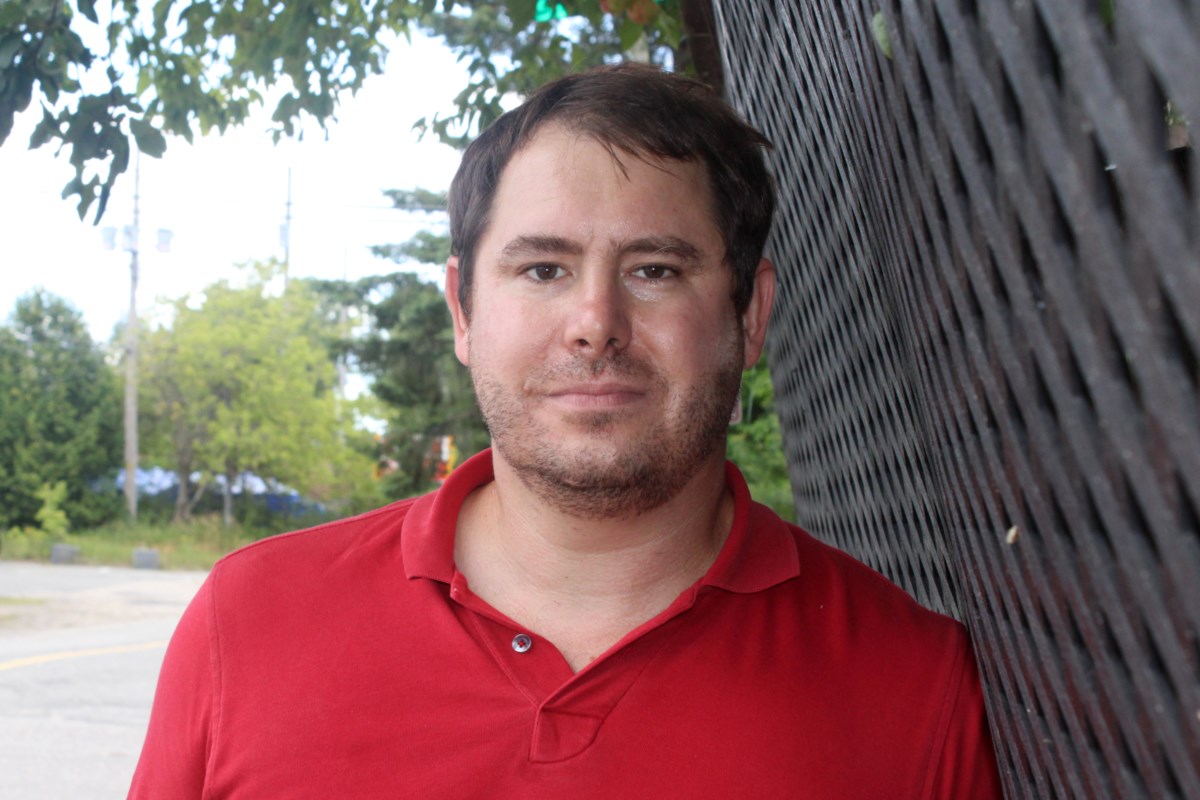
A welding inspector by trade, Michael McIntosh, 38, said his No. 1 goal is the reinstatement of weekly garbage collection
The reinstatement of weekly garbage collection is front and centre in mayoral candidate Michael McIntosh’s campaign.
“This well-intentioned policy has resulted in our city often being covered in garbage, which I think is a detriment to attracting investment, and it’s a public health issue,” he told Sudbury.com.
McIntosh filed his nomination paperwork with the city on Aug. 17, making him the second-latest mayoral candidate to file.
As of mid-day Aug. 21 (the final day of the nomination period), there were eight mayoral candidates, with McIntosh No. 7 and Troy Crowder No. 8, with Crowder having filed on Aug. 20.
(This excludes Bill Leduc’s mayoral campaign, which he recently withdrew in order to run for re-election in Ward 11.)
McIntosh said, “In the unlikely event I should win, I’m prepared to serve,” but that his primary focus is drawing attention to his weekly garbage collection pledge.
“I would be perfectly happy if I didn’t win and we got the garbage picked up every week,” he said.
Residents who don’t have a shed or garage and miss a garbage day are put in a difficult situation, “so you could potentially be in a one-bedroom un-air conditioned apartment with garbage for three weeks.”
The city shifted to every other week garbage collection in early 2021 in an effort to push people to use green cart organics and blue box recycling programs. The shift was phased in over the course of five years, during which collection was eased from up to three bags/cans/bundles of garbage every week to two bags/cans/bundles every other week, with each unit limited to 40 pounds.
Green and blue box pickup has remained weekly.
By late 2021, the city already measured early signs of success, with use of the city’s green cart organics program jumping from 27 per cent of households in 2018 to 43 per cent in a sample of several neighbourhoods. Blue box recycling use increased slightly from 91 per cent of households to 92 per cent, and the number of households with only one garbage bag/can/bundle per week increased by 19 per cent.
More recently, green cart organics pickup use has stagnated around the 45 per cent mark, and an October 2025 study found that approximately half of the 89.8-million kg of waste that entered city landfill sites in the 12 months beginning September 2024 could have been diverted using existing city diversion programs.
“Although population has increased, the amount of garbage landfilled has decreased over the last six years as a result of changes to garbage bag limits and collection frequency,” according to the city’s Sustainable Waste Strategy.
McIntosh contends that, although the city promoted its success, “Would you say that’s been effective when looking around?” arguing that there’s garbage on city streets.
“I don’t feel that’s been effective,” he said. “That’d be my main reason for running.”
McIntosh was raised in Sudbury and left for several years to live in Toronto before coming back in 2019. He is a welding inspector by trade and owns two local rental properties totalling seven units, of which he resides in one.
Although focused mainly on the issue of weekly garbage collection, McIntosh said he’d also pledge to improve the condition of city roads and tackle homelessness.
As for roads, he said improving conditions would be “a decades-long project.”
“Anyone who says they’re going to fix the roads in four years is either lying to you or dangerously misinformed,” he said.
McIntosh would also not take on any more major projects as mayor.
“We might be better served by a mayor that focuses on small goals and fulfilling the commitments and projects we’ve already undertaken rather than someone with grandiose visions, given the economic state of the time and the state of the city’s finances.”
Other mayoral candidates include, in order of registration date, Bob Johnston, incumbent Paul Lefebvre, Rodney Newton, Joseph Boutros, Keenan Menard, Miranda Rocca-Circelli, Michael McIntosh and Troy Crowder.
Crowder is the only candidate Sudbury.com has not written an introductory story on. We have reached out to him and will publish a story in the event an interview is granted.
Crowder is a former NHL player who was convicted of fraud in 2022. According to CBC’s reporting, he pleaded guilty to knowingly submitting a forged document during an insurance payout. Although he subsequently appealed his conviction, the Ontario Superior Court of Justice denied it. Crowder also sought municipal election in the 2018 mayoral race, during which he earned a fifth-place 4,279 votes.
Also in 2018, Crowder ran for the Progressive Conservatives provincially in the Sudbury riding, finishing second behind the NDP’s Jamie West.
Correction regarding McIntosh’s homelessness plan, issued at 5 p.m. Aug. 22:
Sudbury.com initially published the following, attributable to McIntosh’s homelessness plan:
He said he’d take the City of Timmins’ lead when it comes to transitional and supportive housing units, which is also the City of Greater Sudbury’s current direction (40 transitional housing units on Lorraine Street, plus 48 scattered units and more proposed for Bruce Avenue).
McIntosh has since reached out to clarify that we’d referenced an outdated Timmins plan as it relates to homelessness, and that the new plan centres on a sanctioned encampment.
Unlike Sudbury’s sanctioned encampment at Energy Court, McIntosh prefers the latest incarnation of the Timmins plan, which he describes as “away from parks, neighbourhoods and businesses.” The “core idea,” he added, “was to locate the encampment in an area where it didn’t affect residents and businesses while also providing supports.”
A prior proposal in Timmins which McIntosh likes also had modular transitional housing units directly on site.
Tyler Clarke covers city hall and political affairs for Sudbury.com.