

A typical Canadian family of four will pay an estimated $21,115 for public health insurance in 2026—roughly a quarter of its total tax bill—according to new Fraser Institute figures. As Graeme Gordon reported, the study finds Canadians routinely misjudge what they pay because care is free at the point of use and financed through general revenues rather than a dedicated health tax. The invisibility is the problem. A system whose true price is hidden faces no pressure to justify what it delivers for the money.
What it delivers is deteriorating. Since 1997, the cost of health insurance for the average family has climbed 278.8 percent—2.3 times faster than food and 1.7 times faster than average incomes. Total health spending reached 12.7 percent of GDP in 2025, up from 8.7 percent in 1996. In aggregate, $261.1 billion in tax dollars flowed to publicly funded care last year, about $6,269 per Canadian.
The return on that spending is dismal by any international standard. Canada runs the third-most expensive universal health-care system among 30 OECD peers when adjusted for age, yet ranks 27th for doctor availability, 25th for hospital beds, 27th for MRI units, and 28th for CT scanners. Switzerland spends a similar share of GDP and delivers some of the shortest wait times in the developed world—with private hospitals delivering universally accessible care. Canada’s median wait from referral to treatment hit 28.6 weeks in 2025, up 208 percent from 9.3 weeks in 1993. Nearly 24,000 patients died on waitlists last year, according to Second Street. This is not underfunding. It is a policy failure priced at $21,115 per family.
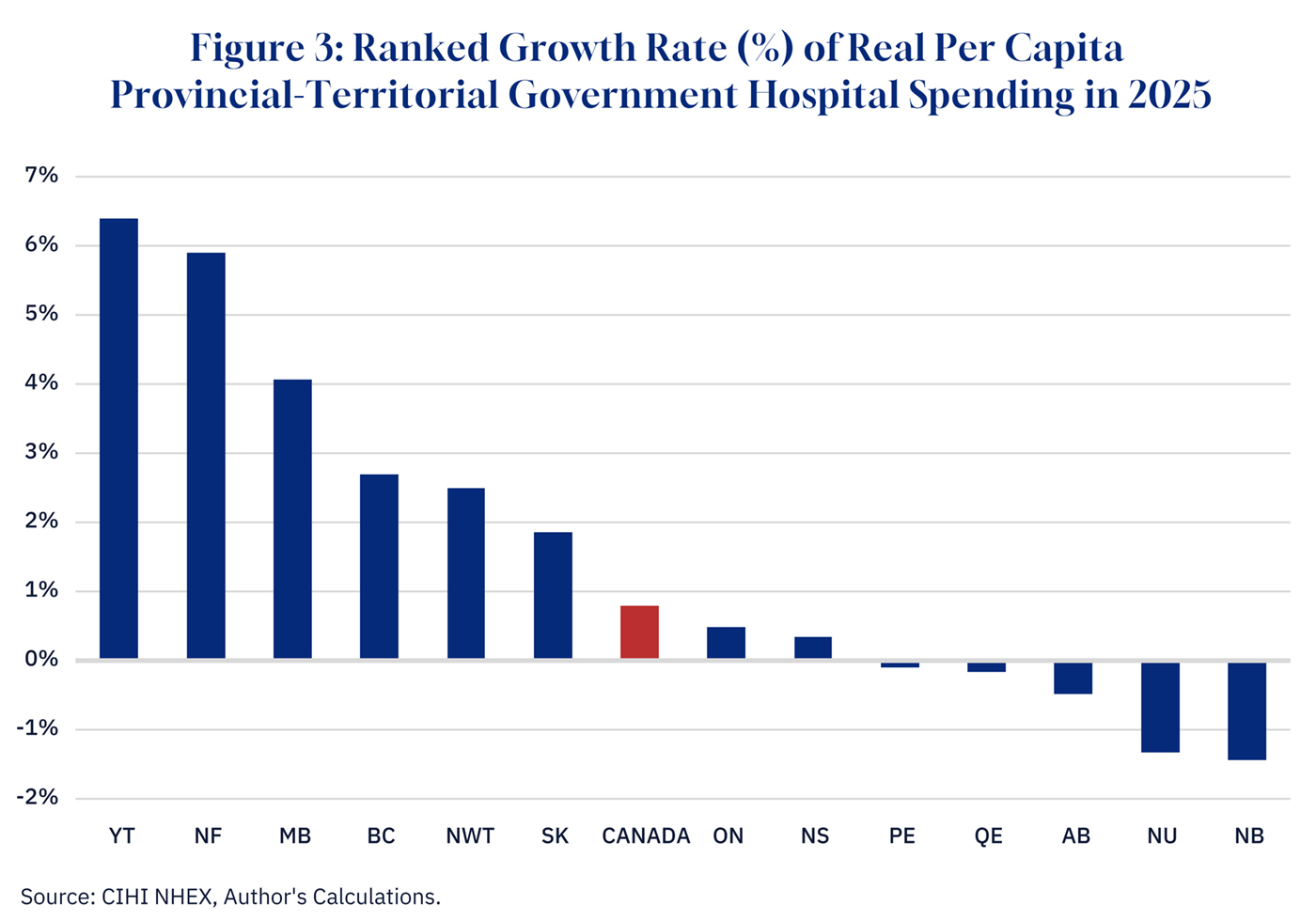
The provinces are no longer waiting for permission to act. Alberta’s dual-practice legislation takes effect Sept. 1, letting surgeons work in both public and private systems. Ontario—which posted the country’s shortest waits at 19.2 weeks—will license four private orthopedic surgical centres backed by $125 million toward 20,000 surgeries. Saskatchewan has cut MRI and CT waits by outsourcing scans; B.C. and Quebec pay private clinics to clear backlogs. Ottawa’s response has been to signal Canada Health Act enforcement, an instrument it used to claw back $267 million from provinces between 2014 and 2024.
Provinces spoiling for that fight should first seize the reform Ottawa cannot touch: how hospitals are paid. Global annual budgets, the Canadian norm, make every patient a cost to be avoided. Activity-based funding—paying hospitals per patient treated, as most universal systems do—makes every patient a source of revenue and rewards timely care with existing infrastructure. Evidence from across the developed world shows hospitals treat more patients, more efficiently, under this model. It requires no private delivery, no user fees, and no Canada Health Act confrontation. Alberta and Quebec have started down this road; the rest of the country remains a laggard.
Public opinion has already moved—56 percent of Canadians are now open to non-governmental care options. The trends are unambiguous: costs rising faster than incomes, waits triple their 1993 length, one in five adults without a regular provider. A system that hides its price from the people paying it will keep charging more and delivering less—until taxpayers see the bill.
Hub editorials speak for economic competition and free markets, free speech, and national dynamism grounded in the people of Canada and their resilience. Fundamentally, The Hub cares about freedom: of expression, of thought, of association, and in economic relations.