
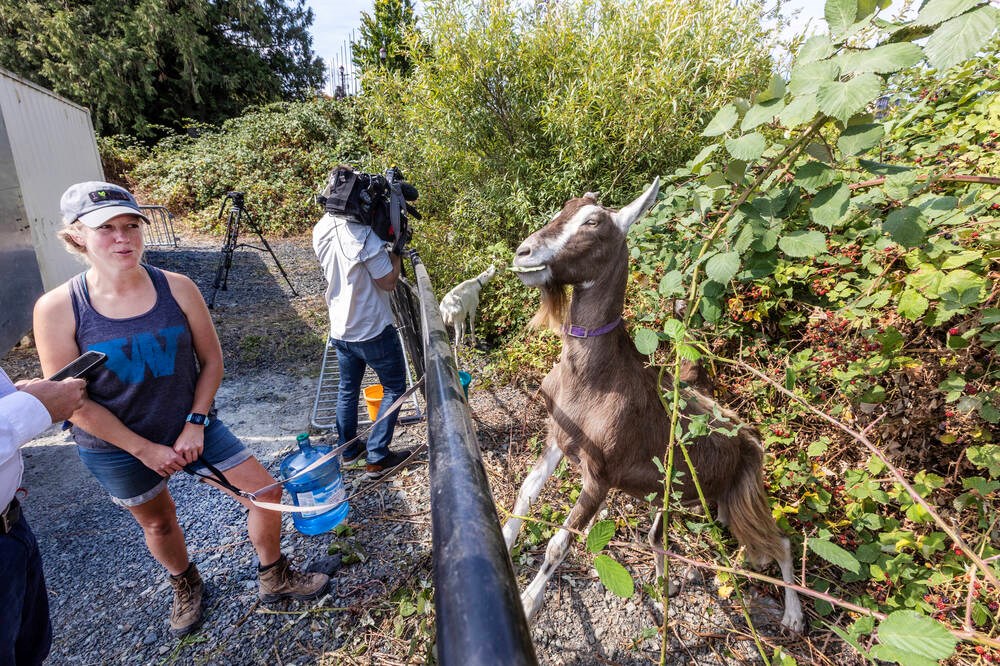
The little herd of different goat breeds work for the Langford Fire Department, clearing a fire hazard of invasive species.
Cookie, Lucy and Bunny seem to love their work as they lean into a gnarly patch of Himalayan blackberry, bamboo and willow along a busy Langford roadway.
Passersby are double-taking, and parents with small children are stopping to watch the small herd of goats munching happily in the thorny tangle outside Starlight Stadium.
The little herd of different goat breeds — Toggenburger, La Mancha and Saanan — are working for the Langford Fire Department, clearing a fire hazard of invasive species while bringing attention to the risk of wildfires in the cityscape around one of Langford’s busiest public spaces.
The idea behind Langford’s Goats in the City campaign is that if Lucy and Bunny can clear away the brush in an extremely dry summer, residents can do a similar cleanup to protect their homes and communities by rolling up their sleeves and hauling away the combustibles.
Courtenay Tremblay, Langford Fire’s FireSmart co-ordinator, said she first heard of the idea of hiring goats as a public awareness tool from a firefighting friend in Washington state, who was planning a similar event with the goal of bringing attention to wildfire mitigation.
“Some people don’t realize that all of Langford is within 1,100 metres of a forest, and wildfire in those forests and into towns is what we’re seeing on the mainland … so that could happen here,” said Tremblay.
The herd of 13 goats from Natasha Murphy’s Vancouver Island Goatscaping will be the star attractions from noon to 3 p.m., Sunday, Aug. 23, in the brambles along the Starlight Stadium parking lot.
The event will feature the friendly goats, of course, but also a chance to get on board a fire truck and learn about FireSmart education and the ways people can protect their homes.
Langford Fire Chief Chris Aubry applauded Tremblay’s unique approach to wildfire resiliency education.
“We could set up an information tent and we might get a few people stop by, but when you’ve got goats going to work here, it gets people’s attention,” said Aubry. He said it’s a delight for children, who might be the ones reminding their parents that the backyard needs a cleanup.
Murphy, who raised each of the goats from kids and bottle-fed them all, charges $35 a day for each goat, and they can make quick work of weeds and overgrowth in a single day depending on the size of the area. The goats eat everything from ivy and broom to small saplings and other invasive species.
She does a site inspection before turning her goats loose because there are some plant species that are toxic, such as daphne and shiny leaf rhododendrons.
Murphy, who is based in Cedar, south of Nanaimo, said her business operates from spring to fall, and she does a brisk business with her little herd clearing yards and properties that might seem too daunting for the owners to tackle.
She believes the living mowers are much better for the environment than the mechanical kind — quiet, more efficient, while aerating the soil and leaving only natural fertilizer behind.
Murphy wrote her PhD on goatscaping, and researched the topic while working for a goat owner clearing invasive species in the Kootenays.
For an entire summer, she camped and rode horseback with a herd of 300 goats and two herding dogs. The goats targeted sulphur cinquefoil, which has invaded grasslands and open forests in areas south of Cranbrook.
“I was pretty amazed at how they would finish in one area and run to the next patch of the invasive we were working on,” she said. “From that, I was actually given a bottle baby, and then started all this a few years later.”
She has kept busy with her growing flock ever since.
Tremblay said the cost of hiring the goats came out of the city’s annual FireSmart grant from the province, which amounts to $200,000 a year and helps educate the public about protecting their homes from fire risks.
The grant is used for education and vegetation clearing and chipping in many of Langford’s “high risk” areas, she said. Tremblay said today’s goat event is a chance to talk with people about what they can do when they get home.
“We’re hoping that people take what they’ve learned and apply it in that 1.5 metre around their home — do you have a woodpile against your house, cedar hedges or branches hanging over? You’re in control of that,” Tremblay said.
She said Langford Fire offers free mitigation assessments where wildfire experts can tour your property and provide a report on where improvements can be made. Those can be booked online at Langford Fire.
Aubry said the capital region, including Langford, is at risk of wildfires due to prolonged drought. The fire department has been called to small brush fires, and there have been calls to homes about backyard bonfires, which are banned.
“You get a little bit of wind, and all it takes is a spark to blow into a forested area.”
The city had an alarm call last year when a property owner with a concave mirror in their driveway reflected the sun into a cardboard box, nearly lighting it and another when a glass garden ornament touched off a small fire in bark mulch.
“We’re getting into the time of year now here, it’s been so dry for [so] long that even bark mulch can ignite from any heat source,” he said. “Just hitting a rock with a weed eater or lawn mower can set something off.”
Aubry said the FireSmart program addresses many potential risks, and he encourages residents to sign up for an assessment or drop by today to talk to staff.
For more information on protecting your home and for a free assessment, see Langford’s FireSmart site at langford.ca/firesmart.