
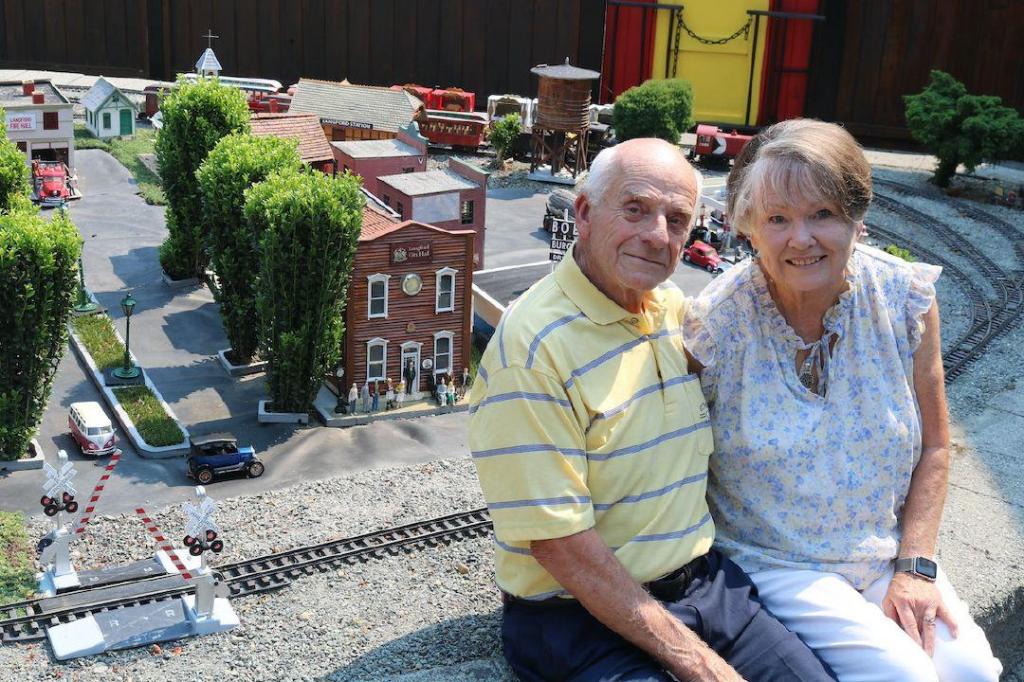
While it has been 15 years since the last Vancouver Island train rolled along the E&N corridor, in a small pocket of Langford, the rail network is thriving.
In the backyard of Lanny and Dianna Seaton’s Glen Lake home, a miniature train meanders through decades of West Shore and Sooke history, passing landmarks such as Langford City Hall, Goldstream Provincial Park and Goodridge Sawmill – a nod to the area’s logging past and Lanny’s father George, who worked as a logger until he was 72.
“It’s a tribute to the people that I remember growing up that were part of my childhood,” says Lanny.
The railway harks back to a time when the West Shore was a collection of small, close-knit communities, long before the rapid growth that would transform the area into one of the fastest-growing areas of B.C.
Before Langford was incorporated, Dianna remembers when the fire department, Legion, churches and the RCMP were the hub of the community, mostly run by volunteers.
“I remember my dad lost his leg in a logging accident, and we didn’t have to ask for help, people just showed up,” she recalls.
That same “let’s get it done” attitude has helped three generations of Seatons construct and grow the backyard miniature railway over the past two decades.
While many hands have made light work, there’s no doubt who is in charge.
“My garden has a railway running through it. I’m very clear about that,” says Dianna with a chuckle.
Lanny’s childhood passion for model railways was reignited after retiring from a 41-year career with the Canadian Coast Guard. As a teenager, however, he sold his original collection to buy spinners and a Hurst shift kit for his 1955 Chevy.
“My dad gave me hell for that,” remembers Lanny.
Now back on track, Lanny has put his skills to work.
A carpenter by trade, he has handmade each of the buildings dotted along the train’s route. Some are reimagined with a little creative licence, while others are replicas of landmarks from the couple’s past.
One such replica is Bob’s Burgers drive-in, once located on the Island Highway in Colwood. Students from Langford, Colwood, Metchosin and the Highlands would all descend on the popular joint after school, Lanny recalls.
It was also where Lanny and Dianna would go on dates.
Married for nearly 60 years, the couple first met when Dianna came to sing with Lanny’s band – a “goofy” group of friends who would gather to jam, with only one member, Neil Arthurs, possessing what Lanny describes as any real musical talent. Arthurs would later go on to cut two records.
At the end of the first session, Dianna needed a ride back to her home in Sooke.
“So I took her home, and that was that,” said Lanny.
Other buildings along the railway pay tribute to Stewart’s barber shop, where Lanny got his haircut; Price’s and Cooper’s general stores, where his family bought groceries; and Bebe’s Garage.
“Harold Bebe did all the mechanical work in Langford,” remembers Lanny. “And Mr. Cooper, he used to be good to all the kids – he rented some ice time for us at Esquimalt arena, and all us kids went in there and played hockey with him.”
But while much of the miniature village looks back, parts of it also point toward the future.
Bears gather on a mountain overlooking the growing town – a nod to what would become Bear Mountain – while the new Langford Legion building is still under construction. Elsewhere, signs announce future developments –Westhills and Southpoint – capturing a community on the cusp of transformation.
“We sit out here at night and just enjoy it,” says Lanny.
“All the memories come flooding back of all the various things we’ve been involved in and done and the people we’ve met,” adds Dianna. “We just feel so fortunate; we’re so, so lucky.”
With family connections to the area stretching back more than a century – Lanny’s family arrived from England in 1908, while Dianna’s great-grandparents came to Sooke in 1886 – there isn’t much of Sooke and the West Shore’s past the pair can’t recall.
That includes some of its more unusual stories, such as James George French and his menagerie of circus animals in Shirley.
“My dad remembered him walking in the woods with a leopard,” says Lanny.
And it is those stories, the everyday memories and the more bizarre ones alike, that the couple hopes will not be lost to time.
Something their garden railway might help keep track of, preserving memories not only of the places that have disappeared, but of the people who helped build the communities around them.
“We’re just so proud of this community and really passionate about it,” says Dianna. “There’s all that history and connection, and it shouldn’t be forgotten.”