
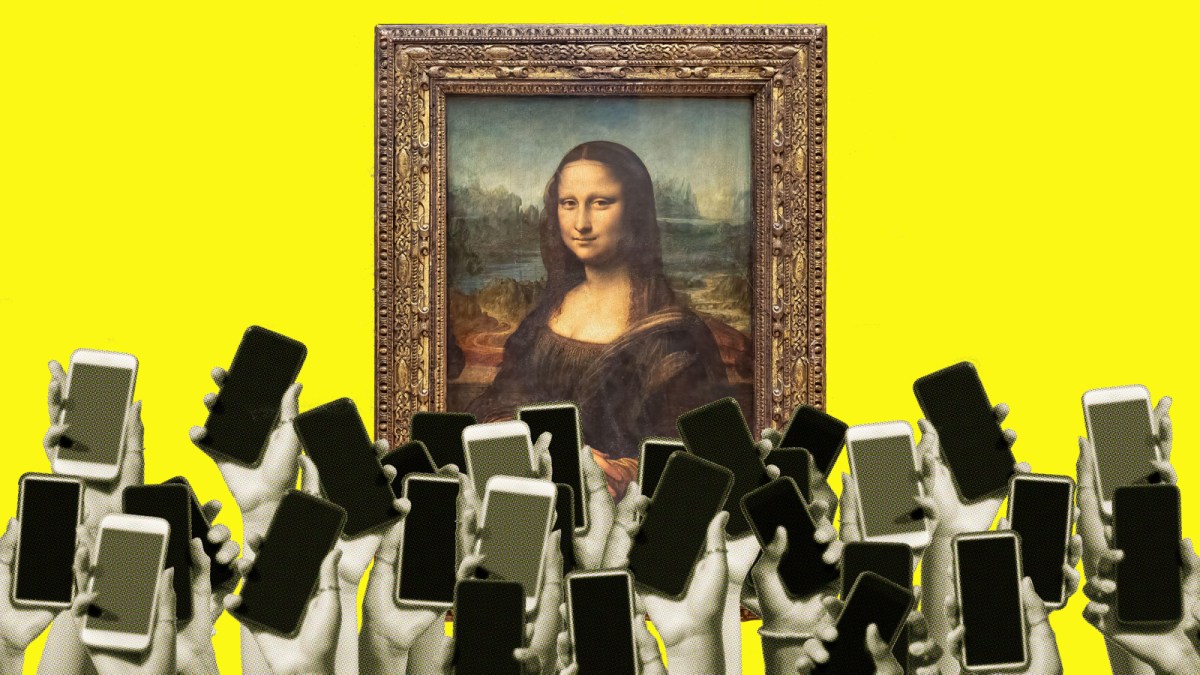
A baking summer’s afternoon at the Louvre. Milling around the Mona Lisa are maybe 150 people, all with their phones held high above their heads so they can snap that enigmatic smile. Meanwhile, in the vast galleries surrounding Leonardo’s masterpiece, an eternal throng of visitors from every corner of the globe trudges wearily on — most, this far into the gallery, seemingly oblivious to the glorious art around them.
Paris’s great museum has about nine miles of galleries, spread over 403 rooms. You enter it from beneath IM Pei’s celebrated glass pyramid, which on a day like this behaves like a giant magnifying glass for the blazing sun. Many visitors probably won’t venture more than half a mile into the heart of the museum.
But in this huge, former royal palace there is one tranquil room. Far from the madding crowd, Laurence des Cars, 59, the first female director of the Louvre in 228 years, sits in her book-lined office, the picture of the formidable, Sorbonne-educated Parisian intellectual she is. If she is physically distanced from the heaving mass of humanity trudging round her domain, however, her brain is constantly occupied with it.
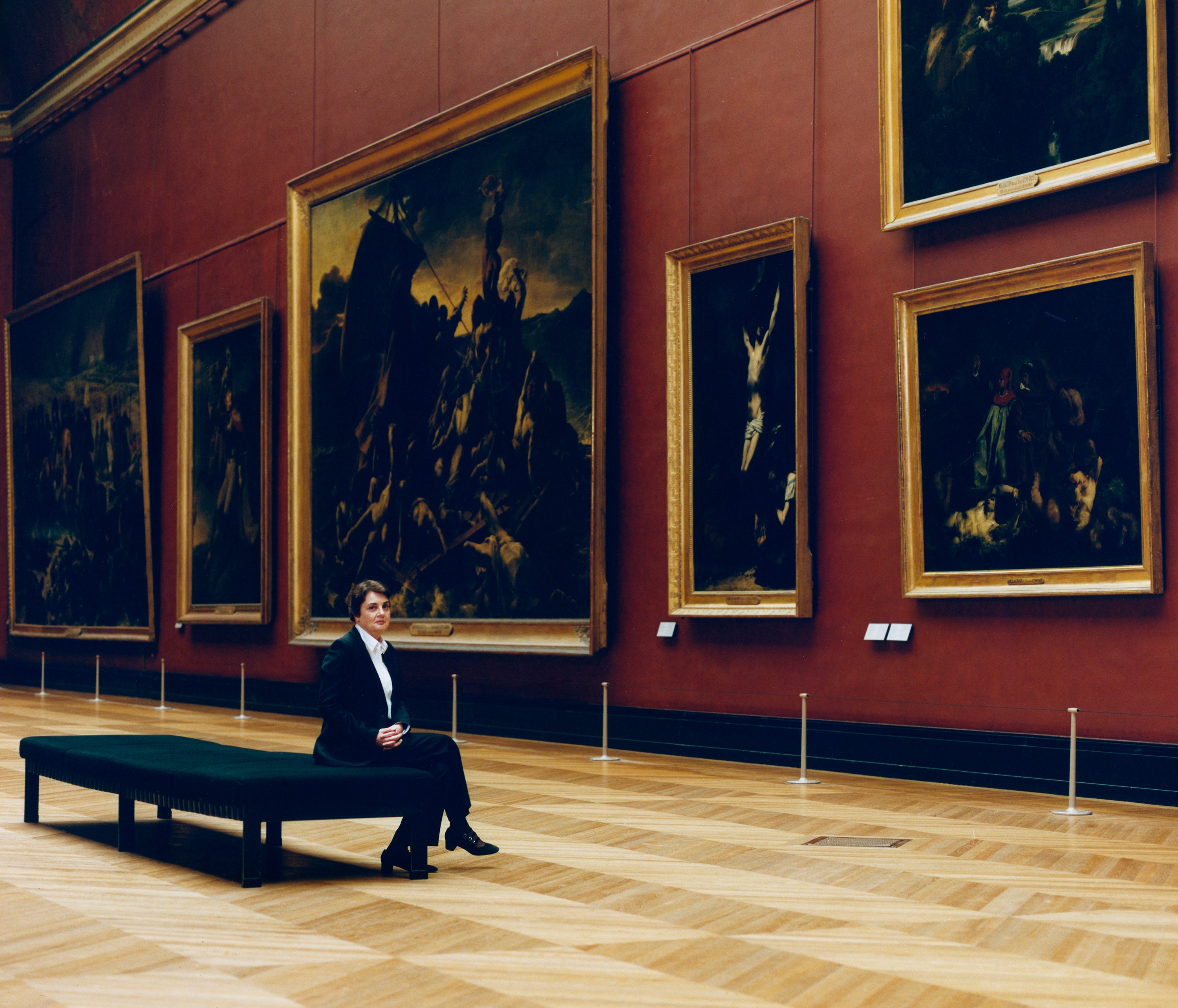
Laurence des Cars is the first female director of the Louvre in 228 years
ILYES GRIYEB
“One of my first decisions when I became the director in 2021 was to limit our daily admissions to 30,000,” she says. “You know that, just before Covid, the Louvre was getting ten million visitors a year? When I got here the staff said, ‘Please let’s not go back to that because some days we were up to 45,000 visitors.’ And that figure is too much. Even now we are saturated. The building is suffocating. It’s not good for staff, visitors or the art.”
Last month the Louvre’s staff emphasised their grievances by going on a spontaneous strike (a “mass expression of exasperation”, their union official said), leaving thousands of tourists outside with no idea why they weren’t being let in. “It wasn’t a strike,” des Cars says firmly. “It was a meeting with the unions because of the conditions and especially the heat. I put in place immediate measures to make things better and we reopened that afternoon.”
All the world’s top museums — from the Vatican in Rome to the British Museum in London — are facing this same problem: huge congestion, especially around the handful of masterpieces that every tourist has heard of. But the overcrowding is felt most acutely by the Louvre, which still receives more visitors (8.7 million last year) than any other museum, yet has some of the worst facilities.
We know this because six months ago a memo outlining its problems was leaked to a Paris newspaper. It caused a stir not just because it was addressed to Rachida Dati, France’s culture minister, but because it was written by des Cars.

The pyramid entrance: “Having just one entrance was a nice idea in the 1980s when we had far fewer visitors”
GETTY IMAGES
She was jaw-droppingly frank. “Visiting the Louvre is a physical ordeal,” she wrote. “Visitors have no space to take a break. The food options and restroom facilities are insufficient in volume, falling below international standards. The signage needs to be completely redesigned.” Pei’s pyramid, she went on, creates a “very inhospitable” atmosphere on hot days. Other parts of the old building are “no longer watertight”.
Nobody has revealed who leaked the memo, but it’s hard to imagine des Cars being upset by the revelation because within days came a dramatic intervention from on high. President Macron announced a redevelopment project that he called the “nouvelle renaissance” of the Louvre. It’s masterminded by des Cars and every bit as radical a reshaping as François Mitterrand’s “grand projét” of the 1980s, which led to Pei’s pyramid.
By chance it will run simultaneously with something similar in London: the £1 billion masterplan to renovate the British Museum, a coincidence that hasn’t escaped des Cars’ notice. “I talk a lot with Nick Cullinan [the BM’s director],” she says. “He’s wonderful, a great professional and he’s dealing with exactly the same issues.”
The most controversial feature of des Cars’ plan is her proposed solution to the problem of that huge rugby scrum around the Mona Lisa. She wants to remove the painting to one of several new underground galleries to be excavated under the Cour Carrée courtyard, where it will get its own entrance requiring punters to buy an additional ticket (the price is yet to be decided).
• The secret life of the Louvre: inside the world’s biggest museum
She also envisages a second entrance to the Louvre on the far side from where the pyramid is. “The idea of having just one entrance to this enormous museum was a nice idea in the 1980s when the Louvre had just four million visitors a year,” she says. “But that was before the Berlin Wall fell, before the Chinese started travelling, before international tourism reached the levels we have today. We are going back to what was always the case — several entrances for the Louvre.”
At the same time the museum will be given a technical makeover. That will take ten years, des Cars estimates, whereas she suggests that the Mona Lisa gallery and the new entrance will be ready by 2031 or 2032. “We are running a competition to find an architect and will appoint one early next year,” she says. “And the Louvre won’t close at all. That’s the strength of having a very large building. You can rebuild half of it and still function in the other half.”
One benefit of all this, des Cars says, is that it will help people to get to different galleries more quickly, introducing more lifts and better signage. “On the second floor we have the most extraordinary collection of French paintings anywhere in the world and virtually nobody looks at them,” she says. “You start to think, what’s wrong with Poussin? The answer is nothing. The real problem is that to get from the pyramid to Poussin takes 20 to 25 minutes, and that’s if you walk quickly and don’t get lost. If we can sort out these problems people will discover many new joys.”
It comes at a price, though. The ten-year project is expected to cost about £700 million. Unlike the British Museum’s masterplan, however, at least half the required funding is already guaranteed. “The technical renovation will be funded by the Ministry of Culture,” des Cars says. “As for the new galleries and entrance, our trademark licence deal with the Louvre Abu Dhabi [which des Cars spent six years helping to set up] will give us at least £175 million. The rest we will raise from corporate and private supporters.” Even here, des Cars has an advantage over her British counterparts. “When you say the word Louvre people all over the world pay attention,” she says.
The gallery has one other huge income stream not available to UK museums. It charges for admission and the ticket prices are about to go up — £19 for EU citizens and a hefty £26 for non-EU visitors, including the poor old Brits. Sounds as if we need to rejoin the EU, I say. “Please do!” des Cars says, beaming. But what does she think of the UK’s generous policy of keeping its national museums free to all, even foreigners?
“I am absolutely not allowed to make any judgment on that,” she says with a laugh, and then makes one anyway. “I mean, it’s very admirable but is it sustainable in today’s world? That’s a political decision. I leave you to have your debate.”
• Best time to visit the Louvre: top tips for your trip
The daughter and granddaughter of distinguished French writers, des Cars was a respected art historian, writing a classic study of the pre-Raphaelites before she started running big Parisian museums (she was head of the Musée d’Orsay and the Musée de l’Orangerie before the Louvre). Surely it must break her heart to see thousands of people using great art merely as background for their selfies, disrupting other visitors’ enjoyment in the process? Has she considered banning the use of phones, as other art galleries have done?
“I know they are trying but I simply don’t know how you do it,” she says. “We considered it when I was at the Orangerie and the security team said, ‘We can’t force people not to use phones.’ Also I think it’s dangerous to go against the times we live in, but you can remind people that they are in a cultural space and need to respect each other, the staff and the artworks.”
• Mona Lisa to get her own room in the Louvre
And perhaps be a bit more curious about venturing into galleries that don’t contain the most famous paintings on the planet? “We are already making changes to attract people to less-visited parts of the museum,” des Cars says. “For instance, we could have put our new Louvre Couture [the museum’s first venture into fashion] in our exhibitions space, but instead we placed it within the department of decorative arts and now those galleries get a hugely increased number of visitors, especially young people.”
As the Louvre’s first female director, can she do anything to mitigate the fact that the vast majority of artworks here were created by men? “You cannot change history but there are other ways of addressing that question. In the spring of 2027 I’m programming an exhibition on the theme of amazons, ancient and modern — from Greek women warriors to powerful women today. It will be a fascinating journey.”
And how is this very powerful woman enjoying her own fascinating journey? “When I was appointed I felt ready to run the Louvre, which sounds immodest,” des Cars replies. “Maybe I will be a disaster and someone will have to shout, ‘Stop!’ I don’t know.” I would be amazed if anyone did that — or at least not until the mid-2030s, when she has finished remaking the Louvre for the 21st century.
Additional research by Ziba Manteghi