

Listen to this article
Estimated 5 minutes
The audio version of this article is generated by AI-based technology. Mispronunciations can occur. We are working with our partners to continually review and improve the results.
As Manitoban businesses are trying to make sense of the trade war with the U.S., some say they’re less concerned about U.S. tariffs on Canadian goods and are more worried about what the federal government’s dollar-for-dollar retaliatory tariffs might mean for their businesses.
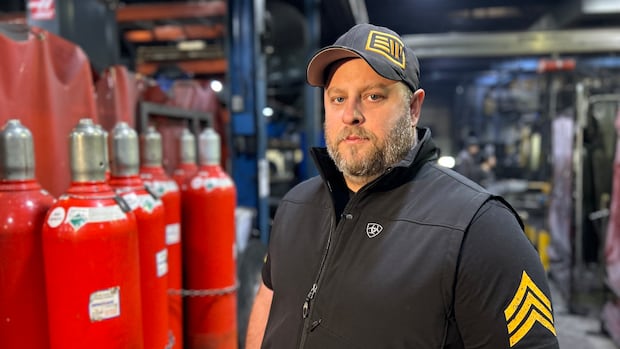
“Our experience isn’t that we’re in a war, it’s that we’re dealing with friendly fire,” said Derek Hird, the owner of Evolution Wheel, a solid-tire manufacturer based in Winnipeg that mostly services the construction and agricultural industries.
“We’re very concerned about what Canada is going to do on the retaliatory tariffs because we’ve been affected by those already,” he said.
Because their product requires a specific type of steel — high strength steel — that is hard to find within Canada, they import the raw material from the U.S.
The steel products they import from the U.S. are already subject to 25 per cent retaliatory tariffs from the Canadian government.
Hird says they’ve requested tariff relief on the steel products they import, as the federal government considers requests for remission of tariffs on goods originating from the U.S. that can’t be sourced domestically and which are used to make other products in Canada.
However, he says he hasn’t heard from the federal government about whether they qualify for existing tariff relief.
CBC News has reached out to the Department of Finance for more information.
The company manufactures in Winnipeg and sells the final product — which Hird says accounts for roughly 85 to 90 per cent of their output — back into the States.
“I mean, if we continue to get tariffs on raw materials that we are importing to manufacture with, then our cost just goes up, so that affects the bottom line directly,” said Hird.
He says the recent escalation has him considering moving his entire business to the United States.
“We’ve looked at it,” he said. “It just depends on what happens and how it goes along, but I mean, at the end of the day, every business has to do what they have to do to survive.”
Honey troubles
Honey producers in Manitoba and across Canada are also facing existential questions, as 50 per cent tariffs from the largest export destination for Canadian honey have just come into effect.
The province of Manitoba is the largest exporter of honey in Canada, accounting for over 50 per cent of honey exports last year.
Ian Steppler, the chairperson for the Manitoba Beekeepers Association, said when he woke up on Saturday and heard the news that the U.S. and Canada hadn’t reached a deal, a pit formed in his stomach.
“There’s a lot of producers who are going to be stuck not having a market for their product as it is the worst time for this to happen, we are right in the middle of harvest right now,” he said.
“A lot of producers in Manitoba, right across Canada just lost one of her biggest buyers of our product.”
 Ian Steppler, chairperson for the Manitoba Beekeepers Association, says this is the worst possible time to tariffs to be placed on the Canadian honey industry, particularly as the U.S. is its top export destination. (Karen Pauls/CBC)
He says he’s especially worried about Canada’s retaliatory tariffs.
“We rely on a lot of supplies from the Americans and to, you know, take less for our price of honey, and then all of a sudden now with these countermeasures, maybe experience higher costs, just adds to our cost production — it could be very bad news,” he said.
In his speech on Saturday morning, Prime Minister Mark Carney said that while his government doesn’t like implementing tariffs, they are doing it to protect industries disadvantaged by U.S. tariffs.
“We start with that, and then we think about matching in ways that have the least negative impact on Canadians,” the prime minister said.
Bram Strain, president of the Business Council of Manitoba, says the mood has shifted from optimism back to “elbows up.”
Strain will be part of the Manitoba-U.S. trade councils meeting with the premier on Monday afternoon, where he expects to discuss what the new tariffs mean for Manitoban businesses, and to get a sense of which supports will come from the federal and provincial governments.
“As long as we support those businesses that are directly impacted because we don’t want them to be victims of a larger political game, then I think we’ll be just fine,” said Strain.
In the meantime, Hird says he’d like to see the U.S. and Canada return to the negotiating table so that businesses like his aren’t used as collateral in a broader political conflict.
“I mean, what are we doing by putting more tariffs on? All we’re doing is either increasing our costs or reducing our capacity to export,” he said.
“But, you know, we’ve got a few weeks and hopefully people come to their senses and ratchet down rather than keep fighting.”
WATCH | Manitoba business worried about impact of retaliatory tariffs: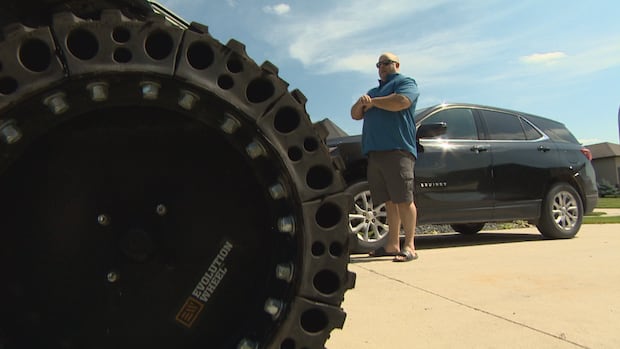
Manitoba business worried about impact of retaliatory tariffs
Canada is planning dollar-for-dollar, retaliatory tariffs in response to U.S. levies imposed over the weekend. But here in Manitoba, businesses who import goods from south of the border are worried about how that may impact T operations.