
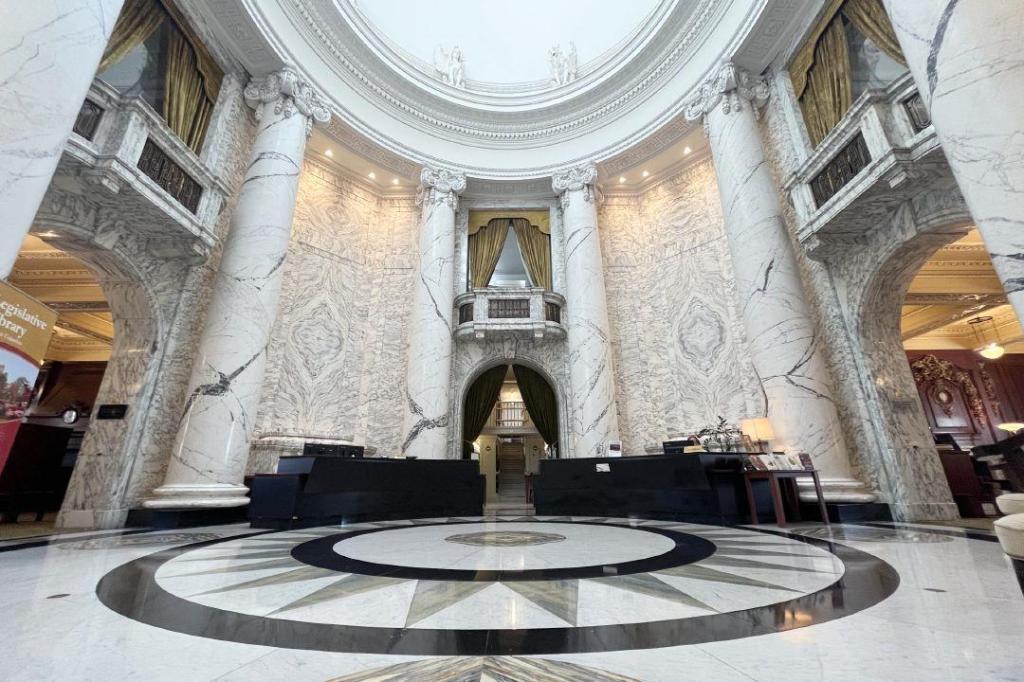
Tucked away from public view, beyond the limits of the B.C. legislature’s guided tours, lies one of the province’s best-kept hidden gems.
Making your way through the maze-like halls of the government building, you can eventually find the legislative library.
As visitors enter the premises, they are met by architecture that blends the grandeur of Versailles with the elegance of Oxford’s historic reading rooms, featuring towering scagliola columns, Carrara marble walls imported from Italy and reading rooms lined with Honduran mahogany.
Stretching back more than a century, the legislative library remains dedicated to preserving the province’s past, present and future.
Birth of a library
The idea of a provincial library took shape long before B.C. joined Confederation. In 1863, a small grant from the colonial legislature funded the establishment of a library. Shortly after, a few books were purchased and shelved unattended in a single room, said library director Peter Gourlay.
“It kind of slowly built up, until they appointed essentially a professional full-time person to run it,” he said.
Three decades after its inception, the library welcomed its first librarian, E. Gosnell. By then, the provincial library’s collection had grown from a few books to a modest 3,000 items.
To accomplish his lofty ambition of creating a library that served not only the legislative assembly but the rest of the province, Gosnell worked to acquire as many works as possible.
Within a few years, the library rapidly outgrew its space. Thanks to Gosnell and his successor, E.O.S. Scholefield, the library’s collection swelled from 3,000 items to 18,000.
Spilling into nine adjacent rooms, legislature staff considered transforming the nearby kitchen and dining room into additional library space.
When plans were made to expand the parliament buildings, a push for a full-fledged, dedicated space for the library followed.
In 1911, famed British architect Francis Rattenbury, designer of the original buildings and the nearby Empress Hotel, returned to lead the expansion project. It included two wings of offices and the library to the south of the main block.
And this time, the provincial library received the space and attention it deserved, said Gourlay.
“They wanted to build it as a showpiece.”
In September of the following year, the cornerstone was laid, and it took three years to build the extension. By the summer of 1915, library staff began moving into their new space. Within a few weeks, the library’s entire collection — counting tens of thousands of items at this point — was transferred, and the space opened to the public on Sept. 15.
When construction was finished, the cost came to $1.2 million — slightly more than the cost of the original parliament buildings.
Serving the province
First called the Provincial Library, and also home to the province’s archives, the institution was established with the goal of creating a library that could serve people across B.C., from the bustling cities of the mainland to the most remote communities.
Starting in 1898, the library launched its travelling library program, which sent collections of books anywhere in the province that required them. By 1919, the service had almost 200 travelling collections in circulation.
“You’d have a local sponsor that… would have everything you need to run a little library,” said Gourlay, adding that books could be anywhere, from lumber camps to lighthouses. “We did that for close to 100 years.”
A new role
In the 1970s, with the archives having moved to a new location on Belleville Street, the library began to reassess its role. As libraries started appearing throughout the province, the need for a single, provincially accessible service gradually became obsolete.
As a result, the institution changed its name from the provincial library to the legislative library, refocusing its mandate on serving members of the legislative assembly and their staff, making it very different from the average neighbourhood library.
“The big difference is our clientele and what we do,” said Gourlay. “We do more in-depth research than at a public library. We can spend time to really dig into a topic if that’s what our clients are interested in.”
Dedicated to safeguarding the province’s legislative history, the library now mainly reflects the interests of the community it serves.
“In our collection, you’ll find almost nothing on topics that are solely the federal government’s responsibility,” he said. “We have very little on foreign affairs but we have lots on forestry, for example.”
A lasting legacy
Today, 111 years since its construction, the library remains virtually the same, said Gourlay. The same chairs, the same tables and the same good ol’ original Otis birdcage elevator are still in use, which Gourlay believes to be the oldest elevator still operating in Victoria and perhaps B.C.
Employing about 20 staff, the library now boasts a collection of more than 500,000 items, as well as 200,000 digital entries.
While the Legislative Library’s collection may pale in comparison with UBC’s 8.3 million items, Gourlay said it holds the province’s largest collection of government publications, which make up nearly half of its 500,000-item collection.
Spread across six floors, the library holds rows upon rows of items, from bound newspapers dating back to 1869 to modern fiction. But perhaps its most intriguing collection is hidden from public view in the rare book vault inside Gourlay’s office.
Once the massive door opens, visitors are met with a small room containing about 1,500 books, including a Geneva Bible dating to 1612, a book written and inscribed by Queen Victoria and perhaps the library’s most famous item: Shakespeare’s Second Folio, published in 1632.
One of only three known copies in Canada — the others held by UBC and the University of Toronto — the Legislative Library’s copy is one of roughly 250 known worldwide. Despite its nearly 400-year history, Gourlay said the book remains in “very good shape,” with no missing pages or major damage.
“The last time we had it appraised was in 2019, and I think it was about half a million dollars,” he said.
Gourlay said a large portion of the vault’s collection came from a single purchase made in 1930, much of it consisting of Elizabethan-era books.
“That was purchased off an eccentric man who had come over from England in the 19th century because he wanted to get away from everything,” he said, adding that the aristocrat corresponded with famous authors of the time, including Rudyard Kipling.
“When he wanted to move back to England, he was getting old, so he sold part of his collection to us,” he said.
While the library’s mandate and role have evolved, Gourlay considers himself fortunate to lead one of the province’s most important institutions for preserving knowledge, more than a century after its inception.
“I think that’s vital to preserve the records we have of the B.C. government,” he said.