
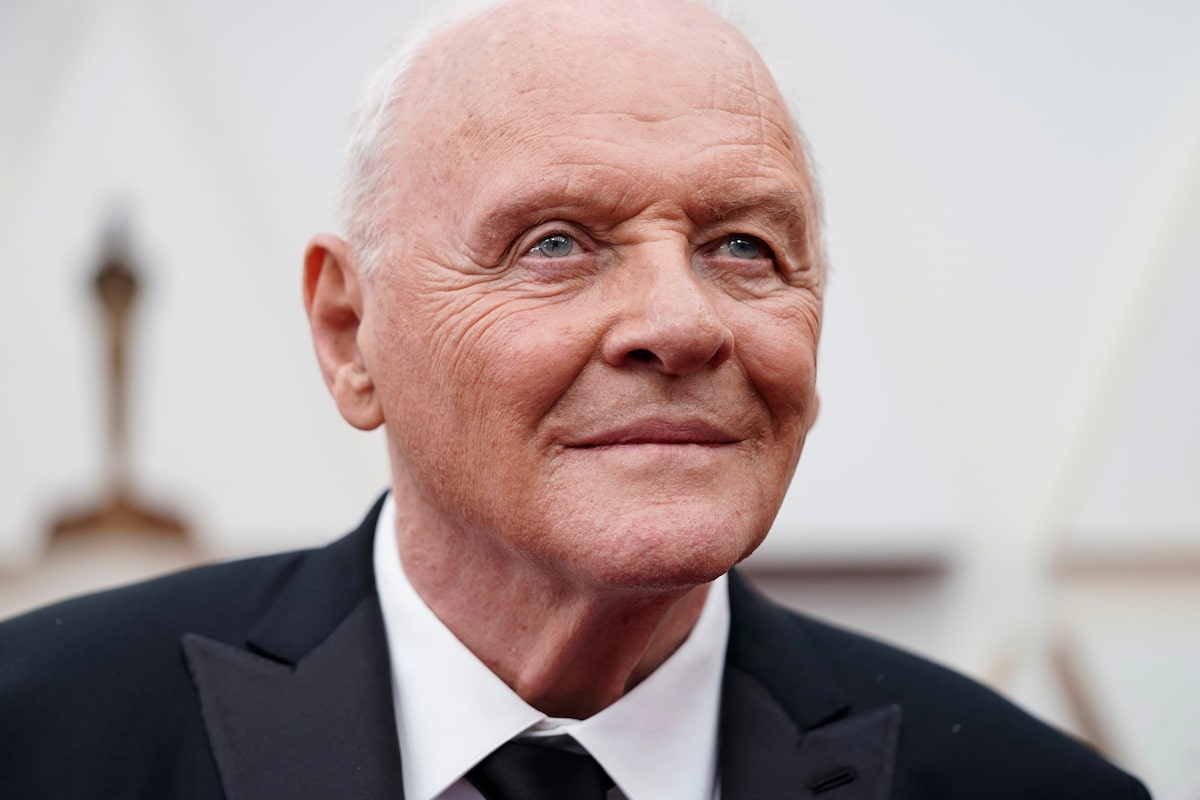
Anthony Hopkins says while his success comes from acting, music is very much a part of his life.Jae C. Hong/The Associated Press
Actor Anthony Hopkins? That’s Decca Classics recording artist Tony to you, thank you very much.
The 88-year-old has just released Life Is a Dream, a selection of often-cinematic orchestral works he’s written across more than six decades inspired by his family and his native Wales. Grammy Award-winner Gustavo Dudamel conducted the London-based Philharmonia Orchestra for the project.
Speaking from Los Angeles, Hopkins, a knighted Academy Award winner, initially insists on being addressed informally as Tony. But he quickly changes his mind when I inform him that the record label that signed him, Decca, had once rejected the Beatles.
“They did?” he asks. “Call me Ringo, then.”
In the 2019 film The Two Popes, Hopkins, as Pope Benedict, asks the future Pope Francis if he knew the Beatles. Given the actor’s accomplishments, perhaps the surviving Beatles should be asked if they know Hopkins.
The liner notes which accompany the album connect the compositions to your life and add an intimacy to the listening experience. Is the context important, or would you rather the pieces stand apart from your own history?
It may sound vain or flippant, but I’m at the age now where it’s no big deal. I’m very grateful for having been given all this. I’ve had a little success in my life. Can I take credit for it? The answer really is no.
You’re being modest.
Well, when I was a boy, my school report was terrible – way below the educational standard of the school. My father said, ‘God, I don’t know what’s going to happen to you.’ I said, ‘One day I’ll show you.’ My father said, ‘I hope you do.’ My mother said, ‘I know you will.’
Was it confidence or was it bravado on your part?
Within 10 years, I was auditioning for Laurence Olivier at the National Theatre. That is beyond my comprehension. How did it happen? I have no idea. But I believe the moment I said that to my parents, ‘I will show you,’ I turned the magic key that opened something within me.
You said that if you had better grades as a child, you would have gone to music school. Is it true that you’d rather have been a musician or composer than an actor?
Not true. Take the word ’rather’ out of it. That doesn’t exist. Music happens to be a second part of my life. Acting has been my professional life. You can’t remove the acting. It has given me a great life.
Is composing music more satisfying than reciting and interpreting a script?
I have a different appreciation for it.
What does it feel like when conductor Gustavo Dudamel brings your pieces alive with an orchestra in front of an audience as he did last year at a concert in Saudi Arabia?
I’m astonished. I can’t believe I wrote it, but I did.
There’s an interesting story about your piece Margam, an ode to your parents, which you originally wrote for your 1996 film August, yes?
That’s right. In 1993, I was in a film called Shadowlands with Debra Winger. George Fenton did the music. In 1996, I did my own film, August. I approached George to compose the score. He came down from London to see it but told me he couldn’t do it. I think he said he was doing a film with Julia Roberts. But he knew I played piano and asked me to play for him. It was a beautiful summer morning. I improvised something. He listened to it and said I should come to his studio and write the score.
You had never composed a score previously. What was the process?
He had synthesizers. He asked me what I wanted to do for the opening scene. I said I wanted strings. He said, ‘press these buttons here.’ I played something and it sounded pretty good. He asked what else I wanted on it. I said I’d like oboe and a horn. George looked at me and said, ‘You’re a composer.’ I said, ‘Really?’ He said, ‘Stop thinking, man. Just do it.’ I thought that sounded pretty good, so that’s what I do.
So you’re not a technician?
I’m not an aficionado. I’m not Bach or Beethoven in a dark room. I live my life, and music is part of my life.
The album includes compositions written over years, yet it’s conceptual in a sense, is that fair to say?
In all this music there’s a melancholy. A kind of sadness, because life is one long goodbye. The piece And the Waltz Goes On represents the Viennese style of the great struggle of life, the glory of living and then, finally, death. But the waltz itself goes on after we’ve died.
Your piece Farewell My Love is in the same vein.
It sums up the very cadence of my own life. Life is glorious, but finally, finally, you say goodbye.
This theme also appears in The Plaza, part of 1947: Suite for Solo Piano and Orchestra. You were inspired by the 1952 Charlie Chaplin film Limelight.
I saw it when I was 14 or 15. I remembered Chaplin wrote his own music. It was so beautiful. At the end he has a heart attack. He says, ‘I believe I’m dying doctor. But then I don’t know. I’ve died so many times.’ And then he dies and the music goes on and the young girl goes on dancing. That to me was the most poignant, tragic thing in my life, at that time of my life. At that age, you don’t want to regard tragedy. You want to have some fun. But I think I was a bit of a sad kid. I didn’t make sense of it all.
And now?
I don’t look back with any sorrow or regret. I’ve lived my life, and if there’s a god, there’s a god for that. At the end of it all, underneath it all, there’s the knowledge that one day you’ll have passed. And that gives a great power in life itself. Enjoy it to the fullest and don’t complain. We can’t be perfect, but at least we have a go at it.
This interview has been edited and condensed.