
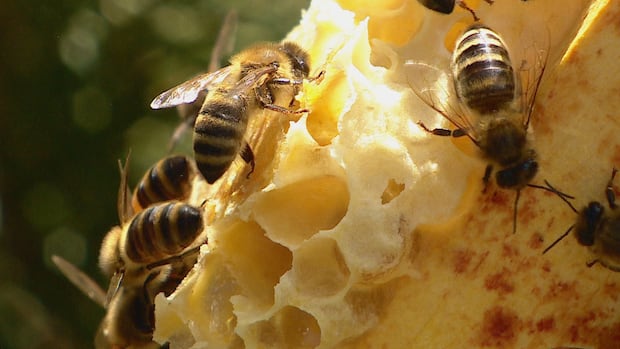
The latest round of U.S. tariffs will “essentially stop all honey heading into the U.S. from Canada,” according to the president of the Saskatchewan Beekeepers Development Commission.
Simon Lalonde says the 50 per cent tariff on $28 billion worth of goods, including honey, that went into affect on Friday “is just too big of a price.”
“The Canadian beekeepers can’t absorb that on their bottom line and most U.S. [honey packers] will probably just source their honey from other countries that they import into the U.S.,” Lalonde said.
Most of Canada’s honey is shipped and sold domestically. The two other major markets are the United States or Japan.
Western Canada — and disproportionately the Prairie provinces — supplies the bulk of honey to the United States, Lalonde said.
Between 15 and 20 per cent of honey produced in Canada — approximately 12 million pounds — is exported to the U.S., Lalonde said, making the loss of that market a big problem for producers.
WATCH | Sask. beekeepers risk losing their biggest market due to tariffs: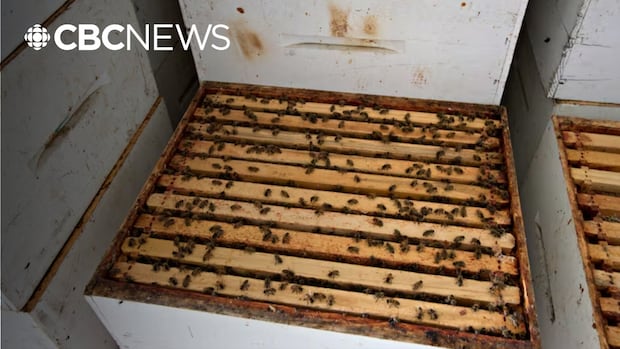
Sask. beekeepers risk losing their biggest market as tariffs hit 50 per cent
Beekeepers say the latest tariff will price them out of the American markets just as harvest wraps up. Premier Scott Moe backs Ottawa’s counter-tariffs and Opposition Leader Carla Beck is pushing for American alcohol to be pulled from shelves.
Beekeepers are right in the middle of honey season, Lalonde said. It’s their busiest time, with many producers focused on harvesting.
Lalonde said the industry is now waiting to see what happens on Sept. 8, when Prime Minister Mark Carney has said Canada will place retaliatory tariffs on U.S. goods.
“Until things start to calm down, and [we] get a good idea if this is going to be a long term issue or if it’s going to be solved in the next few months, [that] might make a really big difference to beekeepers,” Lalonde said.
One expert told CBC’s Blue Sky that Saskatchewan is among the province to feel the least amount of pain from the most recent tariffs.
Jim Farney, director and Stauffer Dunning Chair at the School of Policy Studies at Queen’s University, said that is mostly because Saskatchewan’s major exports are natural resources such as oil, gas and potash, which have thus far been spared from the trade dispute.
“The initial analysis for Alberta and Saskatchewan is that these tariffs will not touch us that closely and in fact, depending which economist you believe, it may be Canadian counter-tariffs that we end up noticing the most,” Farney said.
LISTEN | Is no deal better than a bad deal in U.S.-Canada trade negotiations?:
Blue Sky51:45Is no deal better than a bad deal in U.S.-Canada trade negotiations?
Prime Minister Mark Carney walked away from a proposed trade deal with the U.S. at the 11th hour. So what happens next? On today’s Blue Sky, we discuss the latest with Ralph Goodale, member of the new advisory committee on Canada-U.S. economic relations, and Jim Farney, director of the School of Policy Studies at Queen’s University.
The Saskatchewan Chamber of Commerce has said it is “deeply concerned” about the impact of the latest round of tariffs.
It said the consequences will be devastating for some sectors of the Saskatchewan economy.
The chamber came out in support of the federal and provincial governments’ decision to stand firm in the face of “uneconomic and unfair U.S. demands.” It also called for support from both levels of government to support business across Saskatchewan.
“As an export-driven province, our prosperity depends on access to markets around the world,” the chamber’s statement said.
 Saskatchewan Premier Scott Moe speaks at the 150th Commemoration marking the signing of Treaty 6 at Fort Carlton Provincial Historical Park, in Duck Lake, Sask., Sunday, Aug. 23, 2026. (Matt Smith/The Canadian Press)
The chamer’s comments echo those made by Premier Scott Moe, who issued a response to the tariffs on social media over the weekend.
Moe has said he supports the federal government’s decision to walk away from the table and the dollar-for-dollar counter-tariffs planned by the federal government.
Moe was not made available for an interview on Monday, but Farney said the premier’s response hit a “measured” tone.
“That is probably the best thing for a premier to land on,” Farney said. “The trade relationships we have will outlast Trump.”
A call to support local
One Saskatchewan company has seen a benefit from the retaliatory decision by other Canadian provinces to remove American-produced liquor from their shelves. Although Saskatchewan briefly chose that path, it ultimately decided to leave the choice in the hands of consumers.
As CBC reported earlier this month, the sale of American-produced alcohol dropped by 40 per cent during the last fiscal year, despite the province putting American liquor back on the Saskatchewan shelves.
Black Fox Farm and Distillery owner Barb Stefanyshyn-Cote said the tariffs have opened consumers’ eyes and shifted their priorities.
“People are more interested in searching for Canadian products, or products that we’re proud to showcase actually right here in Saskatchewan. And so I would say it’s been a benefit to us to have less competition out there,” Stefanyshyn-Cotee said.
Meanwhile, Saskatchewan’s Opposition NDP urged the province to remove American alcohol from the shelves of liquor stores.
NDP trade and export development critic Kim Breckner said at a news conference in Saskatoon on Monday that the province should join most other Canadian jurisdictions and remove the U.S. liquor products.
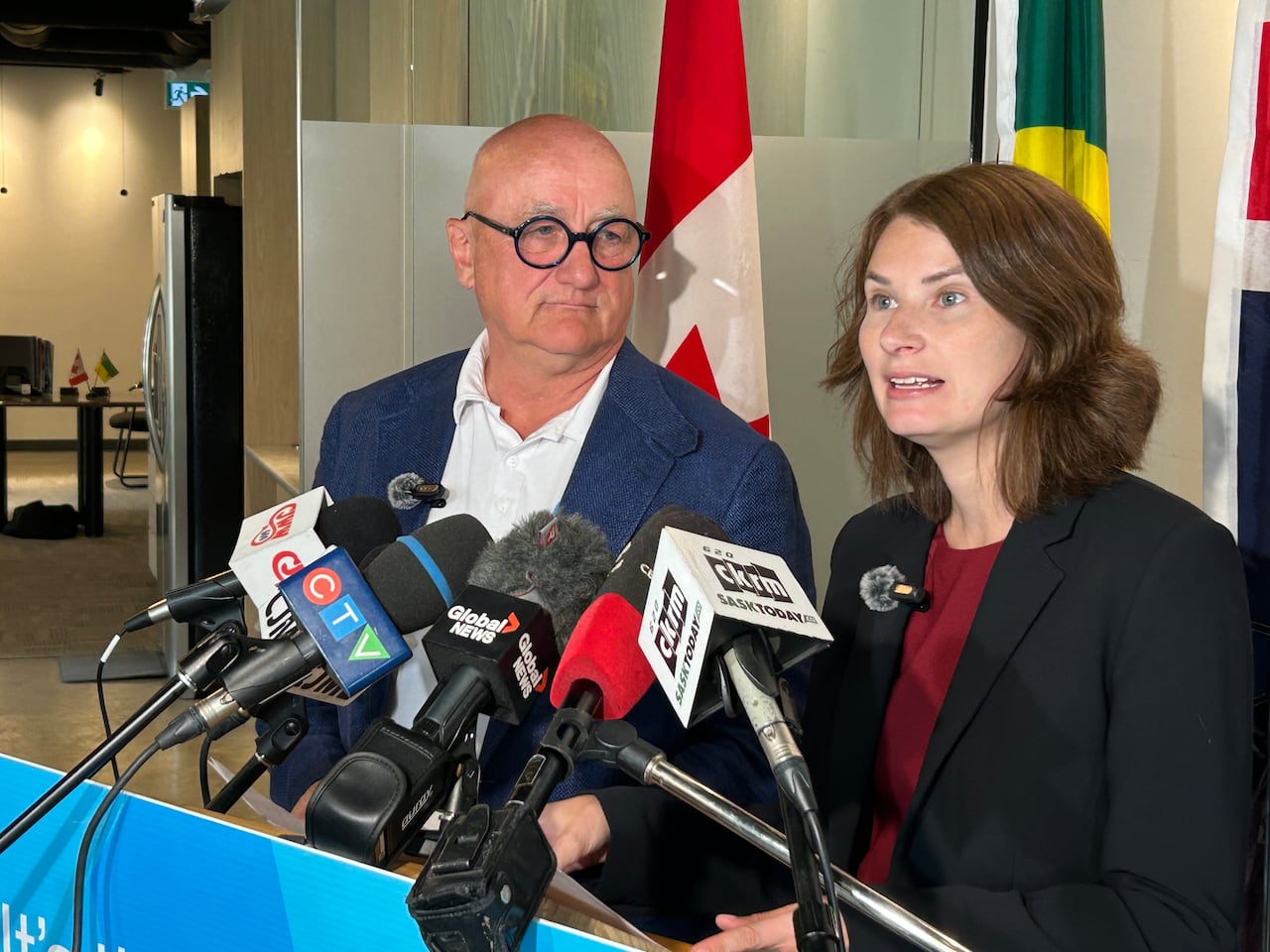 Saskatchewan Opposition critics Kim Breckner, right, and Don McBean speak at a news conference in Saskatoon about the Canada-United States trade dispute on Monday. (Phil Tank/CBC)
Breckner also suggested Saskatchewan should join other provinces by adopting a procurement policy that favours Canadian companies when awarding government contracts.
“We’ve seen a lot of work that should be done by a Canadian contractor that has been outsourced to the U.S.,” Breckner said.
“I’m thinking most recently of our hunting and fishing licence processor. You can’t tell me there isn’t a software company in Canada, let alone Saskatchewan, that can do that work.”
Breckner characterized these moves as small measures with a large symbolic impact. She also said Moe should speak with a “tougher tone” on the trade dispute, because jobs in Saskatchewan are at stake.
WATCH | This Sask. company is in danger of being tariffed twice on the same trampoline: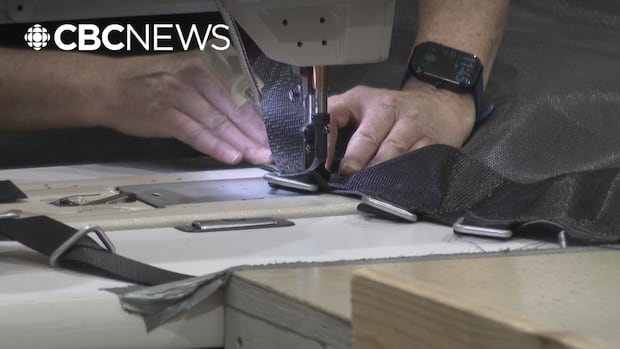
This Sask. company in danger of getting tariffed twice on the same trampoline
Crazy Ape Extreme Equipment in Regina has been making trampolines since the 1970s. More than half go to the U.S. The products are built with American steel and foam already tariffed on the way to Canada. If Donald Trump’s new threatened tariffs take effect, the finished trampolines will also get tariffed on the way back.
Lalonde said there may not be a change in the domestic price of honey this season. The bigger question is whether Canadian producers will find new markets to export their honey to.
“I don’t think there’s going to be any knee jerk management changes to businesses,” Lalonde said.
He said that if the average Canadian family were to eat half a container of honey more in a season, it would help counter the loss of the U.S. market.