
White Rock must mull public pool costs
Published 6:00 pm Monday, August 24, 2026
Yet another item for White Rock council’s wish list – a public swimming pool for the city – will have to wait for a new council to be elected before being given consideration as a strategic priority.
That was the unanimous decision of council members at the July 27 meeting, after they received a pool needs assessment and feasibility study compiled by consultants Cornerstone Planning Group and presented by recreation and culture director John Woolgar.
Inevitably the costs of building, maintaining and staffing such a facility will limit the city to a choice that meets only basic requirements, Cornerstone’s Quentin Talbot-Kelly noted.
According to preliminary estimates, the city would be looking at spending anything from almost $10 million to some $24.2 million depending on the pool option chosen.
“It’s a big decision to make because there’s a lot of dollars there for a small city like White Rock,” Mayor Megan Knight observed.
“Funding is the issue – we all know this,” said Coun. Christopher Trevelyan.
“Even if we get $10 to 15 millon from another level of government, we’d still be on the hook for $1 to 6 million more dollars.”
Woolgar noted that there is increased urgency for a White Rock pool as a result of the City of Surrey prioritizing Surrey residents over White Rock residents who use Surrey swimming pool facilities.
“On January 1, 2025, the City of Surrey implemented a priority registration for Surrey residents in its recreation program,” Woolgar said.
“As a result, White Rock residents must wait up to three weeks, after Surrey residents, to register for (any recreational) programs. For high-demand programs, such as swimming, this delay significantly restricts access for White Rock’s 1,800 children to essential water safety and life skills (training) – an especially important concern for a seaside community.”
Woolgar said staff were seeking council’s support to defer consideration of a public swimming pool as a strategic priority to the next council term, given the demonstrated service gap, community demand and long-term importance of aquatic recreation and water safety.
In his report to council Talbot-Kelly indicated that there is clearly a demand for aquatic facilities in White Rock, where most residents must travel to the nearest South Surrey options; the Grandview Heights Aquatic Centre, the South Surrey Indoor Pool and the Surrey Sport and Leisure Complex (residents also frequently participate in structured and drop-in programs at the YMCA’s Tong Louie facility and at the Crescent Beach Swimming Club, he noted).
Demographic projections indicate an aging population in which, in 20 years time, the majority of White Rock residents (some 76 per cent) will be adults over the age of 40, he said, while the current percentage of children (four per cent) will remain stable, and youth and younger adults will experience either no growth, or declining numbers.
Also to be factored in are evolving family structure – in which two-worker households drive peak demand in post-work hours, while drop-in and flexible use opportunities best fit increasingly complex schedules.
Given the number of more specialized facilities available outside of White Rock, the study recommends providing a facility that meets basic aquatic service – around 104,000 swims per year.
But the bottom line – as always – is going to be how much the city is willing to spend.
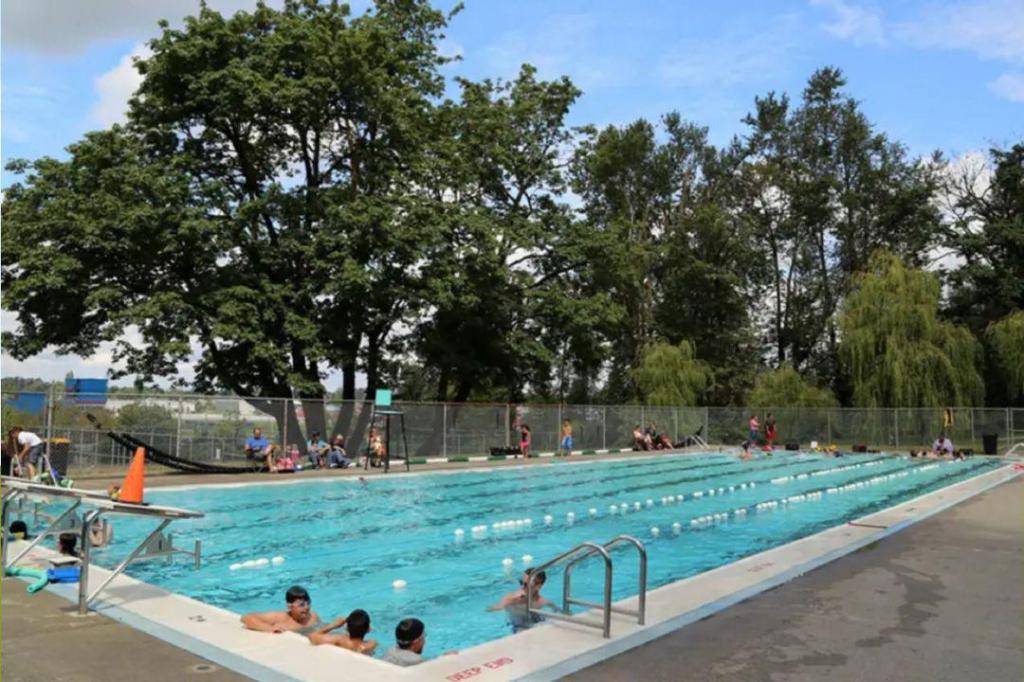
The report developed three options – an outdoor, covered facility offering a leisure pool, lap pool and hot pool; an outdoor ‘standard’ facility, providing a leisure pool and a lap pool; and an outdoor basic facility providing only a lap pool.
The first option would come with a preliminary estimate price-tag of $24.2 million, including an anticipated $17.9 million in construction costs, while the second option would be around $20.9 million, including $15.5 million in construction costs.
The third option, while significantly less expensive (an estimated $9.7 million, including construction costs of $7.2 million) would only be usable for short operating season, with a constrained capacity that would “not meet projected annual swims per capita targets” and would “limit the ability to respond to broader community needs” Talbot-Kelly said.
“While it is the most cost-effective option, its overall service impact is correspondingly low,” he warned.