
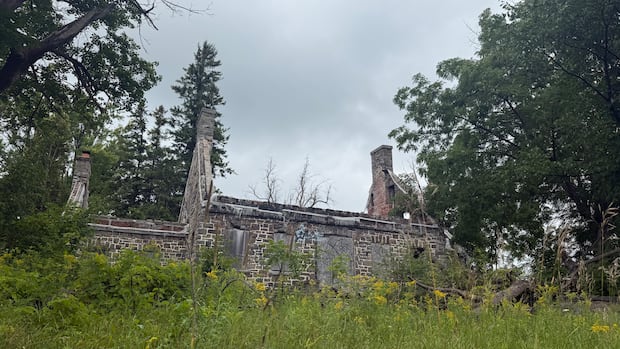
Across the street from the new Anse-à-L’Orme REM station, hidden by vegetation and trees, is the Maison Michel-Robillard.
Dating back to 1797, the farmhouse, named after the Robillard family that built it, sits abandoned and dilapidated in Sainte-Anne-de-Bellevue, in Montreal’s West Island.
The historic site was gutted by a fire in 2012. Two years later, it was designated a heritage site by the town and recognized as such by the provincial government.
Over time, the derelict farmhouse has only continued to deteriorate, sparking a debate over its future.
While some residents want to see the home restored, others argue the site is too far gone and too expensive to rebuild.
The town’s mayor is bringing the issue to the forefront, insisting action must be taken and that leaving the property in its current state poses a security hazard.
A history to be preserved
For years, longtime city councillor Ryan Young has advocated that the Maison Michel-Robillard be restored and protected due to its historical significance.
“Any house that dates back to 1797 is of interest to heritage lovers all across the province,” he said, noting not many buildings from the 18th century have survived.
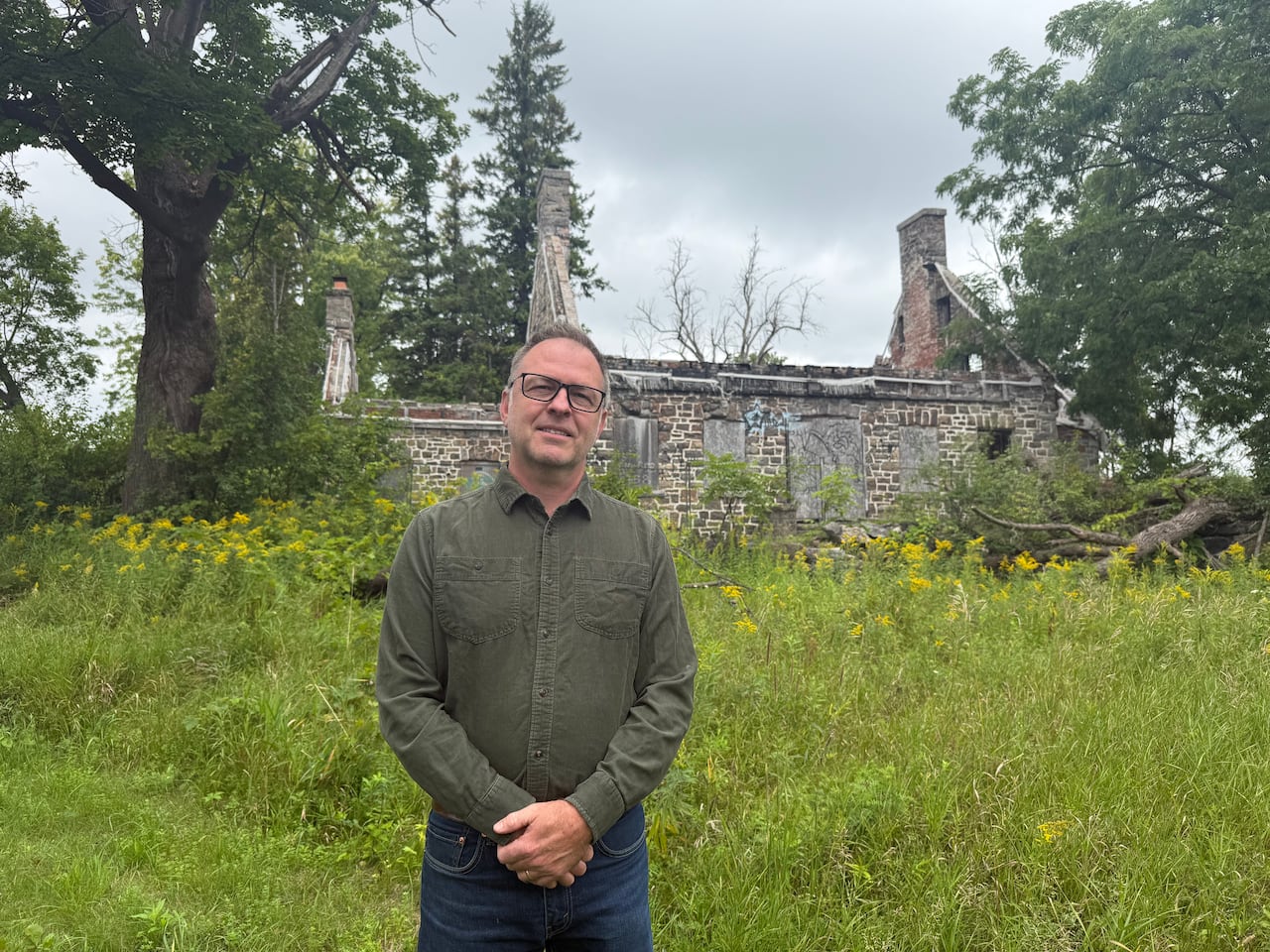 Ryan Young was first elected as a city councillor in Sainte-Anne-de-Bellevue in 2009. For years he has advocated for the restoration of the Maison Michel-Robillard and its importance for Canadian history. (Chloë Ranaldi/CBC)
After being in the Robillard family for five generations, the structure served as a rooming house for British young men who came to study Canadian farming. It was then bought by the Williamson family — when it became better known as the Braerob farmhouse — before it was purchased by a developer.
In 2018, the city bought the farmhouse and the strip of land leading up to it for around $67,000 plus legal fees.
From there, the hope was for the site to become the welcome pavilion connecting the Anse-à-L’Orme REM station to the 3,100-hectare Grand parc de l’Ouest, designed to be Canada’s largest municipal park.
But that plan has been derailed.
A change of heart
In a letter sent to Sainte-Anne-de Bellevue Mayor Michel Boudreault in April, the City of Montreal said it had “no intention of investing in, carrying out or providing financial support for the refurbishment of the Maison Michel-Robillard or any other public reception building at this location.”
The city said the site would not be the entrance point to the Grand parc de l’Ouest and that the welcome centre would be at Cap St-Jacques park in Pierrefonds-Roxboro, a borough into which the massive park entends.
 Former Sainte-Anne-de-Bellevue mayor Paola Hawa says it’s important to restore the Maison Michel-Robillard and hopes to see it transformed as a welcome centre for the Grand parc de l’Ouest. (Kate McKenna/CBC)
Former Sainte-Anne-de-Bellevue mayor Paola Hawa says the original plan for the Grand parc de l’Ouest was always to have the Maison Michel Robillard as a point of entry.
“The Michel-Robillard was supposed to be the introduction or the welcome chalet to that entire forested area,” Hawa said.
She says due to the farmhouse’s patrimonial value, the hope was for it to also become what she called a nature interpretation centre, where people could rent cross-country skis or bikes and have access to the green space.
Dating back to 2019, studies were conducted on the feasibility of preserving the building, with the city providing a $1.5-million subsidy for its reconstruction. Plans to rebuild were roughly around that cost as well.
However, according to the Sainte-Anne-de-Belleuve website, the lowest bid to preserve the building in May 2023 jumped to over $4.3 million, and in July 2023, the city created a demolition committee to evaluate the building, which the current mayor sits on.
Cost to restore building ballooned
The letter from the City of Montreal prompted the mayor to take action on the historic site. He called a demolition committee meeting on Aug. 19 to present the file and listen to the community.
“The committee has to make a decision. And for that we need to have all the information. And we also have, I believe, […] to listen to the citizens about what they want about this house,” said Boudreault.
He says the intention will be to preserve the site in some way or another, whether it be through a plaque or another way to signify the home’s history.
According to public records on the city’s website, the costs for the reconstruction of the building have gone up yet again.
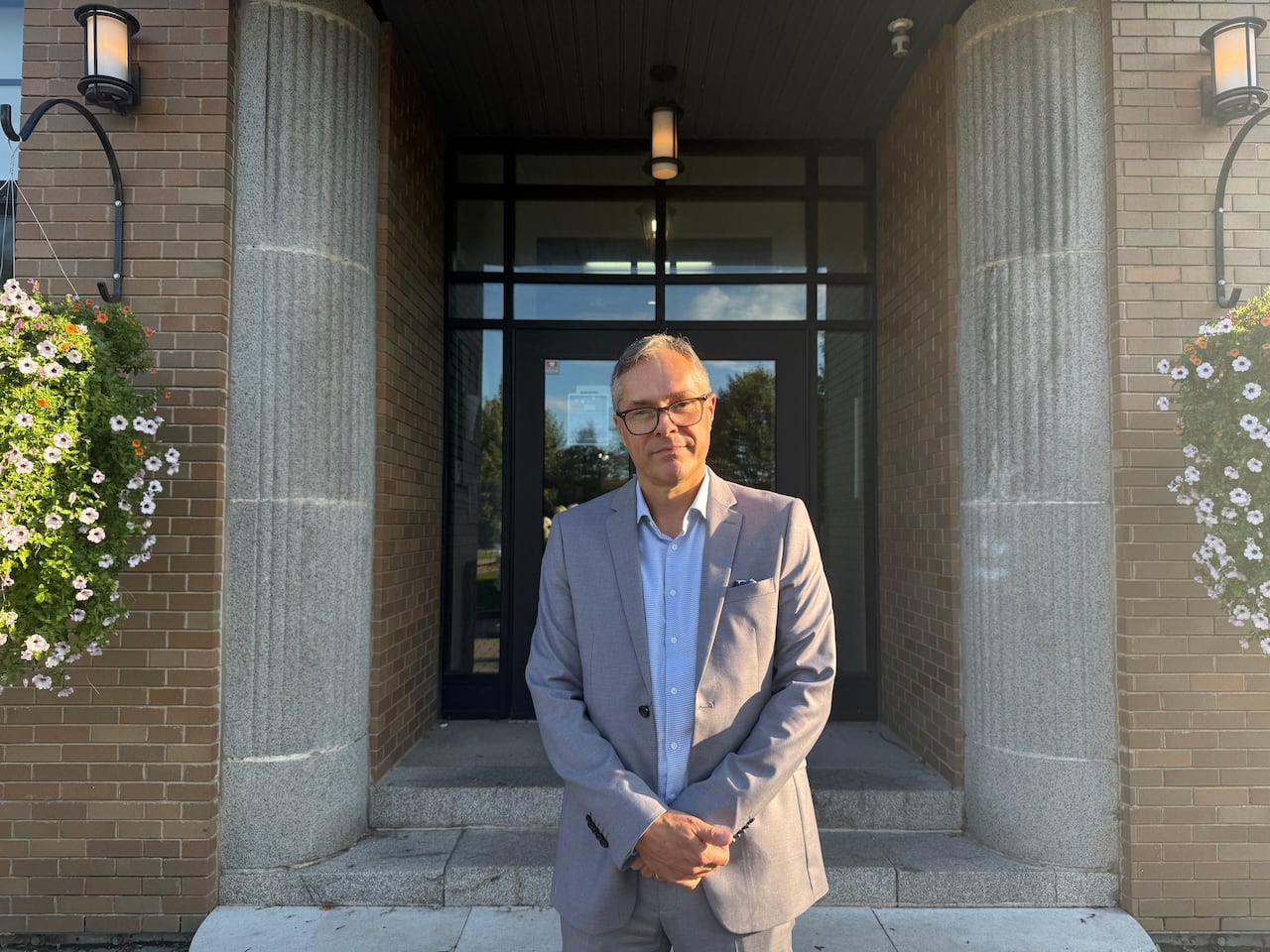 Sainte-Anne-de-Bellevue Mayor Michel Boudreault says his office received notice this fall that the City of Montreal’s plans changed for the Grand parc de l’Ouest, and new conversations must be had on the future of the building. (Chloë Ranaldi/CBC)
In 2025, two options were presented. The first, which included no roof and the reinforcement of the structure’s walls, cost over $6.6 million. The second, including a roof and interior restoration, cost over $7.3 million.
According to the mayor, the city would be eligible for subsidies for the project by the City of Montreal and other levels of government.
However, while some people who attended the city council meeting supported the investment into the historic building, hoping it would attract more people to Sainte-Anne-de-Belleuve, others see the site as beyond repair.
Some voiced concerns about repairing a building where only four walls remain and which was left in disrepair, saying they wanted the money to be invested into other town projects.
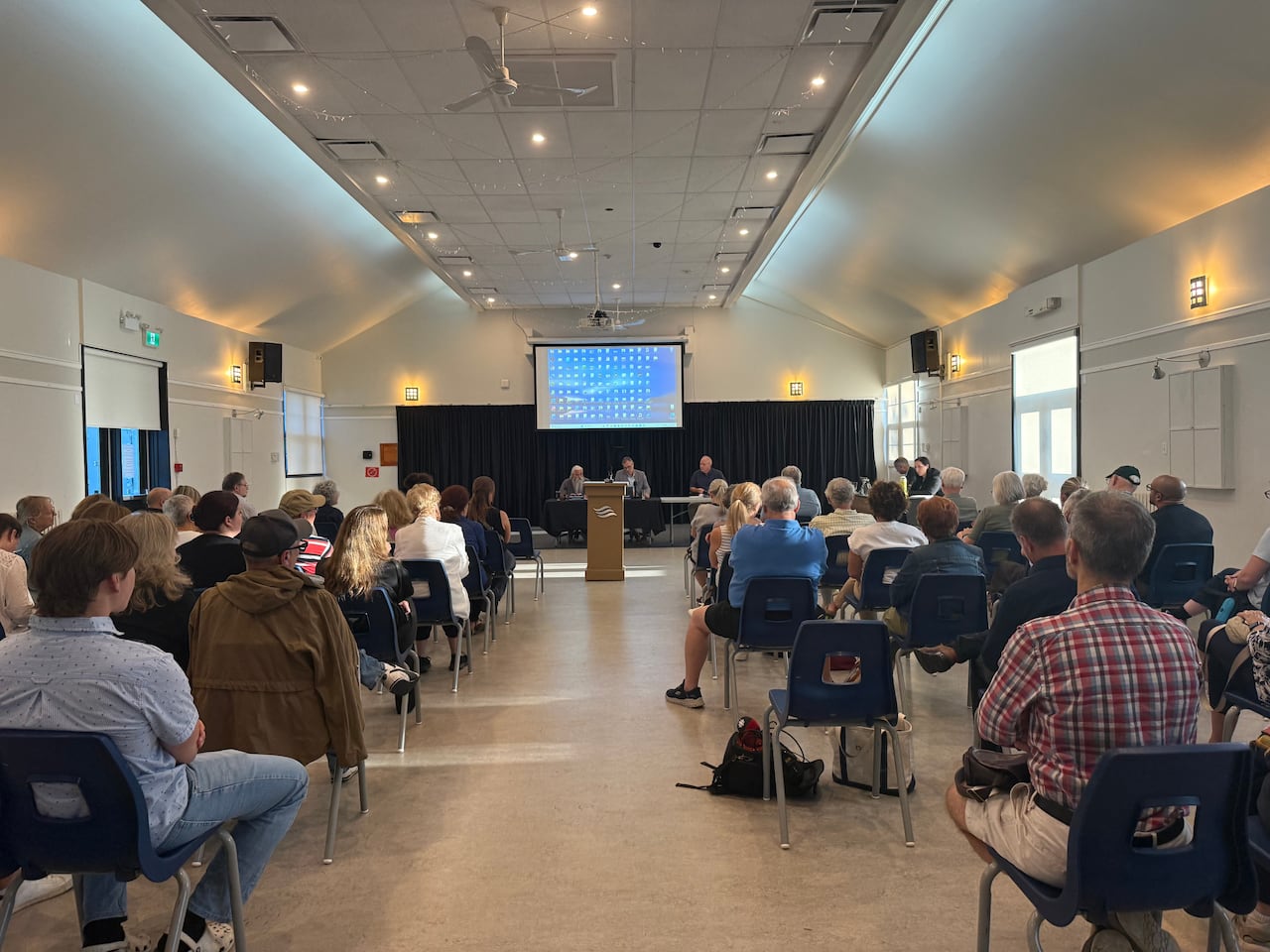 On Aug. 19, the demolition committee held a public meeting, delivering the facts of the file and listening to the public’s opinions in Sainte-Anne-de-Bellevue. (Chloë Ranaldi/CBC)
Dinu Bumbaru, a policy director and spokesperson for Heritage Montreal, believes the project to restore the farmhouse should be adjusted to meet the reality of the situation – and that the heritage should be respected at all costs.
“Sometimes we [say] we’re going to save that building. We let it go to ruin for decades or ages without caring much. And then we say we are going to restore it and resurrect it,” Bumbaru said.
He says after years of neglect, it could be too costly to resurrect the building as it was or transform it into something brand new. He believes the focus should instead be on maintaining the site’s presence and honouring it in some form.
“How could we not do something special here?” says Young.