
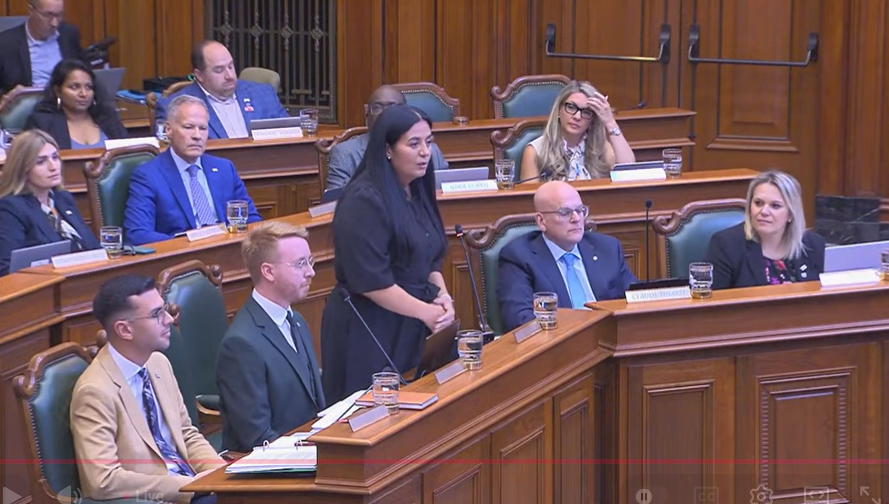
Montreal City Council adopted a significantly amended version of an anti-Israel motion late Aug. 24, after the motion was initially introduced in June by the Official Opposition party, Projet Montréal.
In the end, the accusations of “genocide” were removed, the claim of apartheid was similarly struck from the text, and Hamas was recognized as a terrorist organization responsible for mass murder. The call to cut all institutional ties with the State of Israel was also removed, even though Montreal has no such direct ties.
While the most incendiary and divisive language was excised, other language about support for investigations into genocide claims, International Criminal Court arrest warrants, and Canadian sanctions remained. The amended version passed by a vote of 53-7.
In the face of mounting rhetoric and accusations of “complicity” through the summer, Montreal Mayor Soraya Martinez-Ferrada struck a sober tone, expressing sympathy for people in Gaza and all civilian casualties and victims of war, while reiterating that hers is not a foreign-policy role.
She said as much on Monday before the meeting, telling reporters that city council’s role is not to dictate foreign policy, adding that with South Africa’s apartheid regime, Brian Mulroney’s government “defended the fact that it was a real issue of apartheid, and he did that over four years before the government of Canada recognized apartheid, and then the city of Montreal came into taking a position at city hall. But we are not a government of a national perspective of foreign affairs. That is not our role.”
Projet Montreal councillors Nathalie Goulet, Alex Norris and others, delivered emotional speeches defending their original wording motion, as did interim Opposition leader Erika Alneus before voting in support of the final amended motion, like all her colleagues.
The change in language followed six weeks of debate. While the motion was pushed by protest groups, councillors and cultural and civil society activist groups, denouncing it were leaders of Montreal’s Jewish, Greek, and Italian communities, Christian-Jewish dialogue, and corporate leaders.
United Against Hate director and former dean of city council Marvin Rotrand, urged Martinez-Ferrada and her team to reject the motion, challenging its arguments and recalling that he was the original resolution author in Montreal’s famous 1987 anti-apartheid campaign, an oft-referenced lynchpin of Montreal’s anti-Israel movement.
The current anti-Israel motion he said, was “so distorted as to be irredeemable,” cautioning Martinez-Ferrada “should there be any internal disunity…which may see some administration members vote for the motion, it is better to lose the vote and maintain the integrity of the mayor and executive committee. A vote for a motion like this will have long-term negative ramifications for Montreal and those who supported it.” The charge of apartheid says Rotrand, “is a key element in the decades-long efforts by groups designated as terrorists to destroy Israel. The motion offers nothing but assertions of genocide that Hamas and Iran have made.”
During Monday night’s tense meeting, council president Chantal Rossi restricted gallery access to about a dozen people, owing to last month’s meeting where hecklers berated municipal officials and repeatedly disrupted council. The rest of the audience was relegated to a video viewing area in the foyer, accommodating some 110 people. An unusually high number, up to 650 people, watched the meeting streamed online.
Rossi was unyielding in imposing the three-question-per-topic rule, blocking queries about antisemitism, and even attempting, without success, to shut down a question from Iranian community activist Ayrik Armani, about the city’s tolerance of public harassment of Iranian diaspora communities by IRGC supporters. She even forbade a question about possible copyright infringement of the city logo in anti-Israel campaign materials.
City Hall security guards also enforced a no-keffiyeh rule in the gallery or viewing area, following last month’s meeting that featured regular outbursts, symbolism of inverted flags and inflammatory language between participants. On Tuesday, Rossi clarified that tight restrictions on the gallery and viewing area and the pre-existing ban on wearing symbols needed to be enforced for security reasons, largely due to last month’s meeting where she alleges city employees doing question period registration were mistreated by attendees.
The expedited question period was immediately followed by debate on the motion. Outside, some 70 people with flags, banners, speakers and megaphones chanted that the mayor was complicit in “genocide” and called for “intifada,” while the mayor called for a vote on her party’s amendments.
The opposition rejected the amendments outright, but after debate the final amended version carried 53-7. The seven opposing votes came from within the administration caucus, including Montreal’s only Jewish city councillor – Snowdon’s Sonny Moroz, Côte des Neiges-Notre Dame de Grace Borough Mayor Stephanie Valenzuela, Milany Thiagarajah, downtown councillor Leslie Roberts and three Saint-Laurent borough councillors.
Moroz told The CJN his vote reflected discomfort with some of the final language. “I had three red lines: inclusion of apartheid the way it was defined in the original motion; inclusion of genocide as statement of fact; and application of sanctions because of the first two.” The sanctions reference remained he says, “language I very much would have preferred to be changed, and it’s those kinds of things at the last minute that I didn’t feel comfortable voting for; something I honestly don’t think represents an accurate depiction and I don’t think that my residents would understand my vote for.”
“This vulnerable community makes up a significant percentage of Snowdon,” he says. “They don’t have anybody else. I’m the only Jewish guy there, so I appreciate my colleagues for having also stood up and voted in the way that they did for the amended motion, then against the final amended motion, just to show that the Jewish community is being listened to inside of our party. It may not be a majority, but you know there is an understanding that even when we want to show solidarity with Palestinians, language matters, and that one can’t accomplish that by taking a step towards hurting another vulnerable community.” His support for the amendments however was because he wanted to “find common language for everyone to vote on.”
Being the only Jewish elected official for the last three years has been an isolating experience, he says.
“In conversations with colleagues, trying to have them explain what ‘river to the sea’ means; they didn’t know about what the red triangle meant, or that the red triangle’s been put over my head multiple times in social media posts for the last three years,” he said. An inverted red triangle is used by Hamas to identify Israeli military targets.
“They’re so distant from the daily reality of what’s on our social media feeds and in our community conversations, that simple things we’ve accepted years ago are not part of their understanding.”
Opposition member Nathalie Goulet, who presented the motion, spoke emotionally about “genocide,” “colonialism,” and “apartheid,” and spoke of the tragedy of the “1,200 Palestinian civilians attacked on October 7,” a characterization not corrected, and called out by the Centre for Israel and Jewish Affairs after Monday’s meeting. (Hamas terrorists killed 1,200 people in Israel and kidnapped 251 others on Oct. 7, 2023).
While elected officials “have come to their senses by removing many of the most incendiary and unacceptable aspects,” of the initial proposal, CIJA wrote, “the importation of this conflict by Projet Montréal is all the more irresponsible given that some of its own elected officials do not even grasp the most tragic and basic facts. Hearing an official opposition councillor refuse to designate Hamas as a terrorist group and speak of an ‘October 7, 2023, attack against Palestinian civilians’ when the entire world knows it was a barbaric assault that killed more than 1,200 people, including Montrealer Alex Look,” the advocacy group said, “amounts to indecent revisionism that disgraces the city council.”
On Tuesday, Federation CEO Yair Szlak’s message to the community was that while the vote means “the radical fringe pushing this motion did not achieve its goal of imposing its full agenda on our elected officials, I cannot in good conscience call last night a clean outcome. For nearly an hour, members of Projet Montréal had the floor, on the record, to repeat one-sided characterizations of Israel and the war with Hamas… and did not refer to Hamas as a terrorist organization.”
That omission is not a technicality says Szlak. “It is a lapse that disgraces this council.
The question why “such a toxic motion” comes to a vote at Montreal city hall “is both simple and complicated, and one we fear naming all too often,” Szlak wrote. “Throughout the world today, intolerant fringe minority populations are using democracies and liberal democratic values held by tolerant majorities to try to impose a radical agenda on the rest of society.
“Radical extremists, some funded and guided by the Muslim brotherhood and the Islamic Revolutionary Guard Corps (IRGC), are using our liberal democratic values to try to impose their radical agenda in our institutions and on our streets, first to alienate and isolate Israel and the Jewish people, but eventually to impose their will on the rest of society.”
When leaders “chase the votes of a fringe electorate that will never be satiated, or satisfied with any compromise, the end result is the erosion of the values that bind our society together,” Szlak wrote.
Before the final vote, Projet Montréal party leader Ericka Alneus said, “We had a responsibility to carry the voice of Montrealers and their concerns. Our party will continue to fight for human rights, regardless of origins… and Montreal will remain a place of peace.”
Montreal’s other diaspora communities also took a position before the vote, notably with a call from the Hellenic Community of Greater Montreal to reject the motion. While not diminishing the suffering of Palestinian and Israeli civilians, or any innocent people affected by the conflict, they wrote, “Council should carefully consider the foreseeable repercussions such a resolution may have on our Jewish friends, neighbours and fellow Montrealers on their sense of belonging, their safety and security, their peace of mind, and their ability to participate fully in the life of our city without feeling marginalized or held responsible for the actions of a foreign government.” That was echoed by the National Congress of Italian Canadians and the Canadian-Italian Community Foundation stating: “We concur with our Hellenic brothers and sisters and strongly believe that we should not add fuel to an already explosive international situation by turning it into an equally explosive and even more divisive local issue.”
In an open letter, Quebec secularism activist Romain Gagnon responded to the campaign calling for severing all ties with Israel, adding that the House of Commons “recognized genocide against the Uyghurs in 2021, and the UN High Commissioner for Human Rights concluded in 2022 that the repression in Xinjiang could constitute crimes against humanity. Montreal has nonetheless been twinned with Shanghai since 1985… No one is proposing to sever ties with Shanghai.” (Montreal also has long-established collaboration agreements with Chinese cities Shenzhen and Guangzhou, despite Canada’s leading role in officially condemning the Uyghur genocide.)
What criterion then, would allow for suspending relations with Israel? asked Gagnon. “If there is no such criterion, is it then à la carte foreign policy, reserved solely for the Jewish state?
Montreal businessman and investor Mitch Garber also chimed in, dubbing apartheid accusations “utterly absurd, but they are nevertheless very well marketed,” and argued the motion’s charges were false, adding, “to the antisemites at Montreal City Hall – and you are – you will bring shame to our great city today. But this post is not addressed to you. It is addressed to that person or persons, even just one, who will read it and take a moment to reflect.”
Some minor altercations occurred outside city hall before the meeting, where loud repeated chants of “long live intifada” were heard and at least two people attending council told security staff of concerns about leaving the building through a gauntlet of screaming protesters. They were told to speak to police outside, some of whom escorted people through the crowd, while others stood by the doors directing those exiting.
Israeli Consul-General in Quebec Eliaz Luf acknowledged that there are no direct institutional ties between the city and the Israeli government, telling The CJN that a call to sever ties was nothing “but pure BDS. We know who we are dealing with, but I don’t even think the opposition leadership knows much about what is going on.”
Luf says he never managed to meet with the administration or opposition to make Israel’s case, despite repeated efforts. “Remember,” he says, “anti-Israeli voices are very, very loud but I don’t think there are so many of them. We have so many friends and so many people that are happy to continue working with Israel to create new connections, establish more bridges and good relations between Canadians and Israelis, in every aspect: academia, culture, tourism, and also politics. And in politics, things might look bad, and then they look good, and then they look bad again. It’s a fact of life. I’m in diplomacy for 30 years now and things are always in motion.”
In addition to expediting the motion at City Council on Monday night, Martinez-Ferrada also sped up approval of a resolution to be introduced at Thursday’s agglomeration council, the body governing shared municipal functions of Montreal and island suburbs. That resolution for “Civil Peace, Public Safety, and Social Cohesion” tabled by Côte Saint-Luc Mayor David Tordjman and Westmount Mayor Michael Stern, “aims to combat and denounce this rise in antisemitism right here in our metropolis,” said Martinez-Ferrada. “It is a denunciation that must be made.” It’s also she said, about defending “the right of every person to walk in their neighbourhood, enter a school, attend a place of worship, or wear a symbol of their religion without fear of being targeted.”
It was adopted with Projet Montréal voting against, opposition councillor Olivier Demers Dubé explaining that his party agrees with the need for peace, safety, and social cohesion, and insists “intolerance, violence, and antisemitism have no place in Montreal,” but cannot support a motion which also calls for city council to stay out of a foreign conflict debate, which “would essentially muzzle council under the pretext of social cohesion.”
Joel has spent his entire adult life scribbling. For two decades, he freelanced for more than a dozen North American and European trade publications, writing on home decor, HR, agriculture, defense technologies and more. Having lived at 14 addresses in and around Greater Montreal, for 17 years he worked as reporter for a local community newspaper, covering the education, political and municipal beats in seven cities and boroughs. He loves to bike, swim, watch NBA and kvetch about politics.