
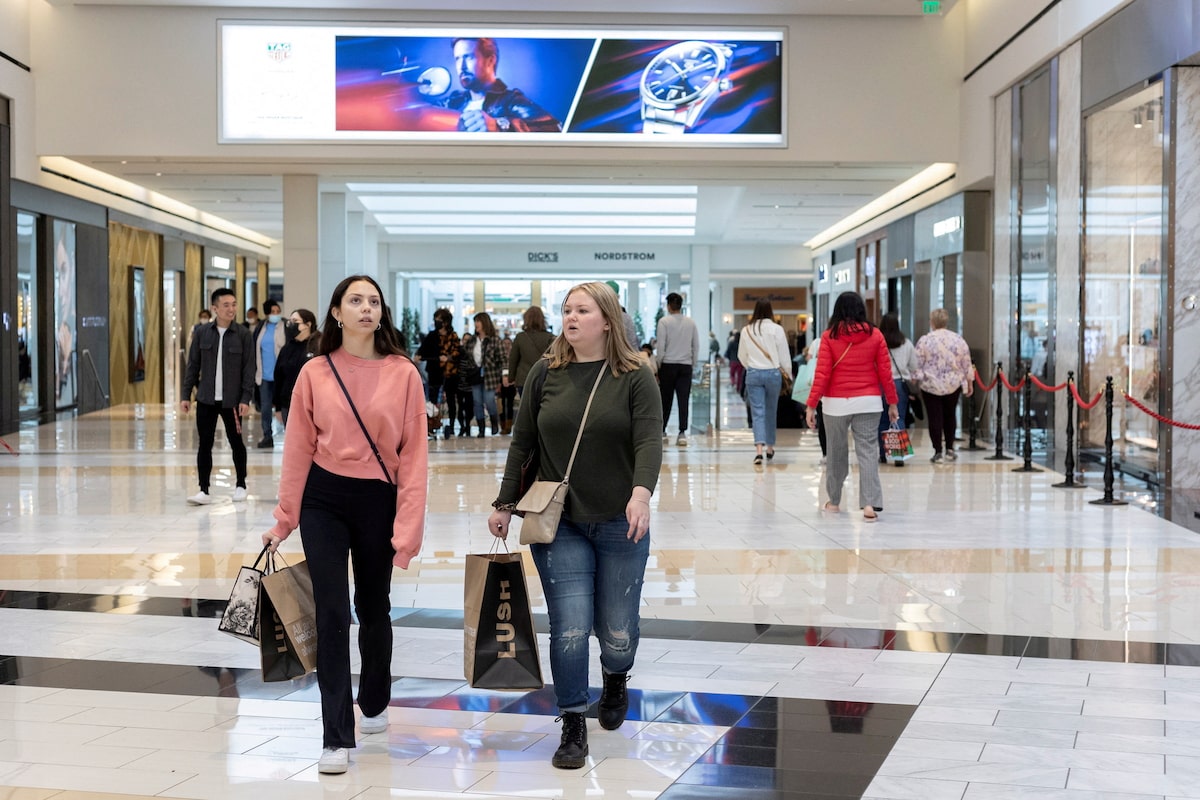
People shop at the King of Prussia mall in Pennsylvania in November, 2021. Inflation as measured by PCE peaked at 7.2 per cent in June, 2022.Rachel Wisniewski/Reuters
Annual U.S. inflation unexpectedly held steady in July well above the Federal Reserve’s 2 per cent target for the 65th straight month, and the pause in the decline from a recent war-induced peak is likely to intensify the central bank’s debate over whether interest rates should be lifted or held steady.
The Personal Consumption Expenditures Price Index increased 3.7 per cent in the 12 months through July, unchanged from June, the Commerce Department’s Bureau of Economic Analysis said on Wednesday. Economists polled by Reuters had forecast a reading for PCE, which the Fed uses to set its target, of 3.6 per cent.
The month-over-month figure also came in higher than expected at 0.2 per cent in July after falling 0.1 per cent in June, which had been the weakest reading since April 2020. Economists had forecast a 0.1 per cent increase. Excluding energy and food prices, so-called core PCE – which Fed officials use as a guidepost for inflation’s underlying run rate – held steady at 3.3 per cent on the year while rising to 0.2 per cent on the month from 0.1 per cent in June.
The above-forecast headline print gave a modest lift to expectations that the Fed may raise interest rates as soon as next month. Fed funds futures prices reflected about a 42 per cent probability of a rate hike at the central bank’s Sept. 15-16 meeting after the report, versus about 36 per cent immediately before.
“This is data that supports a hike,” said Omair Sharif, founder and president of forecasting firm Inflation Insights. “The unrounded core PCE was 0.246 per cent, so it barely missed out on rounding to 0.3 per cent. That is a one-month annualized rate (of) nearly 3.0 per cent.”
Investors hope for clarity from U.S. Fed’s Warsh at Jackson Hole meeting
Annual PCE shot to a three-year high of 4.1 per cent in May in rapid fashion after U.S. President Donald Trump launched air strikes along with Israel against Iran in late February, sending energy prices spiralling upward as the conflict shut in roughly a fifth of global oil supplies.
Six months later the conflict appears no closer to a final resolution, though the exchange of fire has diminished and oil prices and the wider inflation wave they instigated have retreated from their mid-spring highs.
The slowdown in inflation in the last two months has helped buoy the arguments of the majority of Fed policy committee members who voted last month to leave the central bank’s benchmark interest rate unchanged in the 3.50 per cent-3.75 per cent range, where it has been since December. But the sluggish pace of improvement is unlikely to mollify a growing minority of Fed officials who argue tighter policy is needed, given that inflation has been above target since February 2021 and will not get to the 2 per cent level without further restraint. Inflation as measured by PCE peaked at 7.2 per cent in June 2022, and the steepest Fed rate increases since the 1980s helped put it on a path back toward 2 per cent.
That trajectory changed last year after Trump unleashed a wave of import tariffs upon his return to the White House, sending a wide range of goods prices higher, with the Iran war exacerbating those pressures. And new tariff-induced pressures are likely coming, after trade negotiations between the U.S. and its second-largest trading partner, Canada, fell apart on Friday, resulting in new levies on US$20-billion of Canadian imports to go into effect. Since then, Washington and Ottawa have each announced additional retaliatory measures to go into effect in coming months unless a deal is reached to avert them.
The BEA on Wednesday also updated data for economic growth for the second quarter, leaving unchanged its estimate of annualized gross domestic product growth at 1.5 per cent. Among the notable changes from the first estimate was an upward revision to consumer spending during the April-through-June period to 3.4 per cent from the originally reported 3.2 per cent, an indication that the individual consumption that supports two-thirds of U.S. economic activity had held up through the first half of the year.