
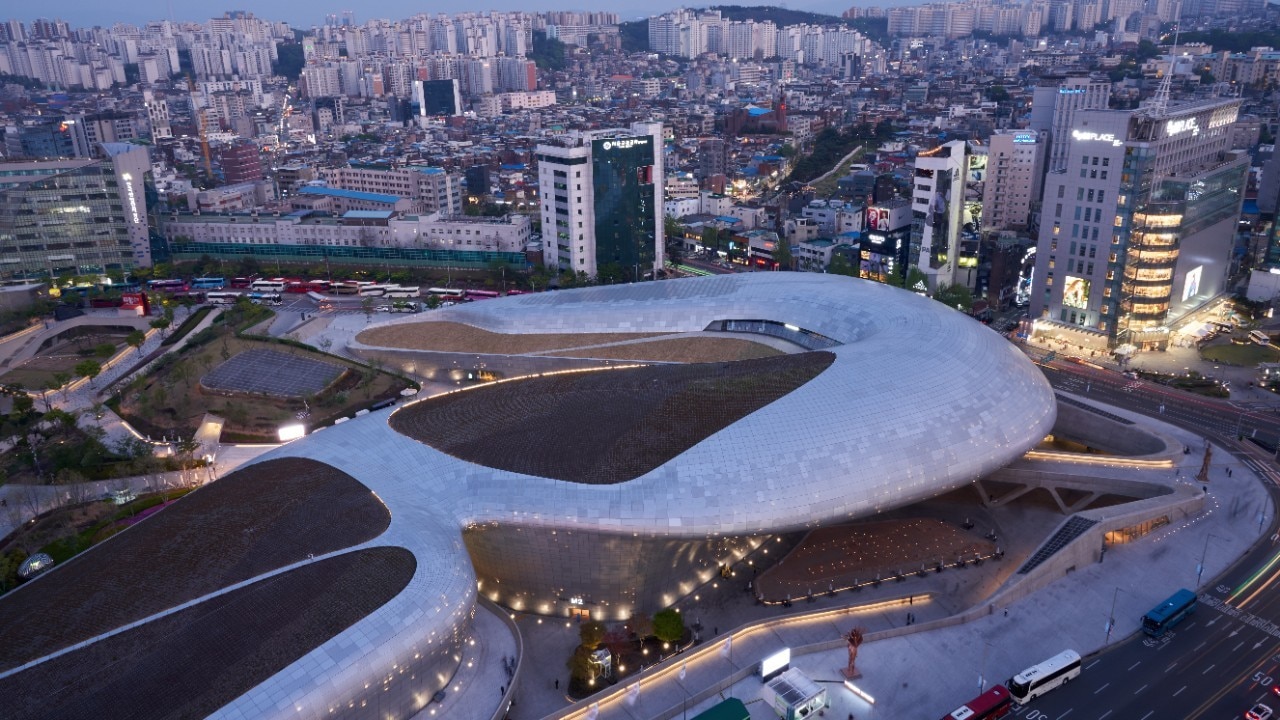
The choice of the DDP is far from accidental. Conceived as a piece of urban infrastructure for design, fashion, and culture, the complex has cemented its place over the past decade as one of Seoul’s defining architectural landmarks and a major engine of urban life.
Inaugurated in 2014, the DDP inserts itself into the urban fabric like an improbable, invertebrate alien organism. Massive yet elusive, its volume translates Zaha Hadid’s radical pursuit of fluid architecture—shaped by topographies, flows, and trajectories rather than rigid Euclidean geometry.
Externally, the structure dips, rises, and sweeps visitors through a continuous sequence of surfaces, curves, ramps, and voids, creating an urban landscape to be traversed rather than a monument to be contemplated. An apparently seamless metallic skin envelops the building, altering its appearance as it reflects the sky by day and the city lights by night. A 30,000-square-meter park, drawing inspiration from traditional Korean gardens, weaves in and out of the structure in a web of pathways and sightlines that blurs the boundary between indoors and outdoors. The result is a “metonymic landscape”—the winning competition concept—conceived to connect Dongdaemun’s multifaceted identities in a continuous dialogue between architecture, landscape, and public space.