

Listen to this article
Estimated 4 minutes
The audio version of this article is generated by AI-based technology. Mispronunciations can occur. We are working with our partners to continually review and improve the results.
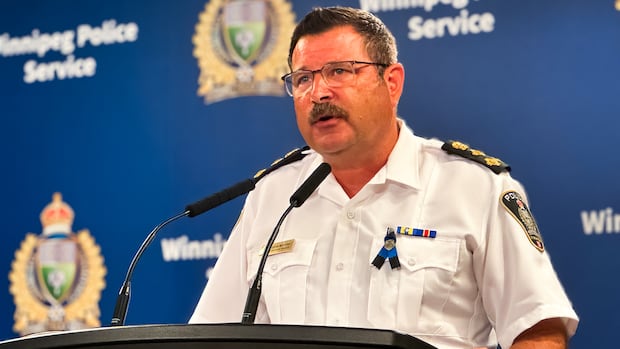
Winnipeg’s police chief says the service will no longer allow retail stores to hire officers for security starting early next year.
For years, Winnipeg retailers have been able to hire city police officers to work overtime at their stores. Starting in January, the police service will start reducing those special duty hours, Chief Gene Bowers said in a member update earlier this week.
Special duty hours will be limited on Fridays, Saturdays, statutory holidays and all major event days, such as when there are parades and public celebrations.
Officers will no longer do special duty work at Winnipeg stores by May 1, Bowers said.
The move comes after police service members and supervisors raised concerns about how special duty retail assignments were impacting staffing and regular operations, he said.
“This change is being made to optimize police resource allocation to ensure the safety of all communities across the City of Winnipeg,” Bowers wrote in the member update. The move also helps address members’ worries around front-line operations, he wrote.
A police spokesperson said the chief wasn’t available for an interview on Thursday.
Bowers said in a statement emailed to CBC News that special duty assignments in retail stores “were impacting our ability to fill critical operational shifts.”
“Our priority is ensuring we have the officers available to meet front-line policing needs across Winnipeg,” Bowers said in the email.
The “phased approach” to pulling police out of stores will give retailers “ample time” to adjust their security plans while police “focus resources on core public safety responsibilities,” he said.
The decision only applies to retail businesses and won’t affect other special duty assignments Winnipeg police take on, Bowers said.
Winnipeg Police Association president Cory Wiles said in a statement to CBC News that they’re aware of the decision to phase out retail assignments, calling the move a “unilateral operational decision made by WPS leadership” that the union doesn’t have a say in.
The association wants to see more police presence across the city, he said.
“When officers are visible in the community, it makes a difference,” Wiles said, pointing to recent anti-shoplifting initiatives.
Shoplifting continues to be a prevalent issue at Winnipeg retailers, said John Graham, the Retail Council of Canada’s government relations director overseeing the Prairies region.
Some stores — particularly large retailers with high theft volumes — relied on special duty officers to prevent people from stealing, Graham said.
“We recognize that there’s lots of demands on existing police officers. But at the end of the day, there are some retailers that really depended on this off-duty program to support their security to their stores,” Graham said.
Several retailers told the retail council they were disappointed by the looming end of the program, which some stores called “fundamental” to their anti-theft responses.
 John Graham is the Retail Council of Canada’s government relations director responsible for the Prairies region. (Zoom)
While it came with a higher price tag than traditional security guards, businesses that could afford it found it very effective at preventing theft, Graham said.
The advocacy group is hoping the police service won’t completely end the program and withdraw all officers from stores, he said.
The retail council has requested a meeting with Bowers to talk about keeping some special duty assignments on the table.
“We recognize that there’s some great demands on the police service,” Graham said. “However, we still think that Winnipeg Police Service … and the off-duty officer program is an important component for very large, high theft targeted stores, and we’re hoping to keep some component of that in place.”
From small mom-and-pop shops to large-scale retailers, stores are beefing up their security by investing in surveillance cameras, security guards and design changes intended to reduce theft.
Loblaw, which owns multiple large supermarkets in Winnipeg, said in a statement that it’s “saddened” to see the special duty retail program come to an end.
Loblaw spokesperson Youmna Rab said the grocery giant is “working through plans for what comes next.”