
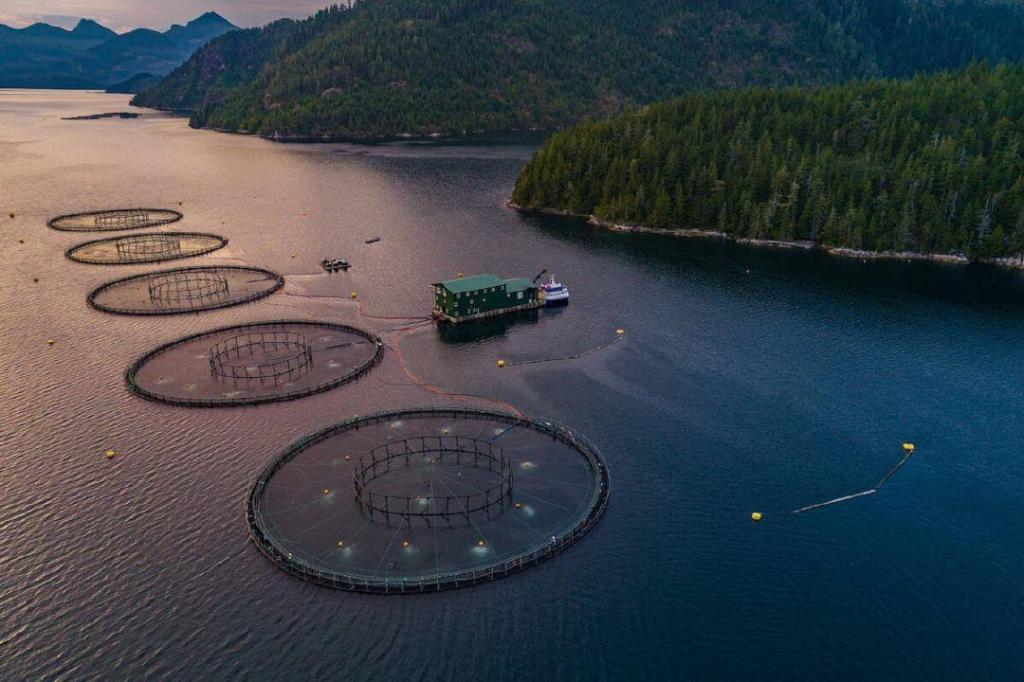
The federal government’s extended silence over the incoming open-net pen fish farm ban, set to begin in B.C. in 2029, is triggering widespread questions about whether intentions have suddenly changed under a new prime minister.
When Federal Fisheries Minister Joanne Thompson was in Victoria last week, she said that while the plan to ban open-net pen fish farms in B.C. is “certainly still in place,” the government continues to engage with stakeholders to find a path forward.
“If there’s a disconnect and varying opinions,” she said on Aug. 20, “then we look to find the space in between.”
Thompson, who is in charge of Fisheries and Oceans Canada (DFO), said Innovation, Science and Economic Development Canada (ISED) has taken over the file and been tasked with making any decisions on how to proceed at this stage. She then refused to comment further.
Advocates for a ban fear the government’s underlying intent is to put the brakes on amid a renewed focus on the economy by Prime Minister Mark Carney.
The fish farm ban was first introduced under former prime minister Justin Trudeau, with a draft transition outline unveiled in 2024. Priorities have shifted dramatically since, as the Carney government grapples with the impacts of a growing trade dispute with the U.S.
And since Carney took over, conservation advocates, First Nations, industry groups — even B.C.’s provincial government — all report they’ve heard nothing about how this ban will be put into effect.
“It’s been absolute silence,” said Bob Chamberlin, who chairs the First Nation Wild Salmon Alliance, a group dedicated to pressing for the removal of the farms.
“I’ve been communicating and emailing and phone calls with DFO and with ISED and nothing.”
Chamberlin is concerned the silence means the new focus on protecting jobs has changed the government’s calculus.
“It tells me that the government has hit the e-brake on this whole transition planning process and has just decided not to talk about it,” he said.
Industry groups supporting the fish farms finding a similar wall of silence are frustrated by the lack of clarity at a time when businesses need certainty to guide investment.
Brian Kingzett, president of the B.C. Salmon Farmers Association, said farms should be hatching fish now to be harvested in 2029 and beyond, but if they do this and the ban stays in place, those fish will need to be euthanized.
“We’re at this go/no-go point,” he said.
Kingzett is still hopeful the ban will be reversed.
“We expect some sort of a decision on the ban very soon, but I’ve been hearing very soon for months now,” Kingzett said.
There are still 61 active fish farms in B.C., down from more than 100 before the ban was announced. Many of those removed were adjacent to the Discovery Islands, between Vancouver Island and the mainland.
A majority of the farms still active are scattered about rural parts of northern Vancouver Island.
Kingzett said operators need to know what to expect now so they don’t waste money.
He also contended that if the eventual ban permits only land-based, closed-containment fish farms, the industry as a whole will be forced to close up shop in B.C., arguing that such facilities are not viable on Vancouver Island because of the cost of building them and the energy required to power them.
“We’re really looking at a black and white situation,” he said. “The ban stays as it is, we’re going to see significant job loss in rural communities.”
Amid all of this, industry, nations and associations are making regular trips to Ottawa to lobby for their interests. This includes several First Nations that operate their own fish farms and want the ban rescinded, as well as organizations like the Pacific Salmon Foundation that want it in place.
Most are jockeying to ensure their needs are met when a plan is eventually unveiled, whatever that looks like.
An ISED spokesperson told Black Press Media in an email that the 2024 transition plan has served as the basis for more than 120 engagements with First Nations and other stakeholders.
“This work has provided a deeper understanding of the industry and regional economy, as well as the diverse views on the transition,” the ministry spokesperson wrote. “The government is reviewing all of the different perspectives in considering how it can best move sustainable aquaculture forward in British Columbia.”
Advocates for the ban want to ensure this doesn’t mean watering down restrictions by allowing new technology they say may not adequately protect wild fish from pathogens.
“Really that means fully closed containment systems should be the only ones allowed after June 30th, 2029,” said Kilian Stehfest, a biologist who works in government relations for the Pacific Salmon Foundation.
Stehfest is encouraged to hear Thompson say the plan is still in place, and urges the government to stick to its original timeline, with adequate supports for laid-off workers accompanying the ban to avoid community pushback.
This is also the stance of the B.C. government, which clearly doesn’t want to be left rebuilding communities after widespread job losses. But the minister in charge is not having much luck getting answers either.
“We’ve been asking for years what the plan is,” B.C. Water, Lands and Resource Stewardship Minister Randene Neill said.
Like Thompson, Neill also acknowledged the differing results reached by studies on the impact of fish farms on wild salmon, adding that she hears fish farm companies are making advances in environmental protection.
But she also says the province’s fundamental conclusion has not changed.
“From [the] perspective of our staff, there are real risks to salmon populations that either migrate or are near open-net fish farms,” she said.
Despite competing findings, groups such as the Pacific Salmon Foundation and the First Nation Wild Salmon Alliance question the validity of studies that dispute the connection between fish farms and disease in wild salmon.
At this point, those groups say the issue is settled — that the “social licence” for the farms has expired, and any decision to back out of a ban would come at a steep cost, damaging relations with First Nations advocating for a ban.
“Should the government decide not to implement that ban, good golly, they’ve wasted a lot of money and a lot of people’s time, and it makes a joke out of consultation with First Nations across the province,” Chamberlin said. “And that certainly doesn’t reflect the honour of the Crown. It doesn’t reflect reconciliation.”