
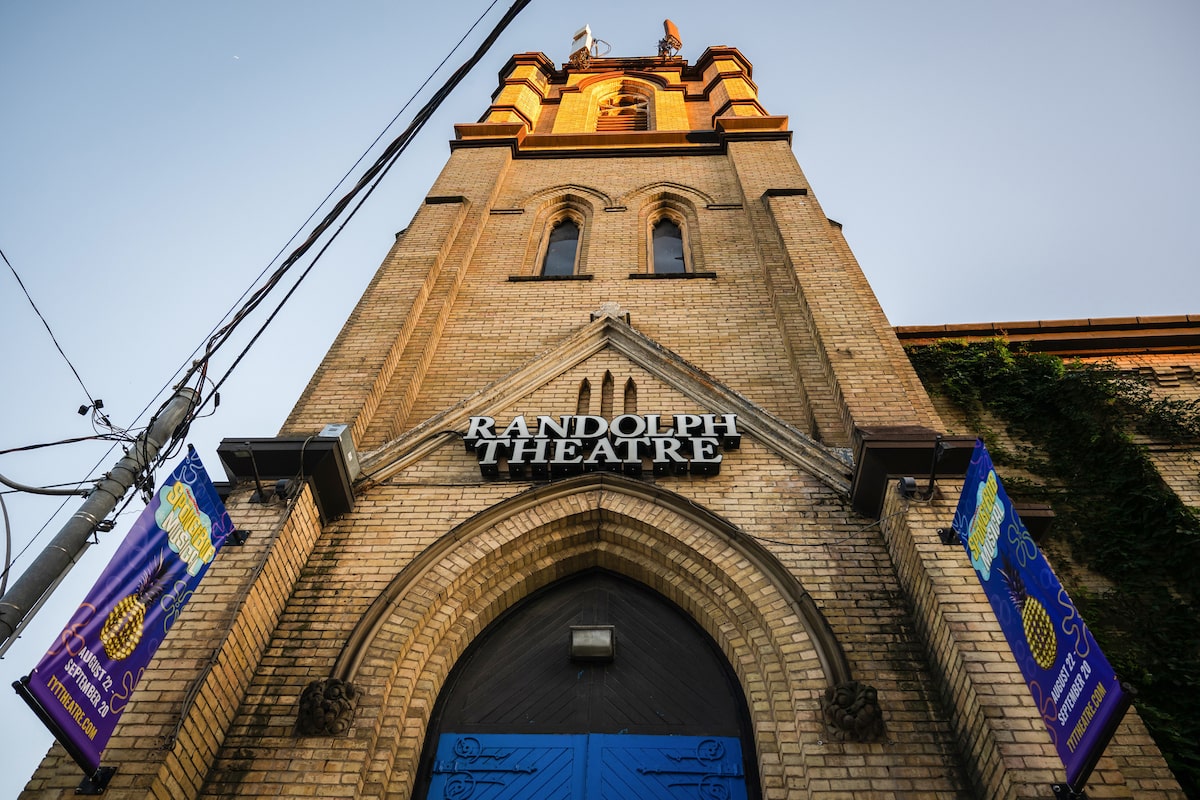
Randolph College for the Performing Arts in Toronto on Thursday.Laura Proctor/The Globe and Mail
Randolph College for the Performing Arts, a private career college in Toronto specializing in musical theatre, dance and acting, has closed after failing to renew its accreditation with the Ministry of Colleges, Universities, Research Excellence and Security.
On Tuesday, 86 enrolled students received an e-mail from MCURES stating that the theatre school, whose alumni include Paul Nolan, Amaka Umeh and Matt Raffy, can no longer operate as a career college.
In the e-mail, whose subject line includes the phrase “Notice of Closure,” students were told they can either continue their studies at a different school or receive a partial refund for fees paid to Randolph.
In a statement, Bianca Giacoboni, a representative for MCURES, confirmed that Randolph has not been permitted to offer vocational programming since Feb. 1, owing to “their failure to submit a complete application for reaccreditation as a career college.”
“Any failure to comply with the requirements under the Ontario Career Colleges Act is unacceptable and will be met with enforcement action from the Superintendent,” Giacoboni said.
The institution, located at 736 Bathurst Street, was founded in 1992 by George Randolph, who in 2017 formally resigned from the school after an independent investigator found that he had engaged in “unwelcome comments and physical gestures.” However, Randolph did not entirely depart the institution: In an e-mail, he said he had retired from the school’s day-to-day operations, but continues to serve as vice-chair of the board of directors, a position he has held since 2019.
Randolph added that the school is currently being run by a group of volunteers and board members. When asked why the school had lost its accreditation, he said it had switched auditing companies, “which took longer than anticipated.”
After losing its status as a college in February, the school continued to offer instruction to students via “non-vocational” workshops, said former program manager Erynn Brook, who left Randolph in early May. According to documents seen by The Globe and Mail, the workshops closely mirrored the school’s typical curriculum.
However, according to MCURES, in Ontario, an institution cannot provide a vocational program that exceeds 40 hours of instruction and costs more than $2,000, unless it is registered under the Ontario Career Colleges Act and the program has been approved.
O’neil Edwards, who was listed as the school’s executive director until Aug. 20, said students were not charged tuition for the workshops. Randolph said that students’ financial circumstances varied: The school did receive some tuition payments after Feb. 1, he said, but only for classes students had already taken. The school’s advertised tuition is $13,000 per academic year.
In an Aug. 26 e-mail shared with The Globe, an investigator from MCURES told incoming students that “there is no legal category of ‘unaccredited school’” that permits the delivery of vocational training outside the requirements of the Ontario Career Colleges Act.
The e-mail also reaffirmed that Randolph’s vocational diploma program will not operate in September, “as they are not registered and there is no present timeline for registration or approval.”
Both Edwards and Randolph said an application for recognition as a private career college has been submitted to the ministry, and that the application is under review.
E-mails seen by The Globe suggest that as recently as this month, the college intended to welcome a new group of students in September. On Aug. 11, incoming students received two e-mails, both from the registrar’s e-mail address. One welcomed students to the school with information about the curriculum, as well as logistical details for a Sept. 2 orientation. The other message encouraged incoming students to follow Randolph’s student council on social media.
Brook and former Randolph Kids program manager Sarah Jean Hodkinson have also been involved in recent payment disputes with the school; both filed complaints with the Ministry of Labour, Immigration, Training and Skills Development in May. (Hodkinson, who left Randolph in April, could not speak to the current status of the school’s popular Randolph Kids program, whose website advertises a current enrolment of around 400 students.)
In his e-mail, Randolph acknowledged that “some staff and faculty” are owed compensation. “Due to regulatory circumstances, we were not permitted to collect tuition payments from students for our diploma program,” he said. “This created significant financial challenges and affected the College’s ability to meet its payroll obligations.”
In recent years, several postsecondary theatre programs, including those at the University of Windsor, Sheridan College, Humber Polytechnic and St. Lawrence College, have been reduced or shut down entirely. Across Canada, only a handful of schools, including Sheridan, St. Clair College and the Canadian College of Performing Arts, continue to offer musical theatre as a specialized course of study.
“This was a musical theatre school, in downtown Toronto, in an old building with two theatres in it,” Brook said of Randolph. “Nowhere else fits that description. The students saw shows every week at theatres across the city. And this was a really nice community.”