
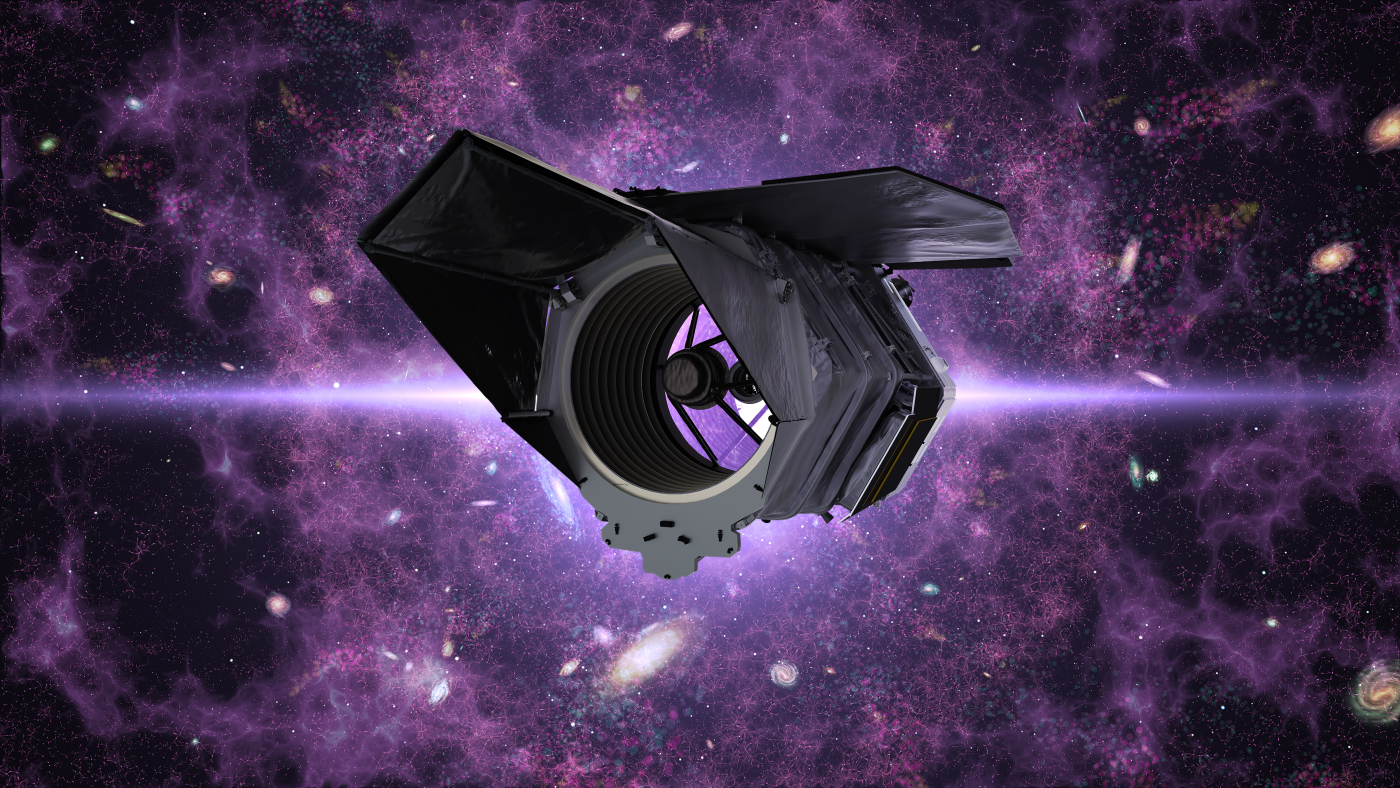
The Nancy Grace Roman Space Telescope is a NASA observatory designed to settle essential questions in the areas of dark energy, exoplanets, and infrared astrophysics.
Goddard Space Flight Center Scientific Visualization Studio/NASA
hide caption
toggle caption
Goddard Space Flight Center Scientific Visualization Studio/NASA
The new Nancy Grace Roman space telescope is slated to launch this weekend. It was originally built for the National Reconnaissance Office as a spy satellite, but was never launched. Instead, NRO gave it to NASA about 15 years ago. After some major modifications, it’s set to begin its five-year mission peering at new supernovas, distant galaxies and planets orbiting stars outside our solar system. It should help scientists get a better understanding of the mysterious force known as dark energy – which will tell us about the fate of the universe.
If you liked this episode, check out Regina’s reporting demystifying the mysterious red dots spotted by the James Webb Space Telescope.
Interested in more space news? Email us your question at shortwave@npr.org.
Support public media with NPR+ and enjoy perks for over 25 podcasts like this one. This show’s perks include sponsor-free listening. Learn more at plus.npr.org.
Listen to Short Wave on Spotify and Apple Podcasts.
This episode was produced by Berly McCoy. It was edited by Rebecca Ramirez. Tyler Jones checked the facts. The audio engineer was Jimmy Keeley.