
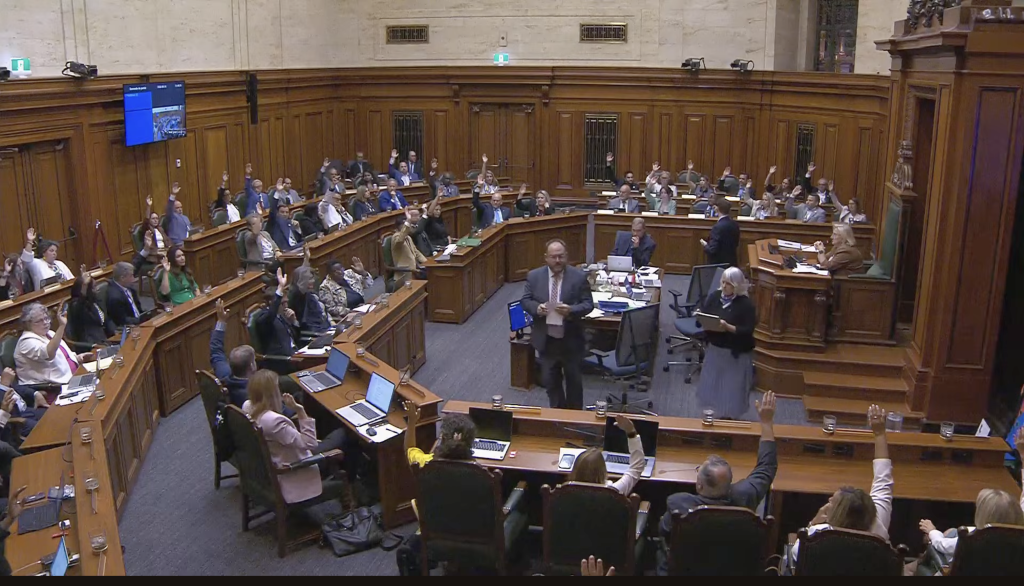
On Aug. 24, Montreal City Council adopted a motion expressing solidarity with Palestinians and all civilians affected, and supporting international investigations into genocide claims and human rights violations, acknowledging that International Criminal Court arrest warrants have been issued for Israeli leaders, and that Canada placed sanctions on Israel.
But divisive sections of the original motion, which accused Israel of genocide and apartheid and would force the city to cut ties with Israel, were removed.
The 54-6 vote came after six weeks of campaigning by Jewish groups, business leaders and allies in the city’s Hellenic, Christian and Italian communities, who sent letters and petitions with hundreds of names to the lawmakers, opposing the anti-Israel rhetoric.
Ahead of Monday’s council meeting, Mayor Soraya Martinez Ferrada and her team worked behind the scenes to cut those parts out of the motion and negotiate a final version. During the debate, she said the city stands in solidarity with Palestinians and an eventual Palestinian state, and recognizes the grave humanitarian crisis—but she also urged her fellow politicians to focus on issues that unite residents of their city.
Some Jewish leaders are calling the final wording “a win”, but unease remains.
On today’s episode of The CJN’s North Star podcast, host Ellin Bessner speaks with Paola Samuel, the regional director of B’nai Brith Canada, who was in the council chamber that day and was deeply involved in the campaign to block the original anti-Israel motion.
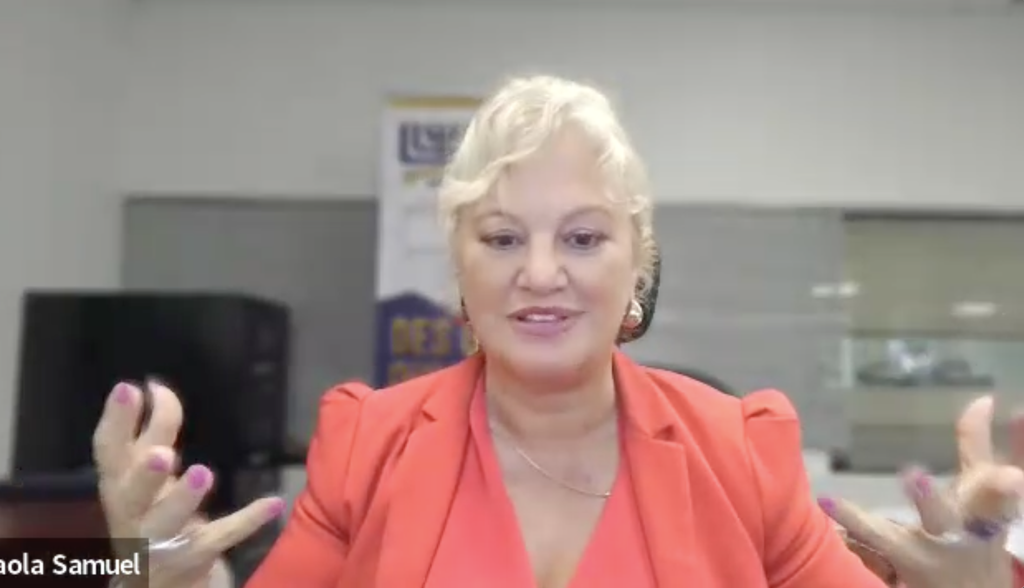 Paola Samuel held lead B’nai Brith Canada’s opposition to the “divisive” original anti-Israel motion from June, 2026. (The CJN photo)Watch The CJN’s North Star with Ellin Bessner and Paola Samuel on our YouTube channel:
Related links
Read more about the controversy surrounding the Projet Montreal motion, and what happened at city council on Aug. 24, in The CJN.See B’nai Brith Canada’s statement issued following the 54-6 vote on the amended motion.Find out why a kosher restaurant was burned to the ground in Montreal’s Jewish neighbourhood in early August, 2026, in The CJN.
Transcript
Soraya Martinez Ferrada: « Nous ne sommes pas la Cour internationale de Justice et nous ne sommes pas la Cour pénale internationale. Et nous ne pouvons pas nous substituer aux institutions internationales qui ont précisément été créées pour accomplir ce travail. »
Ellin Bessner: That’s Montreal Mayor Soraya Martinez Ferrada standing up at Montreal’s City Council meeting, urging her colleagues to remember what the role of Montreal City Hall actually is. It isn’t, she told them, to be indifferent to the suffering of civilians in the Middle East or to what she called the unprecedented humanitarian crisis in Gaza.
But she urged councillors to remember they’re not a substitute for the International Court of Justice or the International Criminal Court and shouldn’t be deciding what is or isn’t genocide or holding people in Montreal responsible for what she said governments, armies, and terrorist groups do thousands of miles away. Instead, she told them to remember the limits of their roles and work to make Montreal a place where all communities affected by those conflicts can live together and try to have a dialogue.
Her speech came during a fraught council session where they were preparing to vote on a motion presented six weeks earlier by the opposition party Projet Montréal.
That motion would have had the city condemn Israel as committing genocide. It would have labeled Israel an apartheid state. And would cut Montreal’s institutional ties with Israel.
Jewish groups feared the motion would further inflame what has already been nearly three years of difficult times since October 7th, 2023 with Jewish schools shot at, synagogues firebombed, Jewish people beaten on the streets, and violent anti-Israel protests outside Jewish student events, places of worship, and community offices.
Over the summer, opponents of the original motion signed petitions and sent letters with hundreds of names to Montreal lawmakers. The opponents included the Jewish community, but also prominent non-Jewish politicians and academics, business leaders and allies from the city’s Greek, Italian, and Christian communities.
So the mayor introduced her own version without the genocide and apartheid wording and without the call to cut ties with Israel, and it passed. 54-6.
Paola Samuel
To us, that was one of the most important things is “Just let’s calm things down. Let’s not add gasoline to this inferno”. So on that side, it was a win. But are there things that we don’t want? Of course! We didn’t want the motion at all.
Ellin Bessner: I’m Ellin Bessner, and this is what Jewish Canada sounds like for Friday, August 28th, 2026. Welcome to North Star, the flagship podcast of The Canadian Jewish News, made possible thanks to the Ira Gluskin and Maxine Granovsky Gluskin Charitable Foundation.
Although the pro-Palestinian groups behind the original motion call what happened a victory for their side, because the new motion does express solidarity with Palestinians and all civilians affected by the conflict, and there’s some other language in there too that they like, Jewish leaders say the mayor and council showed leadership by ratcheting down the temperature. by taking out the most contentious demands of the original wording. And the mayor allowed a free vote by members of her own party.
Former journalist Paola Samuel was in the council chamber during the meeting. She now represents B’nai Brith Canada. She’s their regional director for Quebec and the Atlantic provinces, and she joins us now to talk about what happened behind the scenes and what happens next. Paula, welcome to The CJN’s North Star.
Paola Samuel: It’s good to have you. It’s great to be here.
Ellin Bessner: Thank you. You were there all day Monday. Let’s give a little bit of the sound and color. What did you see and what did you hear that you think are people who weren’t in there should understand?
Paola Samuel: My team and I got there. We decided to get there early.
We got there around noon because we knew that there were crowds gathering. So there were two actually separate demonstrations. There was the protests leading up to the council meeting that started probably at 11:30 a.m. and gathered on the side of the city council, and then the mayor, Soraya, came out at 1 to do a press conference, and part of it is because it was the first session since the summer break. It was a complicated day because we had no idea what the new version of the motion would be.
We knew that they’d been negotiating. We knew that they called two emergency caucus meetings on the Sunday. So we knew that the council had been in negotiations all day Sunday, but we had no idea what the new version of the motion was going to look like.
We knew that they were probably going to take out apartheid. They were going to take out genocide, but maybe replace it with war criminals? Like we had no idea. So we didn’t even know what we were there to lobby for or to, you know, try and, and we just want to have a presence there.
And so when she came out at one, she obviously was asked the question about the motion, and she was very clear in that press conference saying that that this is not the purview of the city council.
This is federal jurisdiction.
And so we thought, OK, is this good or is this bad? It should be. So we didn’t know. And the other thing that was very interesting was, people, the reporters, the journalists were saying “the anti-Israel motion”, and she said it’s not anti-Israel, it’s pro-Palestinian.
So right there we’re thinking, what does that mean? So really that was the start of a very, very long day.
Ellin Bessner : You said there was a protests outside and we know that this was the supporters of that original motion, but was the Jewish community and their allies there too?
Paola Samuel: So the Jewish community and the allies came later on and they came out like in full force. The protest that went from 11:30 to 1:30 or whatever it was, the usual suspects. It was, you know, “Intifada, River to the sea”, the stuff that we’ve been hearing for almost 3 years now.
And then there were some things like there was an Israeli flag, in other words, the two blue bands, and instead of a Magen David in the middle, it was a toilet, right? I said I tried to show, I’m, like, this isn’t for anyone, it’s against Israel.
And I’ll say something because I do want to mention this, unexpectedly, because we were there so early, we were there when they honoured the policeman who was shot down. In the shooting right around the corner from our office. And the whole family was there.
And this is a Muslim policeman who was very close to the Jewish community. In fact, he was one of the policemen who marched with us regularly on the Sunday marches for the hostages and the family was there and it was heartbreaking and devastating, but we were able to honour him with them. And that was a really unexpected, you know, thing that happened.
Ellin Bessner: It came after a hot, horrible summer for the Jewish community in Montreal. You mentioned the shooting earlier in the summer where not just the police officer was murdered, but so was a beloved member of the Jewish community in the wrong place at the wrong time at PA outside the grocery store across from the Hilton up the street in Snowdon. Then they had the Noam. Which is not supposedly antisemitism, but still traumatized the Jewish community, the restaurant that was burned down.
Then this motion is on top of all of this. You know, when B’nai Brith was opposed to the wording, it comes in context. Why did the city take security measures in the council chambers and outside to keep this kind of decorum and tell us what you saw?
Paola Samuel L So I’m going to actually add to what you cite about the summer. The summer has been an unprecedented summer of antisemitism, and I’ll add to that the CF Montréal, our, our beloved (football) soccer team.
There was an incident where the ultra fans were throwing things and insulting an Israeli player on the opposing team, and then it came out with their investigation and CF Montréal called it acts of antisemitism.
There was the incident with the woman and the Jewish family at Park Lafontaine, where he’s saying “My children are afraid of dogs. You’re not allowed dogs,” and she said “Jews aren’t allowed here”, and she went on to an antisemitic rant.
You know, there was, there was in the early summer, late spring, there was the attack on the Temple Emanu-El in Westmount. I mean, I could, we could spend a half hour going through all the different things that happened in person and online. And so we know, you know, in terms of data and the B’nai Brith numbers and the how we watch, and I’m sure as you’ve seen, we know that when things get really heated online, they start manifesting in real time in on the streets.
And also don’t forget that they tried to present this motion in June. So, on June 15th was the first time, and Soraya was able, she decided on a technicality to table it. And I think you had to have three weeks ahead of time, and it wasn’t the three weeks, and so she was able to say, “We’re not doing this at all”, just to try and calm things down for the summer.
Things didn’t calm down for the summer. In fact, it got, you know, more heated.
And I think the extra police were there for several reasons. First of all, in June, it had gotten really heated inside the hall of City Hall, where a lot of [pro-Palestinians] were throwing insults and screaming in the hall, etc. and I, I don’t know if it was intentional, but there was a lot of people that were not let in.
There were a lot of, we came in early and then you can’t see what’s going on downstairs. But there were a lot of people that were in line that were too late, but there was a lot of people who were not let in as well. And there was a lot of security and a lot of police. We felt safe. Let me put it that way.
Ellin Bessner:
But outside leaving, later on, I did see some things, online, where people felt they were being threatened by the protesters who stayed outside. D you witness that?
Paola Samuel Oh yeah, if you, if you look at my, my socials and my reels, I went through it. In fact, so the crowd kept changing, right? The crowd was the people trying to get in, then they were upset, then they were, we heard there were hundreds, then it was 100, then it was.., but then some people left.
By the time we left, – we stayed till the very end– so it was close to 11 o’clock at night, and one of the city councilors, we were walking down, there’s only one exit that you can go to, and he said, “Are you ready?:
And I said, “Ready for what?” And he said, “They’re out there”, and I said, “They’re out? They are still?”
The doors are quite thick, so you couldn’t really hear them, and I have a feeling they were just waiting for people to come out.
It’s not like they were protesting, they were just waiting, and the minute, it was myself, one of my colleagues, one city councillor, and then other people who were just leaving, they could have been people who worked there. The minute the doors opened, first, the first thing we saw was 4 or 5 policemen guarding the doors, and the minute they started with the bongos and “Shame” and “Free Palestine” and “Child killer, baby killer, shame on you, shame on you!” as soon as the doors opened.
Paola Samuel: There was a young kid there who’s screaming, if you’ve seen my video, who’s screaming “Shame, shame, shame, baby killer, baby killer”, and I walked away, and all of a sudden I turned around and I see this police following me because they were following me. People from the crowd were following me, so they had to actually escort me to the corner of the street to get out of that crowd.
It was I, you know, I don’t even know how to describe what it was. It was hateful, that they’re not, as I’ve said many, many times, and I’m sure you’ve said as well, these protests are not for anything.
They are against everything. They are against Israel, they are antisemitic, they’re against Jewish people. They spill hate onto our streets, and they’re only there to intimidate, like the only thing these people are doing, we’re trying to intimidate.
Ellin Bessner: Let’s go back to the actual motion that was finally amended and passed.
Are you at B’nai Brith happy that this was the result with sort of, I said watered down in my intro, but it was still a motion, talking about the Middle East. And so how, how does B’nai Brith feel about this?
Paola Samuel: We’re, our position has been from the very beginning that this motion should never have been, in a position like they, it should never have moved forward to the point where there was all this debate. There were all these letters being sent. It shouldn’t, she should have shut it down in June and said this is not the purview of the city council, period.
That’s our position. Now, once that we knew that they were going to bring back this motion, our fight was to take out the most egregious elements. That was apartheid, genocide, and cutting all institutional ties with the Israeli government, which meant that the Israeli consul general could not walk into city council. I mean, it was madness.
And those were the three most important things. And all of them got taken out, all of them. It wasn’t just watered down, it was also rewritten and, you know, things were crossed out and softened and like there was just all different things. And what it became was similar to what Soraya had said at the beginning of the city council meeting in June, which was she had put out a statement saying, “Our job is to unite the city. We’re city council. We represent all Montrealers. having said that, all Montreal, many Montrealers have connections to the Middle East, whether you’re Palestinian, Israeli, Iranian, Lebanese, Syria”, like she went down a whole list, and “So we stand with all of them and all the things”.
That’s what this motion turned out to be. Some people are spinning it as a pro-Palestinian motion.
I wouldn’t call it. I, if you look at the details, really they’re talking about everyone, but it was a motion that started as an, I call it anti-Israel, motion.
Ellin Bessner : So can I dig down a little bit because some of the wording, I’d like to push back a bit. Some critics have said that it isn’t a win completely, because they’re still saying “We support the investigation by the International Criminal Court and sanctions on Israeli actions”.
Paola Samuel: So I, I’ll take it actually one step before we even saw the motion. The other big thing that was jarring to hear:
There were 3 speeches, so in this debate, it wasn’t really a debate, it was 3 speeches by Projet Montréal, the 3, there was Alex Norris, and the 2 others who were part of it, their speeches were so filled with inaccuracies, fallacies, lies, talking about genocide. Alex Norris said it’s the only first genocide in world history where we watch a genocide in real time, like this kind of rhetoric that was being said in city council.
Ellin Bessner: I heard on one of that, it wasn’t him, it was someone else. Is it true that they said that 1,200 Palestinians were massacred on October 7th?
Paola Samuel: I say that we heard that. I think she said it. I don’t think she said it on purpose. I’m not going to defend her, but I think it was a mistake because she was talking about October 7th devastation.
But you know what, “We all said, ‘Didn’t she, did she just say Palestinians instead of instead of Israelis?’
I don’t know, I don’t know. It’s on the record. So there’s that part, right? And there’s what they were saying, and it was just, it, you know, it was like talking points. That’s what it was, talking points that they were saying, and also what it showed to me is this, this obsession with Israel in the city council, like, why?
Why is all this concentration on this one little country? Why aren’t they talking about the Iranian regime? Like, I mean, why aren’t they talking about trying, you know, we’re going to go down that line. So there was that part that was very disturbing, quite frankly, to hear those speeches.
And then the other part is, yes, of course, there are things in there that we don’t agree with at all, but the biggest things we had to worry about were those three things, and because we knew the motion was going to go through one way or another, the biggest things we had to worry about was what are they going to do? What is the watered down version? And are they taking out those, those are the three main things that were the most important things, and they took it out.
Now, I’m going to tell you that that the 54-6, was it? Six wouldn’t vote for it. And it was also we’re talking about Sonny Moroz, Leslie Roberts, all our allies.
Ellin Bessner: In Jewish neighborhoods?
Paola Samuel: Right, right, Stéphanie Valenzuela, who’s the mayor of NDG_Cote des Neiges, who also is the mayor where the shooting happened, right?
Because they didn’t believe that it was the purview of the city council to present this motion, period.
Ellin Bessner: Do you give kudos to the new mayor for trying to set a different tone than Valérie Plante would have had?
Paola Samuel: Kudos to the mayor for standing up. I don’t know if you had an opportunity to hear the speech and your listeners, if they have a chance to listen to the speech that she did in city council. So what happened was that it was the time for the debate. Three of Projet Montréal, which is the opposition party, spoke, and that’s what we were talking about.
They were talking about genocide. One of them said Palestinian instead of Israeli. That was then. Then nobody from Ensemble Montreal spoke.
Only the mayor stood up, and she did a speech which I thought was impressive. She very clearly stated that – this is a woman, don’t forget, who is a former federal minister – so, what is a huge asset for Montreal is that she fully understands what city council can and cannot do, and what belongs in the federal.
We can’t even compare it to Valérie Plante. Valérie Plante? I mean, the things that were allowed to happen on our streets after October 7th, that I don’t think she quite frankly understood. Soraya is a very different person and a very different leader, and she was very clear that this is not our purview. We represent Montrealers and we were elected to bring the city together. And one of the biggest arguments that we had put forth since June is that this is going to divide the city, and they campaigned on uniting the city.
And there’s nothing about this motion that will unite the city. And we knew that if any of those things passed, it would be, it would be a green light for people who target the Jewish community, to continue to target the Jewish community.
You know, I know you know, Ellin, that we are in a crisis of antisemitism. B’nai Brith has called it a crisis of antisemitism for a while now, and we have seen it in our city spill over onto the streets nonstop this entire summer. So, for that part, it’s a win because it brings the temperature down. And to us, that was one of the most important things is just, let’s calm things down.
Let’s not add gasoline to this inferno. So on that side, it was a win, but are there things that we don’t want? Of course, we didn’t want the motion at all, but that part is a win.
Ellin Bessner: But Projet Montréal says they’re not going to stop. What do you predict happens next?
Paola Samuel: So Projet Montréal was never going to stop, whether this passed or not. No, it was the opposite. They would be like, “OK, now we have this. Now we’re going for the next thing. Now we’re going for the next thing.” What Projet Montréal does or doesn’t do really isn’t my concern. They are a minority in the city council, Ensemble Montréal, that is the sitting government, is the majority, and they have a very comfortable majority.
There are extremists in that party who will always try to bring the subject back rather than the city, but back to Israel, and they’ve been doing this for years. This is not new, and so it’s, it was never going to go away, but it has calmed things down.
Ellin Bessner: OK, so what happens this week? I know that there’s an agglomeration meeting and they’re going to maybe have a motion that condemns antisemitism, right?
Paola Samuel: So that’s the Cote St. Luc motion, and they debated it in city council, because there’s an agglomeration part of the city council meeting, when it’s a full city council meeting like this, and then there’ll be the agglomeration meeting, I believe Thursday night. And Projet Montréal came out with all the same arguments. I have to tell you, like the like antisemitism, anti-Israel, it’s the same arguments that they bring up over and over again, but the fact that that Projet Montréal, counselors in Projet Montréal would argue against something like that, tells you everything you need to know.
Ellin Bessner: Where does this put Canada on the map in terms of world attention to how this Middle East conflict has divided city council?
Paola Samuel: We know that we are, from data, this is not, you know, this is not just chatting with people. We know from the data that we have, that we are, we make up as Jews 1% of the Canadian population, and we are the target of 70% of religious-based hate crime. So, already we are in a place where we never thought we were going to be, OK? I would say that this motion just added to everything else that has been happening in the past 2.5 years, and quite frankly, this summer has been…I don’t think in terms of my colleagues have been a across the country, I don’t think we’ve had to deal with so much antisemitism, actual physical acts we’re talking about now. Because as we’ve said, that it grows online and it over. It manifests as it grows online and we’ve seen it grow to to record numbers online, antisemitism spills over into the real world, right? So I think we’ve already been a spotlight of antisemitism, out of control in North America and I think it shocks people because it’s Canada, right?
It’s Canadians. That’s what everyone’s says. I don’t understand. It’s Canadians. You say sorry about everything, you know? that’s the line that we get all the time.
So, there’s already been this huge spotlight and the fact that after Bondi, let’s not forget this.
This is very important, that this has nothing to do with the motion. After Bondi, CSIS came out and said that we up in Canada, it is not unlikely that something like Bondi could happen. And when I hear that, I think Montreal or Toronto? Because to me, it’s an unfortunate race. Montreal is the worst, then Toronto is the worst, then Montreal.
So it’s depending on what’s going on.
So the motion just added to everything that has been going on and has been escalating since October 8th of 2023, which is why we’re relieved that they took out apartheid, they took out genocide, they took out cutting all ties with Israel, it becomes a motion that you can argue is not great. It isn’t great, but it’s just a motion. It doesn’t do anything.
So, I think the world is already looking at Canada and saying “What on earth is going on?”.
And this just added to it, but the fact that it didn’t pass is a huge testament to that we have leadership that is looking at this properly and not just reacting emotionally. And so that is that to me is it gives me, it gives me some sort of it gives us the ability as a community to breathe a sigh of relief, not because the motion is not harmful because there are things in there that are, but because the biggest part of it, which wasn’t even reworded, it was taken out completely.
But I think we’re already being spotlighted.
I mean, us and Australia, you know?
It’s an unfortunate thing to be. I don’t know many people who aren’t immigrants, as Jews, or who aren’t like recent or recent immigrants. I’m a first generation Canadian. My parents were chased out of Egypt and came to Canada. They loved Montreal and that is our goal, is to bring Montreal back.
And I think when we hear those words from Soraya, it feels like she’s trying to do that, too, to bring Montreal back to what it was, which was this multicultural, multilingual, everyone loves everyone’s culture. Culture city. That’s the Montreal that my parents came to and what we were born and raised into that has disappeared in the past few years.
Ellin Bessner: Well said. And it’s been great to hear a firsthand view, frontline view. Thank you for joining us on The Canadian Jewish News North Star podcast. We’ll speak again.
Paola Samuel: It’s my pleasure.
Ellin Bessner: And that’s what Jewish Canada sounded like for this episode of North Star made possible thanks to the generous support of the Ira Gluskin and Maxine Granovsky Gluskin Charitable Foundation. North Star is produced by Zachary Judah Kauffman with Izzie Helenchilde. Michael Fraiman’s our executive producer, and Alicia Richler is our editorial director.
Thanks for listening.
Credits
Host and writer: Ellin Bessner ( @ebessner )Production team: Zachary Kauffman (senior producer), Izzie Helenchilde (producer and video editor),l Michael Fraiman (executive producer), Alicia Richler (editorial director)Music: Bret Higgins
Support our show