
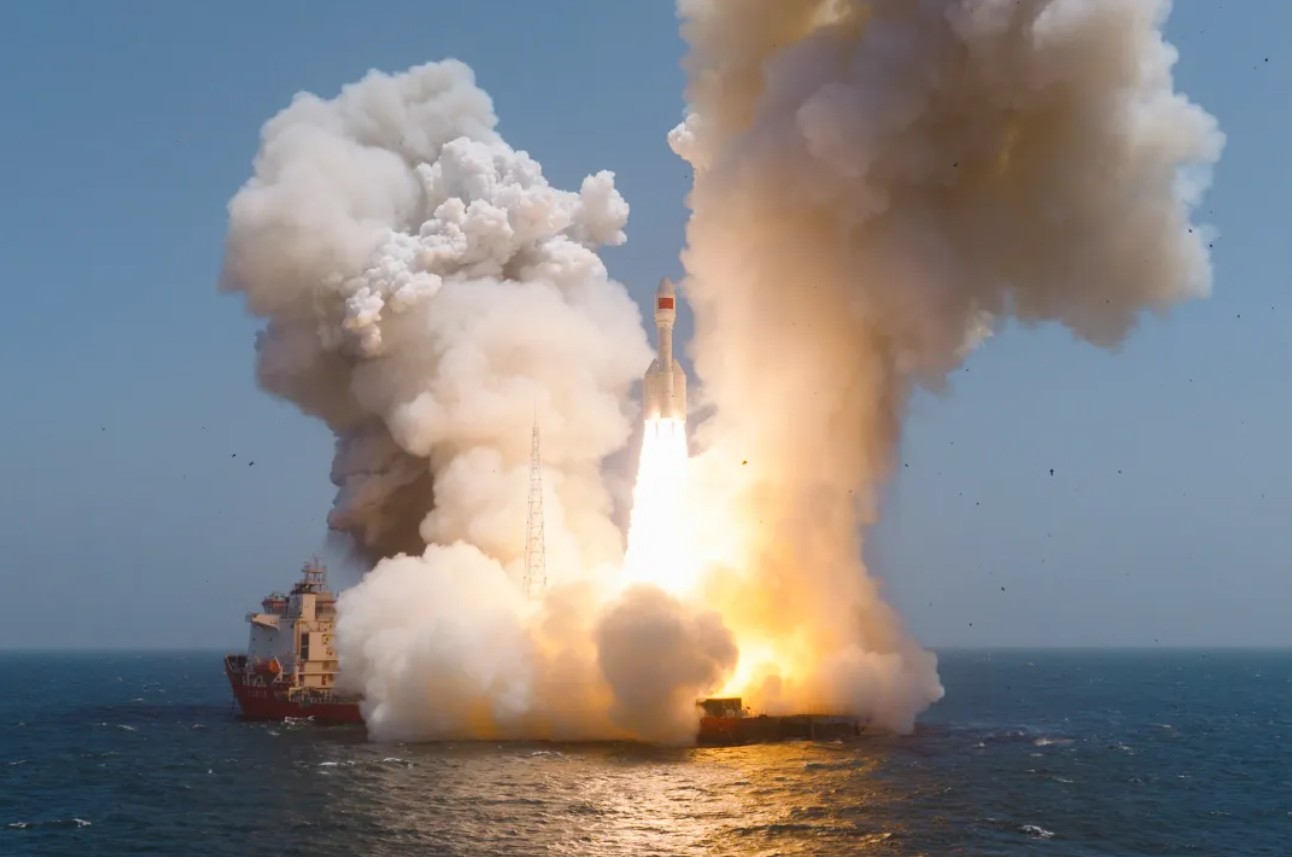
HELSINKI — Shanghai has begun construction on a wharf intended to connect a planned commercial rocket manufacturing hub to sea-launch operations, according to Chinese commercial space sources.
The Linzang Road wharf, on the north bank of the Huangpu River in Shanghai’s Minhang district, will handle rocket rollout, dockside loading and river-sea transfer once complete. The wharf’s construction permit was reportedly issued in early August, with completion targeted for early 2027, according to an industry newsletter report of an Aug. 27 project meeting.
The development is a piece of Minhang district’s planned “Rocket Star City,” a 9.3-square-kilometer commercial space cluster announced in January, part of a plan to create a 100 billion yuan ($14.9 billion)-level space cluster by 2027. The plan targets 80 rockets and 200 satellites in annual production by 2027, rising to 150 rockets and 500 satellites by 2030, according to Shanghai’s municipal government. Minhang district officials confirmed the wharf project’s existence and rationale in earlier remarks to Chinese financial outlet Jiemian News, saying river-sea transport would remove the diameter constraints of overland rocket transit.
Once operational, the wharf would let Shanghai-based rocket makers complete final assembly locally, then ship finished vehicles either to a sea-launch platform off Shanghai’s own coast or onward by sea to established spaceports, including Haiyang in Shandong—which facilitates sea launches and is building a fixed pad—the national Wenchang spaceport and HICAL’s Hainan commercial spaceport on Hainan island, and a planned spaceport at Yangjiang in Guangdong province. In July, commercial launch firm Orienspace launched a Gravity-1 rocket from waters off Shanghai, supported by Haiyang’s sea launch facilities, apparently verifying the validity of such launch operations.
Shanghai first laid out ambitions to build a commercial space hub in a 2023 municipal action plan targeting 50 rockets and 600 satellites annually by 2025. The January 2026 “Rocket Star City” framework supersedes those targets, including 150 rockets and 500 satellites by 2030. The state-owned China Aerospace Science and Technology Corporation (CASC) will play a central coordinating role, fostering growth across the commercial space ecosystem, according to reports.
China has three inland spaceports, at Jiuquan, Taiyuan and Xichang, the coastal Wenchang spaceport, and a sea-launch hub at Haiyang, Shandong province. Commercial sites are planned for Yangjiang and Xichang, with other projects such as Ningbo mooted.
China has already repeatedly set new national launch records consecutively across multiple years, with mass to orbit also greatly increasing year-on-year. China recorded 92 launch attempts in 2025.
This acceleration comes even as the expansion of spaceports, such as the commercial zone at Jiuquan and Hainan commercial spaceport, and the debuting of new commercial and state-owned launch vehicles continue. China is reported to be aiming for well over 100 launches in 2026, having recorded 60 orbital launch attempts at time of reporting. Much of the acceleration will be driven largely by China’s Guowang and Qianfan megaconstellations, with the latter an initiative backed by Shanghai. Galactic Energy plans the first launch of its Pallas-1 launcher from Jiuquan’s commercial zone no earlier than late Aug. 31 Eastern.
Related