
Staff: 7th2025: 11thReaders: 7th
“Once a guy like this gets his shot, he could seize it and run with it.” That quote is from Silver Seven’s own Ross Arnold in his T25U25 entry for Stephen Halliday last year, where he ranked 11th on our board. Halliday got his shot in 2025-26 and certainly made an impact, playing 30 games with the big club across a couple of stints and making a strong case for a full-time lineup spot in 2026-27.
Halliday started the 2025-26 season as the first line centre in Belleville, playing between Arthur Kaliyev and Xavier Bourgault. Halliday’s proclivity for passing the puck and setting up teammates meshed perfectly with Kaliyev’s shoot-first mentality and wicked wrister. The pair started the season hot for Belleville, with Halliday recording 16 points, 15 of those being assists in his first 15 games.
With a pair of assists on Saturday, Stephen Halliday is up to 11 points (1G, 10A) in 9 games to start the season.
Feels like just a matter of time before he gets a look in Ottawa when an injury opens the door.#GoSensGo pic.twitter.com/rIW0NLg9fI
— Sens Prospects (@SensProspects) November 3, 2025
Halliday’s strong start in Belleville combined with a minor injury to Ridly Greig led to him getting called up for the Sens’ California road trip in mid November and making his NHL debut against the Ducks. He played 5:28 in his first game, starting on the fourth line between Nick Cousins and Hayden Hodgson, while also getting a chance on the second powerplay unit. He made the most of his powerplay time, carrying the puck into the offensive zone and finding Shane Pinto for the tying goal in a game the Senators eventually won 3-2.
https://nhl.com/video/shane-pinto-with-a-powerplay-goal-vs-anaheim-ducks-6385388111112
After a strong debut performance, Travis Green opted to keep Halliday in the lineup and he would play effectively on the fourth line in Ottawa. Over the course of the 18 games he played between his initial call up and his return to Belleville, Halliday put up six points, all assists and posted strong play-driving numbers as his skill outmatched most of the opponents he was facing. Halliday’s possession numbers were strong, posting a CF% of 56.63% in almost 193 minutes of 5 on 5 play. As much as this showed how strong Halliday could be against lesser competition while playing in a fourth line role, it also shows off the strength of Ottawa’s depth. Despite the strong possession, Hockeyviz’s analysis reveals a player that still has work to do on both sides of the puck.
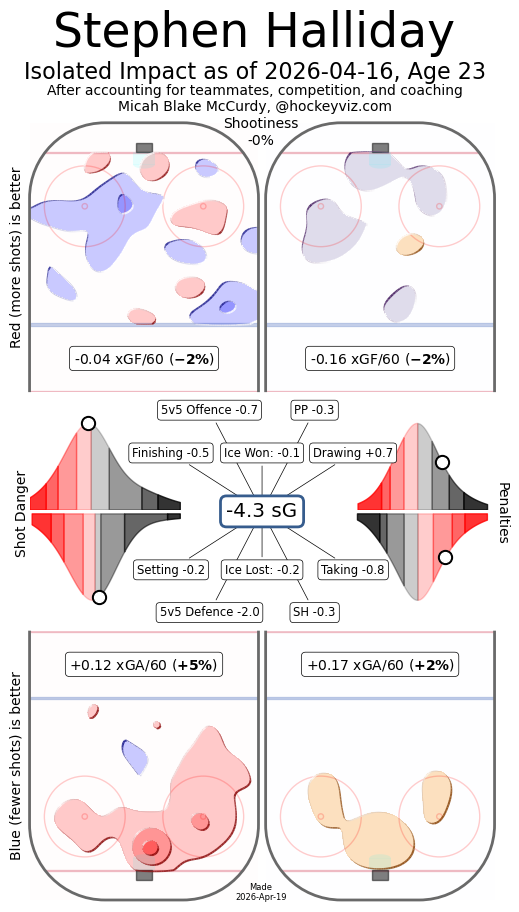
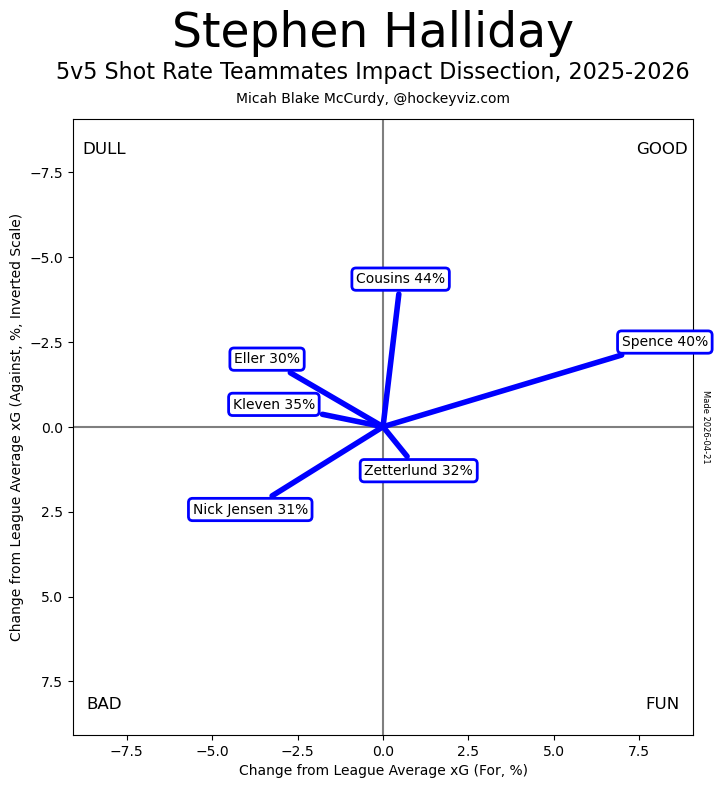
As with most offensively-minded rookies, Halliday’s defensive impacts are his biggest drawback, with many of his other qualities almost breaking even and his ability to draw penalties being slightly above league average. Halliday’s most frequent linemates over the course of the 30 games he played in the NHL were Nick Cousins and Fabian Zetterlund. As a fourth line player, his most common defence pair was Tyler Kleven and Jordan Spence, which helps explain his strong possession numbers listed above.
In early January, when Lars Eller returned from IR, Halliday was sent back down to Belleville, but played so well in his return (7 points in 5 games) that he was called up just weeks later. He played in each of Ottawa’s games heading into the Olympic break, including a game in Nashville against the Predators where he scored his first career goal digging for a rebound off an Eller wraparound.
Grab that puck!
Stephen Halliday pokes home his first NHL goal! 🙌 pic.twitter.com/rU37qfyRMM
— NHL (@NHL) January 23, 2026
While the NHL was off for the 2026 Winter Olympics, Halliday returned to a struggling Belleville team and was expected to inject a ton of offense into a sagging team. His stint in Belleville during the Olympic break was shockingly poor, as he only scored three points in 7 games, with Belleville going 1-6 in those games. He seemed slower and not nearly as dynamic as he had when played in Belleville earlier in the season, and that terrible stretch of games extinguished the faint hopes of a playoff berth in the Bay of Quinte.
The Olympics couldn’t have ended soon enough for Halliday, as he rejoined Ottawa for the remainder of the season. He played in the first three games after the break but then did not suit up again until April 12th, their second last game of the season and after the team had already secured their playoff spot. According to the Ottawa Sun’s Bruce Garrioch, Halliday was kept as the 13th forward and wasn’t sent down to Belleville because “the Senators didn’t want to risk injury and wanted to have him available in case somebody up front got hurt”. The fact that he did not play a game down the stretch when the playoffs were on the line demonstrated that Travis Green had, or maybe still has, reservations about Halliday’s performance.
From his play in 2025-26, it’s clear that Halliday has nothing left to prove in the AHL. 2026-27 is all about cementing his place in Ottawa’s lineup. Whether that’s as a fourth line centre or something more is up to him and the coaching staff to put him in situations that maximize his playmaking gifts. Earning the complete trust of the coaching staff is paramount to Halliday’s improvement next season and his development could be a key to the Sens taking that next step on the path to Stanley Cup contention.