
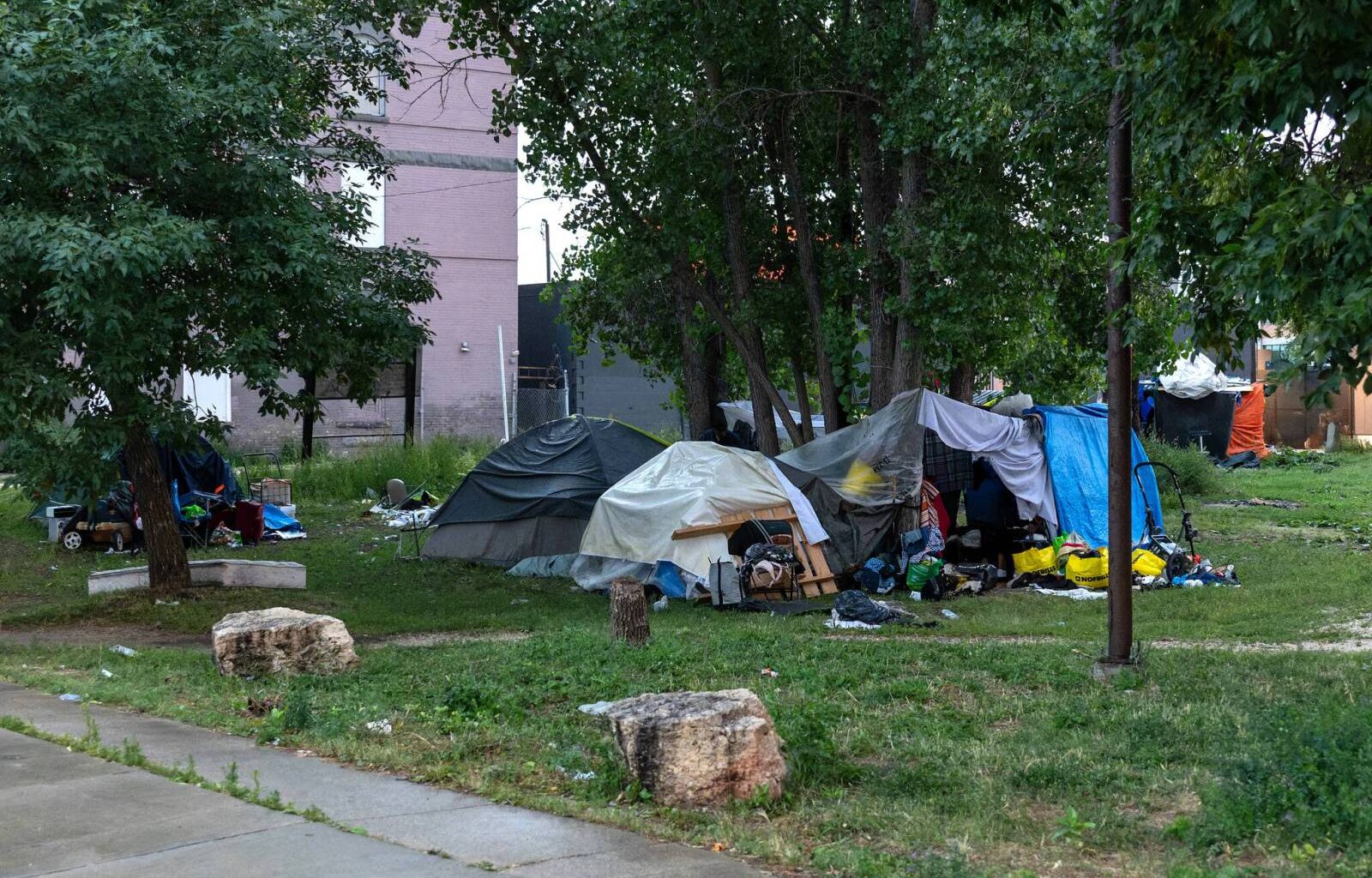
A tally by the City of Winnipeg shows the number of people in encampments has fallen by a few hundred since last September.
A Friday presentation to city council members shows 245 people lived in 72 encampments across the city in July, compared with about 100 encampments with 700 people in September 2025.
“There’s some good progress that’s being made … The number of people in encampments is less than half of what it was last year,” said Mayor Scott Gillingham.
ROBERT LEE / FREE PRESS FILES
A homeless encampment off Higgins Avenue last Wednesday. A recent tally by the City of Winnipeg shows the number of people in encampments has fallen to 245 people in 72 encampments across the city in July, compared with 700 people in about 100 encampments as of last September.
The city did not provide numbers for July 2025. It has previously noted the number of encampments tends to increase in warmer months, which has happened each month since February 2026.
The presentation was linked to the city’s encampment protocol, which prohibits them in many public spaces, such as playgrounds and schools. That ban is in effect at all times in those “sensitive” areas, with enforcement prioritized at camps at all other city properties during the daytime.
The mayor said the city is fully committed to supporting the province’s Your Way Home strategy, which aims to move people from camps into homes. The city presentation said more than 260 people have been housed directly from encampments, though it’s not clear whether that figure is provincewide or specific to Winnipeg.
Gillingham described the protocol as showing early signs of success.
“We’re making sure that parks, playgrounds, and those public spaces are available to the public again … (But) there’s no victory lap yet, there’s a lot more work to do,” he said.
At the end of June, the city said 141 encampments had been cleared since the ban took effect in November 2025.
Chris Brens, the city’s manager for community development, said the protocol has been gaining ground.
“We’ve seen hundreds of people move from encampments into housing, appreciating and acknowledging that there is a lot more work to do. But that is positive progress,” said Brens.
However, some councillors are disappointed in the results.
Coun. Cindy Gilroy (Daniel McIntyre) blames the policy for creating unwanted side-effects, some of which she says involve people who moved from encampments to homes.
“A lot of the housing, that transitional housing, you cannot use (drugs) inside those buildings. So, if they’re going to use, they have to go outside. That is (happening in) our bus shelters. That is (at) doorways to businesses. That is in our communities, outside, our places where kids are going to school,” said Gilroy.
She repeated her call for a designated encampment site, which could offer basic services to people who sleep outdoors such as toilets and garbage collection, at one central location.
“Some of these folks, they’re going to be very, very hard to house, and we need to find a designated area where we can allow them to camp until we can provide them the supports that are needed and encourage them into housing,” said Gilroy.
Coun. Sherri Rollins (Fort Rouge-East Fort Garry) said the latest data doesn’t show the full scope of the problem.
“We have … a failed policy on encampments where Winnipeggers have been told that we will vacate an encampment if it’s (within) 50 metres, (or) next to vulnerable infrastructure, or daycares, schools, etc., and that’s just not the case. We do not have the resources, and we haven’t for some time, with respect to outreach, with respect to even just garbage collection,” said Rollins.
“What Winnipeggers know is that if they phone 311 with respect to an issue around public disorder, in particular someone sleeping rough, that they’re not going to get an answer back, period,” she said.
Rollins said the city would likely need to invest a few million dollars more to fully address the issue.
The mayor said clear steps are included in the protocol for how encampment reports from 311, and all other sources, are addressed.
“When people call in, when a councillor calls in, there’s action from our staff. They start the process of identifying where the need is,” said Gillingham.
Winnipeg Free Press | Newsletter

Staff have confirmed they have the resources they need for the job, though a shortage of housing units can slow down progress, the mayor said.
He expects the police crackdown on open drug use will help address Gilroy’s concerns.
“We need to continue to enforce (that) … We’ve got an addiction problem on the streets of Winnipeg. We’re like every other major city in Canada,” said Gillingham.
joyanne.pursaga@freepress.mb.ca
X: @joyanne_pursaga

Joyanne is city hall reporter for the Winnipeg Free Press. A reporter since 2004, she began covering politics exclusively in 2012, writing on city hall and the Manitoba Legislature for the Winnipeg Sun before joining the Free Press in early 2020. Read more about Joyanne.
Every piece of reporting Joyanne produces is reviewed by an editing team before it is posted online or published in print — part of the Free Press‘s tradition, since 1872, of producing reliable independent journalism. Read more about Free Press’s history and mandate, and learn how our newsroom operates.
Our newsroom depends on a growing audience of readers to power our journalism. If you are not a paid reader, please consider becoming a subscriber.
Our newsroom depends on its audience of readers to power our journalism. Thank you for your support.