
Bird flu has quickly spread around Australia since it was first detected in mid-June.
As predicted, it spread from Antarctica to offshore Australia and then from beaches to inland waterways.
As of late August there are more than 350 confirmed events of bird flu, including several mass mortalities.
But hidden in the numbers are more than 20 distinct species of animal that have fallen to the disease.
According to Rachael Gray, a veterinary pathology researcher at the University of Sydney who has worked with the seals for decades, looking to the global environmental picture, what is happening “is quite frightening”.
“It’s pretty overwhelming at the moment,” she said.
“These animals, who we very much love and admire and respect … these animals are getting sick, they are suffering and then they are dying.”
So, which species have been infected so far and will vaccination be able to slow the spread?
Which animals have been affected?Mammals
One of the most concerning aspects of H5 bird flu has been its ability to infect a broad range of mammal species.
A long-nosed fur seal on Kangaroo Island was the first mammal on mainland Australia to die from H5.
Several species of seal, including endangered ones, are found across the south of Australia from Geraldton in the west to south-east Queensland.
Seals live in close proximity to many seabird species, which can quickly spread the virus around coastal regions.
Thousands of seals, across different species, have died in South America and the Antarctic region.
(Wikimedia: Bernard Spragg/Fur seal/CC0)
A dolphin in South Australia is one of the latest animals to test positive to H5 bird flu in Australia, and the first dolphin to die here.
Cetaceans — the group of marine mammals that includes whales, dolphins, and porpoises — have been hard hit by H5 around the world.
The virus has been found in six species of dolphins and porpoises in the US, UK, Sweden, Peru and Chile.
(iNaturalist: Common Dolphin/Fábio Olmos/CC BY 4.0)
Foxes, which are an invasive species found all around Australia from the desert to the coast, can pick up the virus from eating dead birds.
A red fox has tested positive to bird flu in Adelaide.
The remains of foxes which die from H5 can remain infectious for several days.
(iNaturalist: Mark Hura/Red fox/CC BY-NC 4.0)
Australian birds
A range of coastal and urban birds have been confirmed by CSIRO to be infected with the virus. There are also other birds suspected to have died from H5.
Greater crested terns have borne the brunt, with mass mortalities occurring in South Australia in early August.
The species lives in large colonies with up to thousands of birds in close proximity making it easy for the virus to spread.
Terns mostly live in coastal areas and venture offshore to hunt for food, where they may have been exposed to migratory seabirds with the virus.
But terns with H5 have also been detected in western NSW in freshwater systems.
(iNaturalist: leafymouse/Greater crested tern/CC BY-NC 4.0)
The silver gull — better known as a seagull — is the second most affected animal after greater crested terns.
Multiple cases have been detected across South Australia and Victoria.
Silver gulls can be found in nearly every ecosystem across Australia from the beach to cities and mountains.
They are a prime candidate for inter-species spread because they mingle with other species, live in colonies and travel to faraway locations.
(iNaturalist: Darcy Whittaker, Silver gull, CC BY-NC 4.0)
Australia’s larger seagull, the Pacific gull, lives along the southern coast.
Unlike silver gulls, which gather in large flocks, the Pacific gull is often seen alone or in pairs.
As scavengers they may pick up the virus by either stealing food from, or even eating, infected birds.
(iNaturalist: vbnt/Pacific gull/CC BY-NC 4.0)
Black-faced cormorants, which live along Australia’s southern coast, have been found with the virus in South Australia.
Mass deaths of other cormorant species due to H5 have been seen overseas.
(iNaturalist: Alexander Popple/Black-faced cormorant/CC BY-NC 4.0)
The pied cormorant is found in marine habitats, particularly in the south of Australia, and inland wetlands.
It breeds in small colonies close to water and food sources.
One event of a pied cormorant with H5 has been detected on Kangaroo Island, South Australia.
iNaturalist: Shaun/Pied cormorant/CC BY NC 4.0
Little penguins live in colonies along the southern Australia coastline from Perth to Sydney.
The virus has been detected in little penguins on Kangaroo Island, King Island and Phillip Island.
They are one of the few species where wild animals are receiving vaccines.
Mass deaths of several penguin species have occurred in South America and the Antarctic region.
(iNaturalist: Mick Morley/Little penguin/CC BY-NC 4.0)
The gannet lives in colonies along the Australian coast below the tropic of Capricorn.
So far, the H5 virus has been detected in bird in South Australia and Victoria.
Gannets have been hard hit in other parts of the world.
A European study has suggested gannet populations at two of the world’s largest colonies, in Scotland and Wales, were not expected to recover from the impact of bird flu until 2041 at the earliest.
(Wikimedia: Psuedopanax/Gannet/CC BY 4.0)
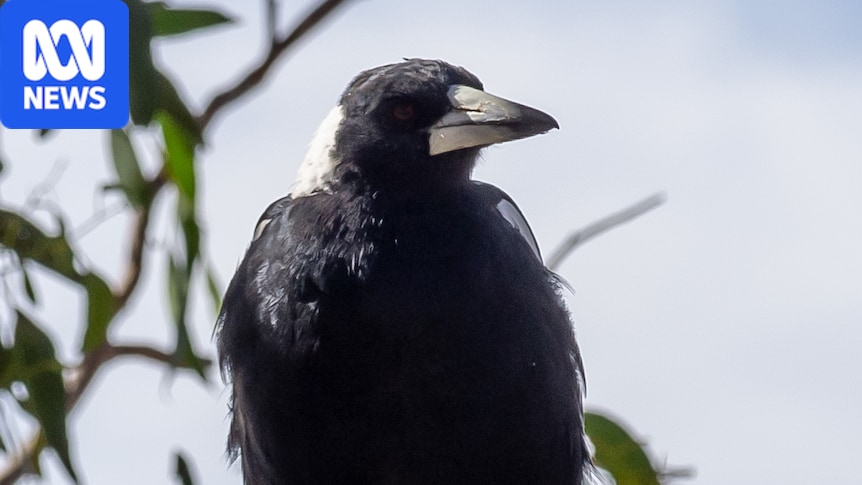
The Australian magpie, found across Australia, has had two positive events, both in Victoria.
The beloved bird is well known for its complex song.
They are omnivorous, and while they mostly eat insects and other invertebrates, they have been known to feed on dead carcasses.
(ABC Esperance: Andrew Williams)
Three species — little, forest and Australian raven — from this group of birds have been detected with the virus in Victoria and South Australia.
These clever birds are opportunistic scavengers and are likely to get the virus from picking at dead animals.
(iNaturalist: Bradley J/Australian raven/CC BY-NC 4.0)
Peregrine falcons are found across the world, and around Australia.
While some subspecies are migratory and travel long distances to breed, Australia’s peregrine falcons normally are relatively sedentary, particularly once they are adults.
The virus has been detected in a peregrine falcon in South Australia.
(iNaturalist: Kenja/Peregrine falcon/CC BY-NC 4.0)
Known by its boo-book call, the southern boobook or Australian boobook is the most common owl in Australia.
The nocturnal raptor is found throughout Australia. It hunts insects and small animals.
There is one event of a southern boobook confirmed with H5 in Victoria.
iNaturalist: Davgriff99/Australian boobook/CC BY NC 4.0
Migratory seabirds
The first cases of H5 in Australia were detected in seabirds which migrated in winter from the faraway subantarctic Australian territory of Heard Island and McDonald Islands.
The virus has also been detected in species that travel between Australia and New Zealand.
The brown skua is a large seabird that migrates from southern Australia, South America and the southern tip of Africa to the Antarctic to breed.
It eats fish, as well as other seabirds like penguins.
A brown skua was the first detection with H5 in mainland Australia. A second skua has been detected in Tasmania.
(iNaturalist: Oscar Thomas/Brown skua/CC BY-NC 4.0)
Both southern and northern giant petrels with H5 have been detected from WA to Queensland.
The two species look mostly similar besides a green tinge in the beak of the southern species and a red tinge for the northern one.
Giant petrels made up most of the first cases of bird flu in Australian states.
There are concerns that birds that mingle offshore over winter will take the virus to new locations like Macquarie Island and East Antarctica.
(iNaturalist: Ben Ackerley/Southern giant petrel/CC BY-NC 4.0)
The white-headed petrel is a small seabird that breeds on remote islands in southern oceans.
The species has a distinctive dark, almost black, eye patch, and a white head and chest.
The species was detected with H5 in a single event in South Australia.
(iNaturalist: Jacob Crisp/White-headed petrel/CC BY-NC 4.0)
Mostly found in New Zealand, white-fronted terns migrate to the south-east coast of Australia as juveniles, and travel back to breed.
The bird is considered “at risk” of extinction.
The species was detected with the virus in Tasmania.
(iNaturalist: Ian Coull/White-fronted tern/CC BY-NC 4.0)
Fluttering shearwaters are brown seabirds that mostly eat fish and crustaceans.
The species breeds in New Zealand then migrates to waters around Australia and the Solomon Islands during the non-breeding months.
One event has been reported in Victoria.
(iNaturalist: zielonagrucha/Fluttering shearwater/CC BY-NC 4.0)
Hutton’s shearwater is a seabird that breeds in New Zealand and lives in Australian waters the rest of the year.
Very similar to the fluttering shearwater, it can be distinguished by its dark grey “armpits”.
It is the only seabird known to breed in sub-alpine and alpine zones.
One event has been reported in Queensland.
(iNaturalist: Leo de la Rosa/Hutton’s shearwater/CC BY-NC 4.0)
Can wild birds be vaccinated?
It’s “nearly impossible” to vaccinate most wild birds, according to Julie Old, a native Australian animal researcher at Western Sydney University.
“They’re hard to catch, they fly long distances, and the vaccines that we’ve got need at least two injections about three to four weeks apart.”
Currently little penguins on Victoria’s Phillip Island and St Kilda are the only wild species targeted for vaccination, with aims to capture and jab 5,000 of the 40,000 penguins in the area.
But while the little penguins are wild, they return to the same spot each night, and as they don’t fly, they are relatively easy to catch.
Catching other species of birds may be impossible, or difficult and stressful for the animal, according to Michelle Campbell-Ward, a wildlife veterinarian at the University of Sydney.
“It can cause other risks to their health or wellbeing. That has to be factored in and planned extremely carefully,” Dr Campbell-Ward said.
Can mammals be vaccinated?
Unlike birds, there is no commercially available mammalian vaccine for animals like seals, Dr Gray said.
There have been some small overseas trials that used a vaccine that is modified for cattle in northern elephant seals.
“[Three seals] received the vaccination and three were controls, and they were able to show that there was an immune response to the vaccine, which is great.”
“But the logistics and the practicalities … to actually implement a vaccination rollout is really challenging in free-ranging populations.”
CSIRO said there were no specific plans yet to vaccinate pinniped animals such as sea lions and seals, which are some of Australia’s highest-risk species.
There is very little understanding of how H5 may affect Australian mammals, including scavenger species like Tasmanian devils and dingoes.
Vaccination is only one tool and is “by no means a silver bullet,” Dr Campbell-Ward said.
Similar to the human influenza vaccine, it is protective, but doesn’t stop infection. It also needs to be regularly updated as the virus mutates.
“We need to be focusing on surveillance so we know where the disease is,” Dr Campbell-Ward said.
“That is, by far, the most important thing for very highly vulnerable and susceptible populations.”
If you see a sick or dead bird:Do not touch it.Take note of the location and, if possible, take photos.Report it to the Emergency Animal Disease Hotline: 1800 675 888.