
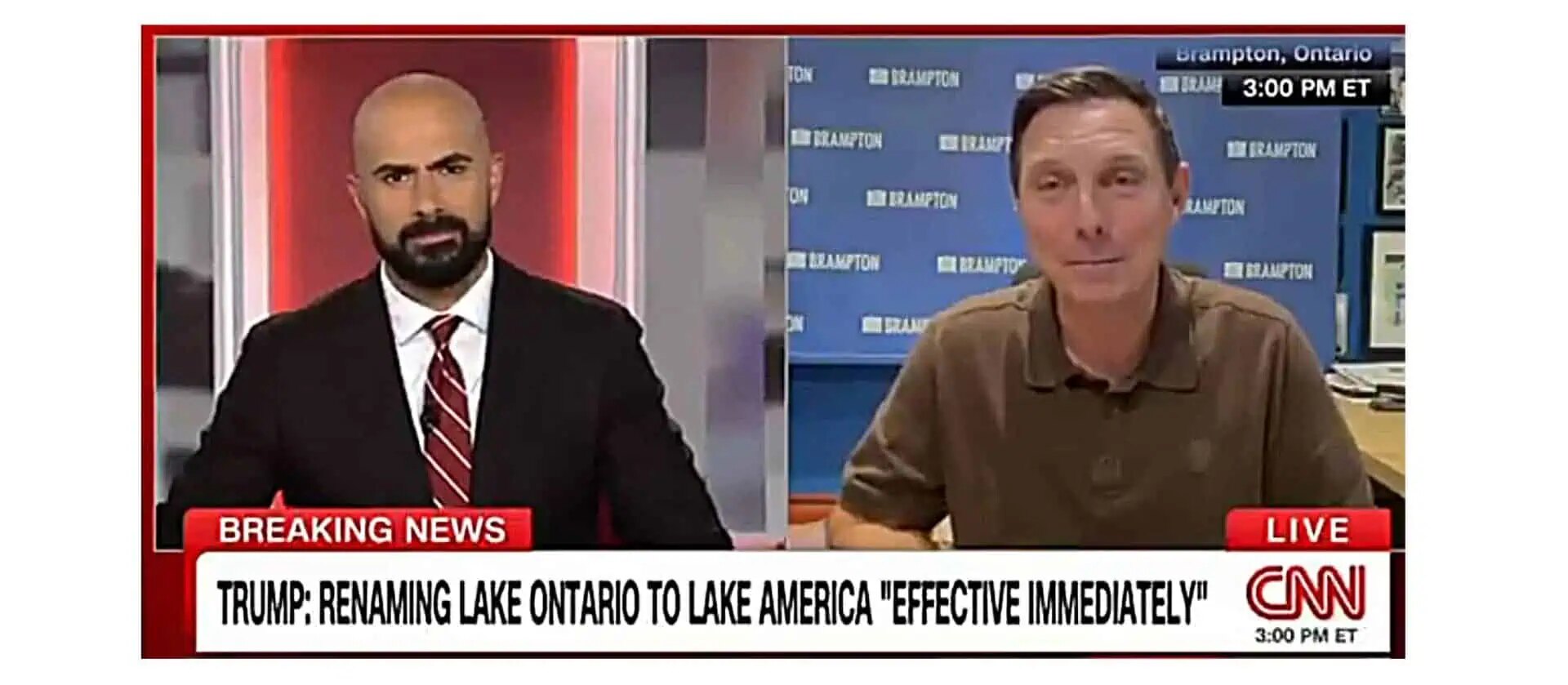
CNN host Boris Sanchez interviews Brampton Mayor Patrick Brown.
Brampton Mayor Patrick Brown has found himself with a rather large audience south of the border this week.
Brown appeared twice on CNN’s News Central, speaking directly to American viewers about the escalating tariff dispute between Canada and the United States and later getting a chance to respond to President Donald Trump’s decision to rename Lake Ontario “Lake America.”
The appearances are part of a busy week for Brown, who has also been interviewed by several U.S. media outlets as tensions between the two countries continue to simmer.
And while Brown has been unapologetic in defending Canada’s position, his message to Americans has been remarkably consistent: Canada wants a deal, the two countries are better off working together and the current trade fight benefits neither side.
“We consider ourselves America’s closest friend and ally,” Brown told CNN during his second appearance Thursday. “We fought world wars together, faced adversity together.”
Brown’s first CNN appearance came Tuesday, when anchor Boris Sanchez asked him about Trump’s description of Canada as the “most difficult and unreasonable” country for the United States to deal with.
Brown said the situation was “a bit surreal,” pointing to the longstanding relationship between the two countries.
“Canada considers America our closest neighbour, friend, ally,” he said, noting that the two countries have fought wars and faced adversity together.
He acknowledged that Canada is prepared to retaliate if the trade dispute continues to escalate, including imposing additional tariffs and other measures.
Last 30 Days: 32,251 Votes
All Time: 1,488,825 Votes
1795 VOTES
How much more would you pay to buy Canadian instead of American?
But Brown stressed that such measures are tools intended to bring the two countries back to negotiations and not an outcome Canada wants.
Brown made much the same argument Thursday when CNN asked him about Ontario Premier Doug Ford’s threat to cut off electricity exports to the United States.
He said both countries were looking at “different tools in the toolbox,” but emphasized that they were tools neither side wanted to use.
“At the end of the day, we want to get back to building great products together,” Brown said. “No one wants this trade war. No one wants to have to use tools like electricity or additional tariffs.”
That theme — the deep economic integration between Canada and the U.S. — was central to both interviews.
Brown pointed out that the two countries have spent roughly 120 years building an economic relationship in which businesses, industries and families on both sides of the border have become deeply intertwined.
He argued that tariffs ultimately make both countries less competitive while giving an advantage to competitors in Asia and Europe.
“The only people sipping champagne right now are competitors from Asia and the EU,” Brown said Thursday, arguing that those countries see the turmoil in North America as an opportunity to increase their market share.
Brown also pushed back on criticism of Canada’s bilingual labelling requirements, which have emerged as one of the issues in the tariff negotiations.
He told CNN that Canada is officially bilingual and that manufacturers in English-speaking Canada are subject to the same requirements.
The mayor suggested the issue should not stand in the way of a broader agreement.
Brown’s message was perhaps most clearly summed up near the end of his first interview.
He said he was hopeful the current tensions would eventually pass and that the two countries could return to the prosperous relationship they have enjoyed in the past.
“I’m optimistic we’re going to see the same type of prosperous relationship in the future that we’ve had in the past,” he said. “And hopefully wisdom will win the day.”
Brown’s second CNN appearance came just days later, this time with Trump’s decision to rename Lake Ontario providing the immediate backdrop.
When Sanchez told Brown that Trump had signed an executive order changing the lake’s name to Lake America, Brown didn’t appear particularly concerned.
“We’re still going to call it Lake Ontario,” he said.
Brown, who represents a city within the Greater Toronto Area and lives near Lake Ontario, joked that the name change could prove most troublesome for the American president.
“The only person who’s going to have trouble with what to call it is your president,” Brown said.
He compared the move to a hypothetical decision by Canada’s prime minister to rename the Mississippi River, suggesting Americans would react with similar amusement.
“The whole notion is a bit preposterous,” he said.
But even with the lighter Lake America exchange, Brown quickly returned to the larger issue.
When CNN again pressed him on Canada’s retaliatory measures, Brown defended Canada’s desire for free trade while emphasizing that the current conflict was not something Canada had sought.
“We don’t want tariffs on either side of the border,” he said.
Brown pointed to the close economic and political cooperation between the countries under previous leaders, citing the relationships between Ronald Reagan and Brian Mulroney, and later Bill Clinton and Jean Chrétien.
His message was that Canada and the United States have spent decades proving that cooperation works.
“We just really need to get back to that,” Brown said.
INsauga’s Editorial Standards and Policies
Win two tickets to The Great Outdoors Comedy Festival (GOCF)

Enter for an exclusive chance to win 2 tickets to Great Outdoors Comedy Festival (GOCF), a $500 Gift Card to Square One Shopping Centre, and a Visit Mississauga Swag Bag. The approximate retail value of the prize is $1,000.
“*” indicates required fields