
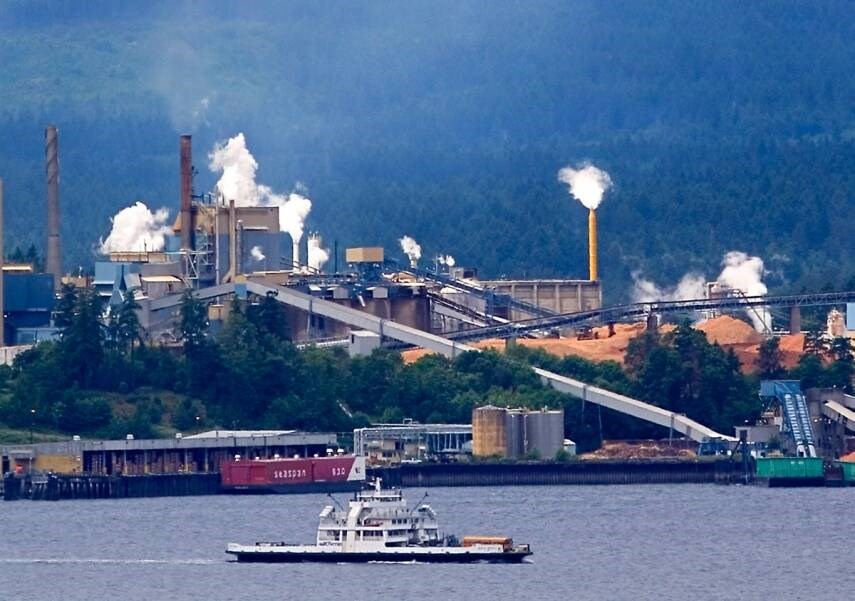
MP Jeff Kibble is asking the federal government for an immediate feasibility assessment, in conjunction with the Royal Canadian Navy and with industry and the community “at the table.”
The MP for Cowichan-Malahat-Langford is urging the federal government to assess the closed Crofton pulp and paper mill as a possible port for the Royal Canadian Navy before the site is sold.
Jeff Kibble, a Conservative MP, said the deep-water port and 107-hectare upland industrial area at the former Domtar mill would be a rare opportunity as Ottawa plans to expand its submarine and destroyer fleet.
The Crofton mill, a fixture in the Cowichan region since 1956, announced in December that it would permanently close after years of curtailments due to weak pulp and paper markets. The entire site has been shuttered since spring.
More than 300 people lost their jobs, and the Municipality of North Cowichan lost millions in tax revenue that helped to finance infrastructure and essential services.
“As an MP for the region and Crofton, [the closure has had] a devastating impact on the local economy and indeed for the whole Island,” said Kibble, shadow minister for defence procurement in the Opposition and a retired navy veteran.
“This is one potential solution, and my goal is ultimately to help the economy and the workers and those affected.”
Kibble is asking the federal government for an immediate feasibility assessment, in conjunction with the Royal Canadian Navy, and that industry and the community should be “at the table.”
North Cowichan Mayor Rob Douglas said in an interview that Domtar has listed the mill site for sale and enlisted BMO Capital Markets to assess possible buyers and future uses.
“The municipality has seen over a dozen proposals, and I understand there are others that have gone directly to Domtar and BMO Capital Markets while others have gone to the province,” said Douglas.
He said new industrial proposals are from manufacturing companies, including some in the forestry industry, and energy production.
Douglas said Premier David Eby had recently spoken with him about the Crofton site as a possible shipbuilding and repair site.
“If we could have shipbuilding on the site, that would be a great way to generate some high-paying jobs here locally, taxes for the municipality and could fit into the proposal that our member of Parliament has brought forward,” said Douglas.
Kibble said, if feasible, a new port would ease future congestion at CFB Esquimalt. He said the federal government has committed to 12 submarines and 15 River-class destroyers.
“Nearly all of our Pacific naval and industrial capacity sits in a single harbour at Esquimalt, where $1.1 billion is being spent to replace aging jetties,” said Kibble. “That is replacement, not additional capacity.”
Kibble said the Crofton site includes both industrial capability and a deep-water port, and is pressing on the federal government to move quickly.
“What sits at Crofton is rare,” Kibble said. He noted the site has deep, sheltered water behind the Gulf Islands with berthing that loaded bulk carriers of mill materials, industrial power and water..
“A building can be put anywhere,” said Kibble. “A depth cannot be built to order, and there are few places on this coast that have one.”
Kibble said acquiring the Crofton site, if it proves feasible for navy use, would be “well within” Ottawa’s planned military spending budgets.
Domtar has not listed the price of the mill site.
Domtar has blamed closures and indefinite curtailments on low global pulp prices, reduced overseas demand and a shortage of affordable fibre.
The company, formerly known as Paper Excellence, has acquired seven mills in the province since 2010. However, only mills in Port Alberni and the East Kootenays remain open.
Last month, Domtar divested the last of its mill sites in Powell River, signing a purchase agreement with Cranberry Business Park Ltd., which has plans to revitalize the waterfront site for long-term economic development. The first portion of the site had been returned to the Tla’amin Nation in March through an agreement focused on reconciliation.
Douglas said Domtar was North Cowichan’s single largest taxpayer, contributing about $5 million a year in property taxes, and the mill provided high-paying, long-term jobs.
“We’re still reeling from the loss of the jobs on the site and the big hit that it’s had on our tax revenue, which has already started this year and could get worse next year,” said Douglas.
“Ultimately, we’d like to see some kind of industrial use continued on the site, whether it’s forestry related or if it does tie into some of the federal defence commitments.”
Kibble said the high-paying jobs the mill provided have to be replaced, as the impact has had a knock-on effect on other shops and suppliers. “Everyone benefits from a productive facility.”
Kibble said the 350 people affected by the mill closure and their families are “still in the community, and what happens next on that shoreline matters to them first.
“If the answer is no, we will have an answer,” said Kibble. “What we should not do is find out after the fact.”