
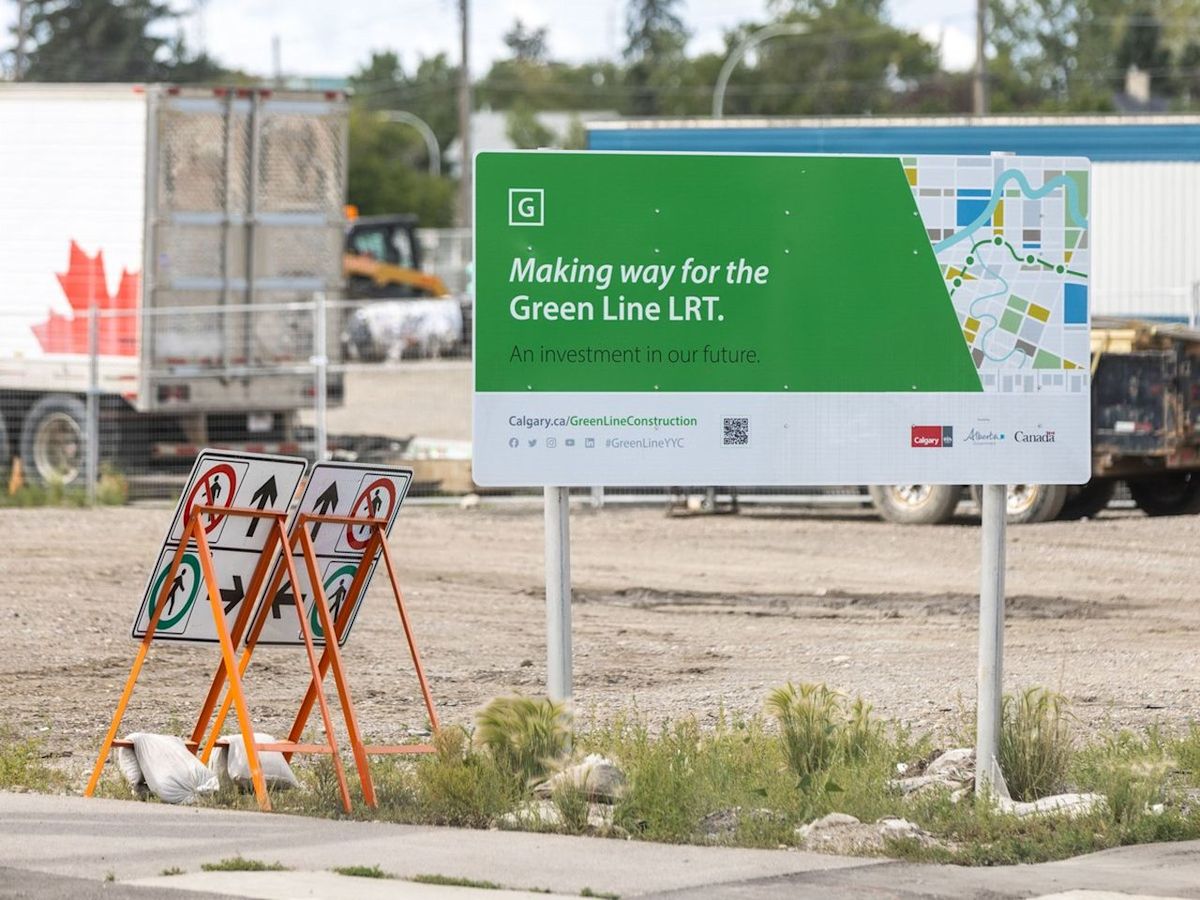
On Sept. 8, city council’s executive committee will hear from city administration on alternative downtown alignments for the Green Line LRT project. After a summer of speculation, Calgarians will finally learn which options the city believes can carry this project forward.
Some ideas have been promising; others raise serious concerns.
The downtown alignment is not a technical detail — it is a key segment on which the project’s value to Calgary will either be secured or diminished. That is why the evaluation process must reflect the expectations of all Calgarians — not just budget pressures or the preferences of a few select stakeholders.
Right now, the work underway appears too narrow in its consultations and too vague in its guiding principles. Without clear metrics rooted in the Green Line’s long-standing vision, alignment options risk being judged primarily on cost or ease of construction.
Those factors matter, but they cannot be the only guardrails. Calgarians deserve assurance that the final version of the Green Line will still be recognizable as the project they were promised.
To protect that vision, any recommended alignment should be evaluated against four core principles.
First, the Green Line must connect north and southeast Calgary through the downtown.
A downtown alignment that severs or significantly delays the link between the north and southeast should be considered the least desirable outcome. The Green Line was conceived as a single, city-shaping spine. Any option that undermines that connection must be scored accordingly.
Alignment options that terminate south of the CPKC tracks without a clear design and funding pathway to a future phase that extends north should also be seen as less desirable.
Second, the Green Line must deliver riders directly to the downtown job centre.
Downtown employment has long been concentrated near 4th Street and 7th Avenue S.W. The currently recommended 2nd Street S.W. alignment was already a compromise between construction realities and transit utility. Moving the line farther south or east reduces its usefulness as a commuter service.
Any alignment that forces transfers or lengthy walks should be scored lower.
Third, the Green Line must include a Beltline station.
The Beltline is home to more than 25,000 residents and major employers. Eliminating a Beltline station would be a significant loss and should be scored accordingly.
Fourth, the Green Line must serve Eau Claire and Prince’s Island Park.
Prince’s Island Park hosts dozens of major festivals each year, and Eau Claire Plaza has been redeveloped to support even more community events — yet the area still lacks direct transit access. A station here would benefit tens of thousands of visitors annually and support redevelopment of the Eau Claire Market lands.
Any alignment that moves a station farther away, or removes it entirely, should be considered less desirable.
These principles reflect real value: connecting Eau Claire and Prince’s Island Park to the LRT network, supporting major redevelopment, bringing rapid transit into the Beltline for the first time and putting thousands of workers within a short walk of their jobs.
But the job isn’t finished when the tracks reach downtown. The Green Line only reaches its full potential if it continues north along Centre Street — connecting growing communities, linking with MAX Orange, and delivering fast, frequent transit where demand is already strong.
We urge council to present all considered options that have either been recommended or rejected alongside a transparent evaluation matrix that scores them against these four guiding principles, and also include clear context on future funding pathways.
Calgarians have waited long enough. The city needs a downtown alignment that protects the project’s promise — and a commitment to build the full Green Line, north and south.
This is the moment to move beyond studies, honour the vision and deliver the transit future Calgary deserves.
Alex McBrien is vice-president with the LRT on the Green Foundation and a resident of north central Calgary. LRT on the Green Foundation is a volunteer-driven community not-for-profit governed by a board of Green Line community members.