
On September 14-15, Energy Mix will be on location in Toronto to host The Better Ideas Show, a unique livestream featuring the investors, entrepreneurs, policy- and decision-makers, and advocates who are working to build Canada’s clean climate economy from the ground up.
The show coincides with Prime Minister Mark Carney’s Canada Investment Summit, and it’s meant to fill an important gap in the planning for the main event. It’s summed up in this question:
What if you organized a high-powered, high-stakes summit to try to
bring new investment to your country and build a brighter future, but
some of your top prospective partners with the best, most durable
nation-building ideas never showed up? Not because they didn’t
want to, but because you never invited them?
That’s the risk Carney is running with a guest list that includes a reported 100 to 150 of the world’s biggest investors, but may leave some of the best nation-building project ideas on the outside looking in.
In a moment when the country’s economic future and its very sovereignty are under immediate threat, it’s a bit remarkable that Carney, and by extension Canada, can put so much financial clout behind a promise to Build Canada Strong.
But the summit will miss out on the opportunities and future benefits in a multitude of climate economy projects that are practical, affordable, and ready to scale, but can’t yet hit the minimum $200 million value for the investments on offer at the summit. That means the voices that have been calling for “nation-building, not nation-burning projects” won’t be at the table.
Until now.
Through a series of news interviews, distributed and amplified on every channel we can line up, we’ll be spotlighting the projects, policies, and investment strategies for that can actually build the nation—build the nations, including Indigenous nations—rather than driving us farther apart.
Sign up for our livestream now.
The last week has reinforced every reason we’ve ever had to be glad Carney is looking to quickly, widely diversify Canada’s trade and pull in investment from pretty much every corner of the globe.
Every corner, let’s hope, except for the rogue regime whose big business enablers already hold far too many of our assets, the one that currently occupies the territory just south of the body of water that is still and will always be known as Lake Ontario. Sharpies be damned.
Since last Saturday, we’ve all seen the constant drip of information, claims, and counter-claims about trade negotiations that were made more complicated than they needed to be, and were ultimately blown up, by Trump administration gangsters for whom Canada’s very existence as a sovereign country is a trade irritant.
For some time now—repeating something you might remember reading in last week’s Energy Mix Weekender—I’ve been carrying around the idea that, at least in his own mind, Mark Carney came to office with the shortest job description on record.
You have one job, one job: Protect Canada as an independent nation. Whatever it takes.
That’s it. That’s all. Except that the job description comes with a footnote:
Job #2: If in doubt, refer to Job #1. If you’re still in doubt, refer to it again. After that, quit referring and get down to work, because time is short and the stakes are high.
After Trump signed his ridiculous executive order declaring that Lake Ontario will now be known as Lake America, at least in his own addled brain stem, Carney’s response was pitch perfect.
“The name Lake Ontario comes from the Wendat word Ontari’io, which, appropriately, means ‘the lake is beautiful, the lake is big,’” he said. “The name is more than 400 years old, predating both the Confederation of Canada and the Declaration of Independence of the United States of America.”
But the “nonsense is deadly serious,” staff columnist Andrew Phillips wrote for the Toronto Star.
It’s deadly serious, just as his jibes about the “51st state” were no joke. It took us a while to come to grips with that, precisely because it seemed so absurd. But eventually we had to realize that Trump meant exactly what he said: he thinks Canada should be part of the United States and his policies are aimed at accomplishing just that.
As retired news anchor Kevin Newman added on LinkedIn, citing coverage in the Wall Street Journal:
Here it is. A unilateral claim on Great Lakes fresh water…the most precious resource for the future.
While we were chuckling over a name change, Trump snuck something sinister into his executive order. Currently the U.S. and Canada jointly manage the Great Lakes. Trump has now declared the U.S. “owns” more than half of Lake Ontario (even though the boundary says it is mostly in Canada). And he hints he wants to drain it to help the parched U.S. southwest, and likely export it for cash:
“The Trump executive order says that ‘with the deepest parts of the Lake’s waters lying within United States territory, the United States claims most of the Lake’s volume’ and that the lake would ‘continue to play a pivotal role in shaping America’s future and the global economy’.”
As a neighbour pointed out during morning dog walks Saturday, the change in acronyms brought on by Trump’s hallucinatory order says it all. With Ontario in the mix, the acronym for the five Great Lakes is HOMES. Replace Ontario with America, and all you’re left with is SHAME.
But the shame is ours, all ours, if we don’t do what it takes to withstand the risk.
If Trump were the only threat on the near horizon, the investment path Carney chooses to build our future might not matter quite so much. But making that leap of faith would do nothing to fulfill the PM’s signature injunction to “actively take on the world as it is, not wait for a world we wish to be.”
In “the world as it is”, we face a cascading climate emergency, stunning loss of the planet’s biodiversity and natural capital, a stubborn affordability crunch, staggering inequality, and more. We won’t solve any of those crises, nor will we build the trust and cohesion we need to stand up to Trump, by rolling back 50 years of environmental impact regulation, fast-tracking a pipeline that no private investor would want to own, promoting new liquefied natural gas terminals for which future demand is sketchy at best, and ripping away at what remains of our social safety net.
That’s why our narrative for The Better Ideas Show begins with two of the most powerful words known to humanity:
What if?
It’s a question that decision-makers and investors don’t ask often enough, but it isn’t new. It’s the starting point for some of the best, most useful thinking in energy futures modelling, and a cornerstone for the fast transition to the new climate economy that is already unfolding before our eyes.
That makes “what if” one of the most powerful questions we can ask. It gives us a window on what’s possible, just by tilting our assumptions by 10 or 15 degrees.
So let’s take a quick “what-if” journey through a menu of climate solutions that start out where we live, then work from the ground up.
What if you could work from home one or two days out of five, rather than donating 90 minutes of unpaid commuting time each way each day? What if a generation of Millennial employees the generations coming after them wanted that flexibility, and expected employers who were attuned to climate solutions?
What if it were the late 1980s and you were working on a previously unimagined system of global connectivity that would put an end to print newspapers, wipe out much of the need for retail space, reduce air travel for meetings you could now attend online, and cut loads of carbon as a result? What if you decided to call that system…the Internet? Don’t ever let anyone try to tell you that some smart people dreamed up the Internet in the 1980s because they knew people in the 2010s would be scared witless by climate change. But the Internet still had that unintended effect [pdf]. Just imagine if we’d been trying!
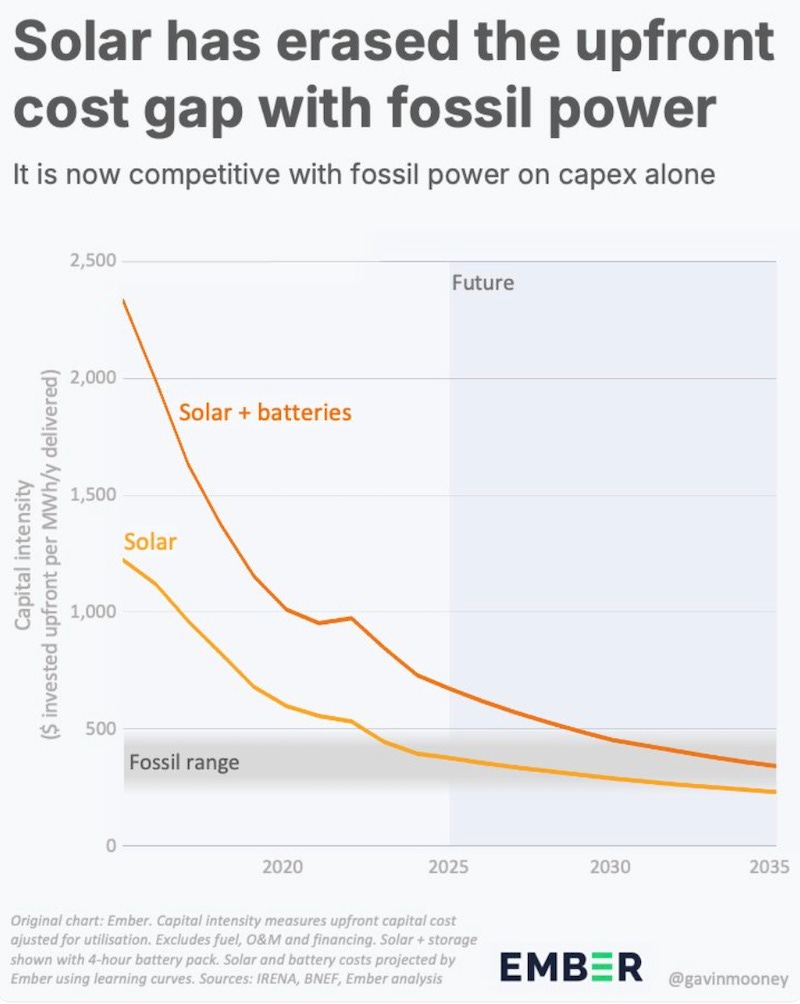
Then what if solar and wind—not coal, not gas—turned out to be the best way to power the data centres that kept that global system running? (No one was thinking of AI data centres in their present form when the Internet first arrived, but renewables with energy storage are still the best way to power them, while we take the next steps to reduce their overall energy demand, environmental footprint, and community impacts.)
What if the battery that powers your next car could put money in your pocket when your electric utility used it to store power from an all-renewable grid? And what if you bought that electric car knowing that it would curb your emissions, but secretly craved your time behind the wheel because it was such a fun ride, and so cheap to operate?
What if making every building net-zero for energy and carbon made them cheaper to heat and cool, stopped the poorest among us from having to choose between food and fuel, made us all more resilient in a climate disaster, and created many thousands of jobs that couldn’t be exported?
Who could blame you if you were terrified that climate action would steal away your well-paying job in the fossil industry—until you realized your employer was already trying to replace you with a robot? And what if you could make a good, secure living putting your skills to work in the clean energy economy?
And what if we redirected the trillions of dollars that governments squander each year on fossil fuel subsidies to a product that didn’t fry the planet when used as directed?
All the pieces of this what-if universe are already practical, affordable, ready for prime time, and starting to scale. And they’re a gateway to the bigger-picture solutions that will get us where we need to go. Massively increasing the energy efficiency of everything. Decarbonizing fuels and electricity. Rethinking our cities to cut sprawl and increase transit. Restoring forests, bogs, and farmlands to store carbon. And phasing out fossil fuels, once and for all.
This particular line of thought dates back to 2019, when TEDx organizers in Ottawa were looking for a talk on how to build wider buy-in for faster, deeper carbon cuts. But it is absolutely not a roundabout way of saying, “hey, let me tell you about my TEDx talk!” I’m not linking this post to the video because the talk itself is beside the point. The back reference only matters, nearly seven years later, because so much of it has stood up well through a global pandemic, an affordability crisis, and multiple wars and energy price shocks.
After all this time, what if? is still one of the biggest mostly unasked questions on the road to the new climate economy. It’ll still be there after the Canada Investment Summit and The Better Ideas Show have both run their course.
Pre-registration for The Better Ideas Show is open now. And there are still a few days left in our online, open line discussion, asking you for any better ideas on how to spend the $43.7 billion in public funds that Energy Minister Tim Hodgson seems so keen to pour into the new West Coast Pipeline.
The full lineup for the Better Ideas is still taking shape. But we already know there are far more smart, practical, creative, shovel-ready ideas out there than we’ll be able to profile in six or seven hours of live video.
It’s one of the best problems any event organizer can ever hope for. And it bodes well for the much wider mix of real nation-building projects that Canada can take on—with the help of Canada Investment Summit participants if they’re onboard, or at one step removed if their attention is elsewhere.

Mitchell Beer traces his background in renewable energy and energy efficiency back to 1977, in climate change to 1997. Now he and the rest of the Energy Mix team scan 1,200 news headlines a week to pull together The Energy Mix and The Energy Mix Weekender.
 Ember via Gavin Mooney/LinkedIn
540+ Dead, Hundreds Missing as Towering Flash Flood in Nepal Points to Extreme Heat, Heavy Rainfalls
Trump Trade War Could Be a Catalyst to Speed Canada’s Energy Transition, Experts Say
Alberta Woman Maps Out the Facts About Power-Hungry Data Centres
Extreme Summer Heat Has Roads Buckling, Cracking, Melting
New Brunswick Greenlights 500-MW Tantramar Gas Plant, Subject to Conditions
Canada Silent as Trump-Backed Deep-Sea Mining Threatens a ‘Vital Climate Buffer’
Smaller, Simpler Heat Pumps Remain Out of Reach for Canadian Renters
Shrinking Sea Ice Opens Possibilities for Churchill Shipping, But Not Without Risks
A Veteran Tahltan Wildfire Fighter’s Solution for the Current Megawildfire Crisis

Oil prices swing Alberta’s $9.4B deficit to $2B surplus, but finance minister urges caution (Canadian Broadcasting Corporation)
First Nations stuck in ‘spiralling cycle’ during wildfires: federal housing advocate (Toronto Star)
Canada’s Carney to attend EU’s State of the Union (Politico)
Big oil and gas companies are partly responsible for California’s water woes, study finds (Los Angeles Times)
Two planned datacentres will have higher UK carbon emissions than ExxonMobil, analysis finds (The Guardian)
UN desertification talks stall as US blocks climate language (Carbon Pulse)
How climate is driving new geostrategy (The Financial Times)
Fossil power loses its cool in Southeast Asia (Green Central Banking)
The Iran War Shows China’s Energy Strategy Is Working (New York Times)
Fewer people in Germany ready to accept economic losses to save climate (Clean Energy Wire)
UK harvest even worse than previously thought (Energy & Climate Intelligence Unit)
The Price of Diesel, the ‘Workhorse’ of Fuels, Nears a Record High (New York Times)