
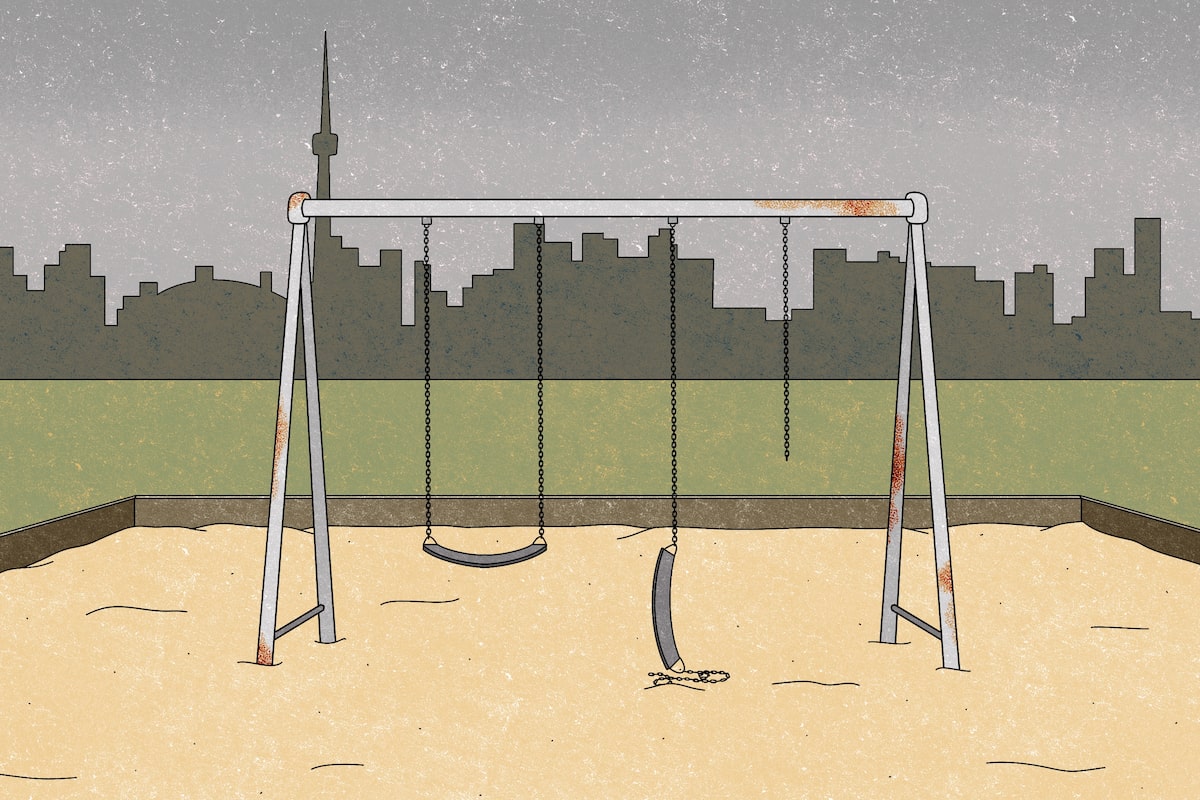
In May, Toronto Mayor Olivia Chow cut the ribbon on a new building that will deliver 255 rental apartments, 51 of them with below-market rents. It’s a sign of the times that this, the construction of a single midrise building, is seen as a success in a dynamic city of 3.3 million.
But it is. Homebuilding in Toronto and its surrounding region has cratered in the past few years. Canada Mortgage and Housing Corp. projects housing starts this year will be roughly half of the 2023 total.
This connects to two other statistics that should give pause: Toronto is losing children at a rapid pace, and the region’s population has gone from growth into a sudden decline. Statistics Canada data shows that the Toronto metropolitan area swelled by 269,000 people between 2023 and 2024. In 2024-2025, it lost about a thousand. And in the City of Toronto, the number of children under five dropped 12 per cent in a decade from 2011 to 2021.
Toronto’s elementary schools have pupils from all cultural backgrounds, but overall, the number of young children has declined in recent years.Fred Lum/The Globe and Mail
What does it mean when a city is losing its youngest residents? Can it have a future?
Toronto can, but that will require dramatic changes in attitude and in public policy. The region – and especially Toronto itself – must be deeply concerned with building much more housing, making the city more accessible to the young people who are its next generation.
Who are Canada’s big city leavers? Mainly 25 to 44-year-olds, with young children
At the moment, the story here is one of young people being pushed out.
In 2024-25, the Toronto area still took in a robust 53,000 international migrants, despite a dramatic throttling down of international-student visas and other forms of migration.
But these new arrivals were outnumbered by 77,000 residents who left the Toronto area for elsewhere in Canada.
As the economist Mike Moffatt has noted, most of these people are in their twenties and thirties. They are starting families, and moving their kids, in other places: Halifax or Calgary.
Despite all the economic and cultural factors pulling Canadians to its largest metropolis, the big city and even its suburbs are simply proving too expensive.
Vaughan Metropolitan Centre is still in condo construction mode, but finding homeowners for the complex has proven difficult: More than 900 are unsold, according to data from research firm Zonda Urban.Sammy Kogan/The Globe and Mail
Torontonians in their twenties and thirties have many economic incentives to leave, seeking cities with less unaffordable housing.Alejandro Gomez Garcia/The Globe and Mail
Fixing this must begin with a new attitude: It should be easy to build new housing in Toronto, especially housing that suits families. Today, it is not.
Where are people with kids living in the big city? Largely, in places where new homes are getting built. The fastest-growing populations of kids in the city since 2000 have consistently been in the downtown. Young families move where they can afford to buy, or to rent. A backyard is out of reach, financially.
But a condo may also be out of reach, and the rising government fees on new development are a major reason why. Governments – and Toronto is a particular culprit – have used development fees to fund all sorts of projects, many of which are only tangentially connected to the new homes. A Toronto Board of Trade report found these charges have increased 178 per cent since 2011.
An example: A decade ago, Toronto’s Spadina Subway was extended a decade ago into the neighbouring city of Vaughan. The new subway stations spurred thousands of new condominiums in Vaughan, but almost zero within Toronto.
Yet new homebuyers in Toronto were paying for it. Over a decade, Toronto plans to spend $900-million on this project that it collected from development charges. There is no geographic correlation between these charges and this expense. That is typical. The same Toronto buyers – most of them young, many of them new arrivals – are funding a significant piece of rebuilding the crucial Yonge-Bloor subway station.
This attitude of dumping costs onto new arrivals has been a dead weight on homebuilding. Low-priced homes are simply impossible when they have charges and taxes of $100,000 tied to them. The conversation around such fees has been changing. For the building Ms. Chow was celebrating in May, the city is deferring all development charges. Prime Minister Mark Carney has committed billions of federal dollars to Ontario and B.C. specifically to reduce development charges. But in Toronto, that deal just takes these charges back to where they were in 2018.
Toronto Mayor Olivia Chow, Prime Minister Mark Carney and Ontario Premier Doug Ford have each said the housing crisis is a top priority.Nathan Denette/The Canadian Press
The necessary changes go far and beyond money. Planning regulations of all kinds continue to make it hard to build apartments. Toronto has now legalized “multiplexes,” or small apartments of up to six units, in certain zones, and larger apartment buildings on particular streets. This is slow and incremental change. So far these policies have delivered only a few hundred new homes. And the federal government has allowed Toronto to slow-walk reforms. When the city backed off on legalizing six-unit buildings, Ottawa let them get away with it. Ottawa’s Housing Accelerator Fund – which is designed to spur growth in cities – gave Toronto almost all of the funding it had been promised.
Nobody has the right to own a home: Pushing shoebox skyscrapers over family rentals
What’s needed is much more decisive. Apartments should be legal, in a commercially viable form, everywhere. In the last 30 years, Toronto’s growth has been hyperconcentrated in a few places, largely in certain parts of the downtown.
There are models for how it could spread out more broadly. Look at history: Between the 1950s and 1970s sizeable apartment buildings were constructed in existing neighbourhoods across Toronto, and those today house hundreds of thousands of people.
The sleek, white apartment towers in the Annex, designed by Estonian architect Uno Prii, took shape when midcentury Toronto was more open to density in existing neighbourhoods.Tibor Kolley/The Globe and Mail
In the Annex, one of the city’s most successful neighbourhoods, apartment dwellers form a majority of the population. Students, pensioners and professionals, they live in towers whose presence has not made the sky fall. But contemporary architects and planners are also looking ahead. Impossible Toronto: On The Courtyard, a report from the Neptis Foundation, puts forward a specific proposal for family-focused housing in Toronto. Designed by Studio Vaaro and Gabriel Fain Architects, these are apartments of up to six stories with green, shared courtyards. Their courtyards provide light and air, and somewhere comfortable for little kids to play. The report sets out a series of regulatory changes that would be required to allow housing on this scale to be realized. These include highly technical matters such as elevator regulations. Altering fire regulations to allow an apartment building with just a single stair could be a key to delivering bright, liveable apartments. In short, if Canada’s governments can follow the lead of their Swiss or German counterparts, city dwellers will be able to live better, in conditions that rival the lure of the suburban backyard.
At the moment, such designer’s visions are impossible in Toronto because the city’s own rules still don’t allow buildings of six storeys on side streets. Will that change?
It must. Cities make choices about who belongs. Toronto’s choice, over the past generation, has been to welcome growth while taxing and restricting the new homes that growth requires. The result is predictable: They come, drawn by the city’s opportunity and dynamism, and then they leave. A city that wants a future cannot simply celebrate the occasional new building that weaves through a system. It must instead build a new system.
Where you live: More from The Globe and MailThe Decibel podcast
With condo prices plummeting in Toronto and Vancouver, governments are trying to revive the market, with only degrees of success. Real estate reporter Rachelle Younglai spoke with The Decibel about how we got here. Subscribe for more episodes.
Costs of living
Canada’s 100 best cities for renters in 2026
Should we have a baby? Four couples across Canada navigate the question
In the Toronto-area real estate market, some buyers are bottom fishing