
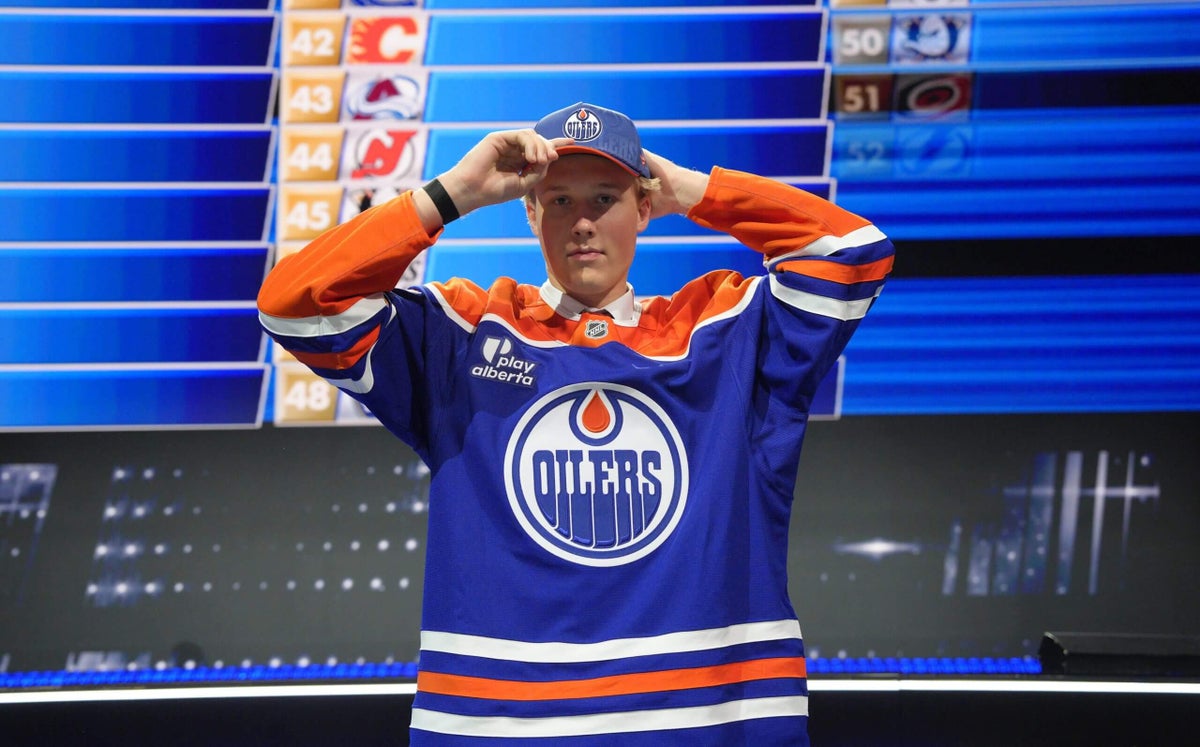
Edmonton Oilers 2025 fourth-round draft selection David Lewandowski impressed during his one-game look with the Bakersfield Condors in the spring. Lewandowski showed plenty of second effort, passed the puck well and showed up at the play ready for contact. These skills are showing up more often among the team’s prospects.
Since Stan Bowman arrived in Edmonton as general manager during the 2024 offseason, the team’s additions have good mobility, are aggressive in puck pursuit and recover quickly when the puck is turned over. This player type runs counter to the heady days of acquiring elite offensive talents with hopes each prospect would grow into the finer points of the defensive game. The Oilers don’t draft in the first round anymore, and appear to have concluded the later picks should be spent on support players.
Is it working?
Get that puck!
Lewandowski’s time with the WHL Saskatoon Blades showed real growth and maturity. He went from 0.75 points per game in his draft year to 1.14 points per game last season. Still only 19, standing 6-foot-2 with room to fill out (AHL site has him at 176 pounds), his single game with the Condors showed much of what made Lewandowski a quality junior should translate to pro hockey.
He never shies from contact, and works well along the wall. As a pro, he’s more likely to help his line secure pucks along the boards and find an outlet (he’s a good passer) than he will be driving to the net and looking for a pass. Lewandowski is a good skater and has improved in this area over the last year. He doesn’t shoot enough but finds the net often enough to suggest a 20-goal season in the AHL during his entry-level contract is possible.
Players who own similar attributes are marbled across most of the names Edmonton has drafted since the arrival of scouting director Rick Pracey. Here’s a quick description of the skaters chosen by the Oilers in the three most recent drafts.
PlayerSkills and future
Quality 2-way C with NHL future
Skates, hits, great in coverage
Exceptional checking centre
Speedy C with 2-way ability
Burner, possible middle-six W
Possible middle-six W
Energy depth W, 5 NHL GP already
Considering the Oilers have used just one of their first-round selections (Sam O’Reilly), and dealt him to the Tampa Bay Lightning for Ike Howard, this is an impressive list of puck hounds, speedsters and possible NHL futures.
Pracey is emphasizing responsible play, speed plus size when possible, and aggressive pursuit of the puck. A player like Rudolfs Berzkalns is already an impressive suppression centre, with the only question mark surrounding his ability to score goals. If he can develop into a 12-15 goal-scorer annually, his future is on an NHL third line. If he doesn’t progress offensively, he still has a chance to be an effective fourth-line centre/penalty killer in the NHL down the line.
Asher Barnett has been gaining momentum as a prospect since his draft year. Corey Pronman at The Athletic recently wrote, “a highly competitive defenseman. He’s a strong skater, too, who can defend at a high level. trusted by coaches, especially when the games get heavy. He could be a third-pair defenseman.” There’s a buzz in the industry about Barnett, and it’s safe to say Pracey and his scouts plucked a top-75 talent in the fifth round of the 2025 draft.
Faced with the reality of drafting outside the first round annually, Pracey and Bowman have focused on players normally associated with depth lines and pairings (along with some solid goaltending choices). The organization clearly wants to contest every play and to be more difficult to play against. Most of the draft picks over the last three summers reflect that template, with the Oilers no longer using later picks for long shot bets on purely offensive talents.
Why worry?
Since the club has significant elite talent on the NHL roster, the idea of finding future checkers and penalty killers at the draft has appeal. The problem for management comes when it is time to restock the skill lines. The current workaround for the issue involves trading third-line talents for top-six forwards. In the summer of 2024, acting GM Jeff Jackson acquired Matt Savoie from the Buffalo Sabres for third-line centre Ryan McLeod. The following summer, Bowman dealt O’Reilly for Howard. The Savoie trade has worked out; the outcome of the Howard deal is too soon to know.
What does a home run look like?
Many of the Oilers draft picks are similar to current Oilers impact winger Zach Hyman, with one notable exception: scoring ability. A fifth-round selection in the 2010 draft, Hyman was known as a player with skill before being chosen by the Florida Panthers No. 123. Some voices suggested Hyman was badly underrated due to the league he played in, and based on his offensive output in the OJHL during his draft season (he led his team by an impressive margin in points), NHL scouts appear to have overlooked a real talent based on his playing in a lower league.
The Pracey era draft picks in Edmonton lack a forward who scored at an impressive clip during his draft year. Malcom Gastrin, chosen in the summer from Swedish junior leagues, finished second in team scoring for MoDo. Gastrin’s 1.04 points per game count as the most impressive among the Pracey selections in draft seasons.
The most interesting player drafted by Pracey among the forwards is Berzkalns. He’s clearly on track as a future NHL player. In the moments after he was drafted, Pronman wrote, “Berzkalns is a clear NHL-caliber athlete. He’s a big, strong center with good foot speed and the ability to overpower junior defenders. He has direct skill and can beat opponents one-on-one. He’s not overly creative with the puck, and the way he attacks is basic. His two-way play and effort level are good enough, though, that he could become a useful bottom-six forward/depth player.”
The numbers suggest that Pracey has drafted shy skill twice in his time as Edmonton scouting director. O’Reilly was a first-round selection whose scoring suggested a career on the third line, and Berzkalns’ production implies even less offence. If the Oilers are seeing something in Berzkalns’ resume that suggests he will emerge as a top-six centre, math does not support the notion. Pracey is still searching for a true offensive contributor.
Why does it matter?
Next summer, the Oilers may reach a crossroads with captain Connor McDavid. Owner Daryl Katz will move heaven and earth to keep him, but an unsigned McDavid entering fall 2027 represents anxiety for ownership, management and fan base. The Oilers will have no stomach for another rebuild, and fans won’t stand for it without at least one Stanley Cup to show for the McDavid era. That’s a tough place for any organization.
The team will have to watch McDavid walk (if he chooses to) via free agency in 2028, or trade him next summer. The price should include several young, NHL-ready skill forwards who have been drafted in the past three years. Ironic, but true.
The Oilers have traded multiple first-round selections, most before a selection was made and several (O’Reilly, Reid Schaefer) long before the players reached the NHL.
The act of drafting complementary offensive forwards, combined with the trading of a decade of first-round picks (everything after Evan Bouchard in 2018 is gone), places the franchise in a difficult situation. Maybe Berzkalns becomes the second-generation Hyman, but there is no evidence to project that.
Maybe Howard works out in a similar way to Savoie, the Oilers win the Stanley Cup, and everyone is happy.
The Oilers under Bowman and Pracey have taken a practical, sensible shoes approach to the draft. Trying to thread the needle and find an offensive driver in the fifth round (like Hyman) is more luck than skill. One can justify the decision to look for good support players.
Still, that practice is contributing to what looks like a reckoning, which could be less than one year away.