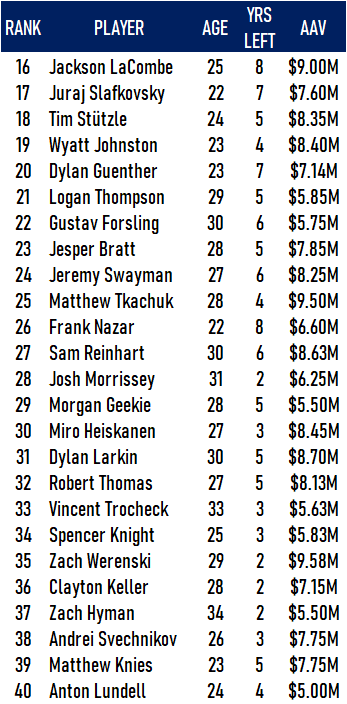
Welcome to my annual tradition spanning 1.5 decades ranking the NHL’s best bargain contracts, the last half of that mobilizing online democracy to help make the final decision. I published a pair of books during the pandemic about the 450 best and 450 worst contracts signed during the salary cap era, so it’s not a matter of needing help, but public polling is a fun way to decide, especially in the summer when nobody is playing hockey. The other issue being a Red Wings fan is the extreme value of Moritz Seider and Lucas Raymond. A high ranking validated by outsider opinion carries more merit than the authoritarian declaration of a biased Wings fan.
Twitter ain’t what it used to be, so I reached out to Substack colleagues for assistance. There was a spike in Twitter contract polling interest early July, but that collapsed by August. Fortunately, best contract polling wrapped in July, and it was the worst contract voter turnout suffering max apathy, traditionally bad deals produce greater views than good. People just like slowing down to stare at traffic accidents, but the rising cap has fewer GMs crashing into trees lately, whereas this list was wickedly competitive, which becomes clear when you look at the 25 runners up left off the top 15.
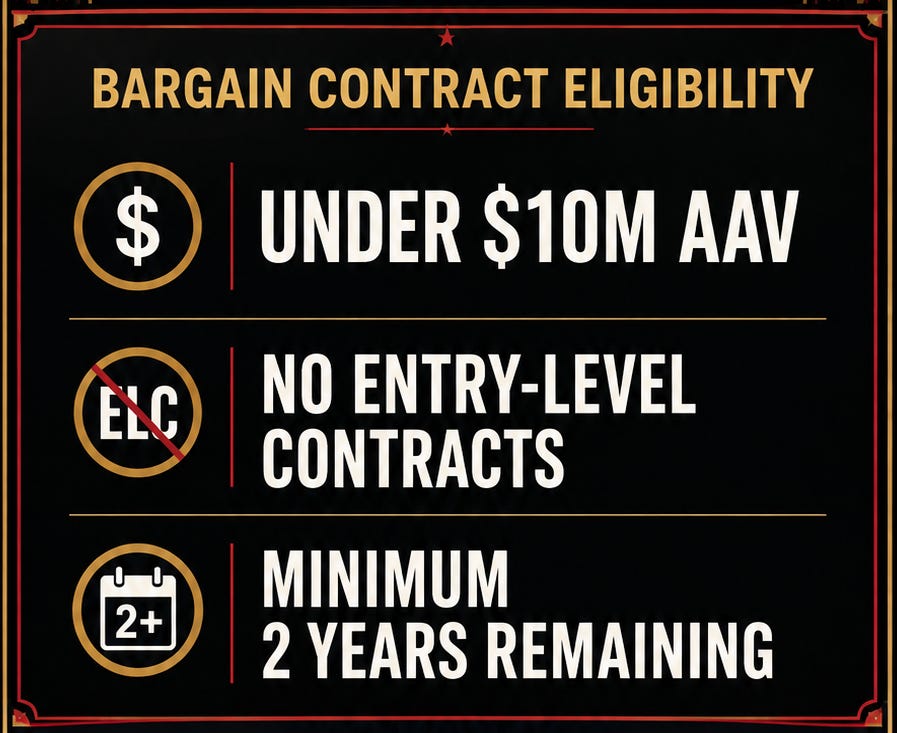
My threshold for inclusion has been set at $10M AAV for the last few seasons, which made sense with the elite tier signing in the $12M to $14M, but suddenly this summer the wage ceiling is pushing higher. Kaprizov spent time alone on that Island, but more have joined lately, colonizing a new stratosphere will only attract more going forward. Many of these bargains below, size of underpayment is only growing, the market resetting in real-time as this list was compiling. Cale Makar just pushed that even higher, breaching $20M AAV this weekend. On the Makar $20M, Byram $12M scale, there’s a few of $15M+ defenders below.


 CLICK IMAGE TO FOLLOW ME ON TWITTER!
Lane Hutson makes his debut on this list dethroning the back-to-back-to-back defending champ Jack Hughes before a single game has been played at his new salary. He was the #1 seed in this tournament before a single vote was cast for the simple reason that my career modelling flagged this as a severe underpayment, and that obscene value was also recognized by voters. When Bowen Byram became the highest paid defenseman in the league and the ceiling started climbing, Lane’s price tag became absurdly low by comparison, then Cale Makar signed for more than double, dwarfing everyone.
The sample size on his career is still small, so Montreal did take a risk handing $70M to a defender with only 1 year service under his belt, but sometimes you need to assume some risk in order to bank a big reward. Hutson scored 78 PTS, helped Montreal to the conference final, and if he went UFA tomorrow, doubling his current salary would be a real possibility. Makar cashing a $20M AAV ticket transforms the marketplace, though one could argue that came when Byram signed.
Bowen Byram was the NHL’s highest paid defenseman for 2.5 months, but I would be shocked if a single NHL GM would trade Seider for Byram straight-up, even if they made the same salary. The Spittin’ Chiclets podcast recently compared him to Chris Pronger, big, tough, mean, excellent in both ends of the ice, the type of defender you need to go far in playoffs. That’s why there’s undoubtedly a significant proportion of NHL GMs would rather have Seider on their roster than Hutson, but we’ve still never seen playoff Mo, and frankly might not for the duration of this deal.
Speaking of Detroit’s dwindling playoff prospects, my Red Wings fan bias requires disclaiming. Though given the events this summer and the Atlantic division only getting stronger, that bias is leaning more pessimistic than optimistic. I’d rather see them finish 32nd in the standings than 17th, but bottoming gets harder with a defenseman of this quality logging 25 minutes per night.
Jack Hughes attempt to 4-peat as the league’s most underpaid player failed, which could plausibly be a biproduct of an unfortunate restaurant injury, and that’s the rub. Deadly when healthy, but freakishly prone to injuries, even visiting steak houses. The decline of the New Jersey Devils in general might also factor into the declining bargain rating, although the word “decline” is relative to the field, because Jack still beat some big names below. This contract has much in common with Nathan MacKinnon’s previous deal, but at least that ridiculous bargain produced a Stanley Cup. Jack still has 4 years to make that happen, I’m just pessimistic the franchise is trending in that direction.
While “injury risk” could have negatively impacted his approval rating, that’s also a big reason they got him on an 8-year deal at that price. He was battling injury early his young career, surely reducing his desire to “bet on himself”, but that’s a tough determination to make when offered life-changing money. We could quibble over whether a $64M pay day constitutes a “bad bet”, but there’s no question he left at least $30M on the bargaining table, possibly more.
If this list had been posted at the end of the regular season, unlikely Logan Stankoven even cracks the top 15. The offensive stats were mediocre and below many of these contemporaries in points per dollar, until playoffs happened. Any hardcore fans in a coma from April to June would likely wake from their slumber and look at this deal #4 on the biggest bargains list with confusion. The diminutive center scored at a 44-point pace in the regular season, 69 PTS in the playoffs. If not for Jordan Staal’s heroics in the final, Logan could/should have won playoff MVP.
Stankoven, Blake, and Hall combined for 55 PTS in the playoffs, while Aho, Jarvis, and Svechnikov scored 34; leaving little doubt who deserves more credit for the championship. Some might argue that the Florida Panthers injury situation is the only reason Carolina climbed to the summit, but the way this roster is built and average age compared to Panthers, Canes have a strong chance of adding more banners to the rafters in the next 8 years.
Last year Matt Boldy finished just outside the top 15 in polling results, but landed #5 one year later after winning a playoff series and an Olympic gold medal. My own opinion would have ranked him ahead of Stankoven, but given what Logan accomplished winning the Stanley Cup, I’m not executing executive override. Playoff stats notwithstanding, Boldy is in another stratosphere of offensive output for a comparable price, but half as many years remaining. Matt’s career scoring rate is 75 PTS per 82 GP, reaching 92 PTS per 82 last season.
Wherever that production peak lands next 4 years will likely depend on whether or not Quinn Hughes is feeding him passes, but at least this upcoming campaign, Matty is poised for big numbers. Rumours made the rounds this summer that Boldy was Detroit’s demand in a Larkin trade, and as a Wings fan, I’ll concede that’s a ridiculous request unless Wings are sweetening the deal with picks/prospects. Wild Bill Guerin ain’t trading one of the league’s biggest with what a Hughes extension would cost them, especially after Makar just banked record money.
It’s interesting that Seth Jarvis dropped from #4 to #6 on this list after winning the Stanley Cup, but he only scored 4 goals in the playoffs vs Stankoven’s 11, so didn’t get the same playoff boost. We found out later that he was battling an injury that required surgery, so he may yet prove to be a bigger bargain for the remainder of this deal than his teammate. Seth finished much higher in my pre-polling seeding which was completed in early May, and even with everything unfolding afterwards, he still gets my vote ahead of Stankoven if we rebooted this tournament tomorrow.
Many people didn’t buy membership in the Seth Jarvis fan club until his breakout with Team Canada at the 4-Nations Faceoff, when he proved he belonged on the biggest stage against elite competition. He’s the complete package, career stats per 82 GP, 61 PTS, 197 shots, 94 hits, plays both power play and penalty kill, scoring 16 short-handed PTS last 3 seasons, ranking him 2nd in the NHL in that category behind JG Pageau. That’s impressive, and may retrospectively change the hearts/minds of a few Stankoven voters…
Cole Caufield scored 51 goals last season, and given how rarely that level of sharp-shooting talent reaches the open market, he could potentially double his salary with a ceiling reset in progress. The caveat for Cole is a very potent offensive supporting cast, spending substantial time on ice with Suzuki, Hutson, Slafkovsky. If he played the entire campaign with the Vancouver Canucks, he’d be lucky to pot 35 goals, not diminishing his accomplishment, but maybe a little bit.
Caufield’s scoring rate dropped from 89 PTS per 82 GP in the regular season to 56 in playoffs, so the opposite of Stankoven, but Montreal faced much tougher competition surviving Atlantic division attrition, facing the Vezina winner in round one. The knock on Cole’s value in the eyes of traditionalists is the same reason he slipped in the draft, size. However, that’s a potential knock on 4 of this list’s top 7 names, so perhaps that market discrimination is part of the reason the signees where willing to accept long-term, team-friendly deals.
We already discussed my Red Wings fan bias and the need to let democracy (and Substack colleagues) decide the final rank, and this is the chosen slot for Lucas Raymond (which is higher than my initial seeding). Adding to the bias is several Raymond rookie cards in my collection, making me financially invested in his future. Adding irony to my financial/emotional investment in his career was my anger when Rangers won the rigged draft lottery and picked Lafreniere in 2020, but Lucas scoring 330 PTS in 400 NHL GP versus Lafreniere’s 250 PTS in 462 GP, retroactively reduced my rage.
You can accuse me of fan bias for Seider’s #2 and Raymond’s #8 ranking on this list, but democracy shields me from your accusations. One thing that has surely raised his approval rating compared to last year’s tournament, was his performance at the Olympics, finishing 3rd in scoring behind McDavid and Celebrini, easily the most productive offensive player on Team Sweden. So, to all the nay-sayers, put that in your pipe and smoke it…
Whether or not Brandon Hagel or Lucas Raymond had more “value remaining” became a source of contention between me and my Substack colleague who covers the Tampa Bay Lightning, but we let democracy do the deciding, since both of us had biased opinion. That said, I’m a bigger fan of Team Canada than Detroit. Hagel won my heart at the 4-Nations Face-off, and nothing would please me more than him being a 90-point player unleashing forechecking Hell on opposing defenders for the next 6 years with zero decline. If I could trade Detroit never makes the playoffs again in my lifetime for Team Canada wins every Olympic gold in that span, I’d take the deal.
The biggest thing Raymond has over Hagel is age. I’ll concede that Hagel’s tenacity and physical play should provide an edge given comparable offensive output, but that’s also part of my concern with age and term. He battled injury this season, a possible forecasting of things to come, but I’m not biased enough to deny, both players as they are right now, Hagel is a bigger bargain and one I’d rather have on my team. Let’s just see where this is at when Hagel is 32 and Raymond is 28. Also, Raymond did not spend 674 minutes on the ice with Nikita Kucherov this season, yet still scored more PTS than Hagel.
Jake Sanderson finished 3rd in last year’s poll tournament, but dropped to #10 in 2026. He battled injury this past season, dropping from 80 to 67 GP, but total points only dropped from 57 to 54. Higher points per game, fewer played. I even lamented last year that my guy Mo Seider might not be the best bargain D contract for the remaining term because Jake the Snake had more time remaining at a lower price tag. Yet, 1 year later, voters decided Mo was #2 and Jake was #10, my own personal bias did not play a factor….
All that said, Jake is among the league’s best defensemen, and Makar making $20M, Byram making $12M probably slots Sanderson at a $16M market value, double what Ottawa is currently paying him, at age 24 with 6 years on the clock. Like others on this list, he proved belonging among the elite tier at 4-Nations. People already knew he was really good, but that tournament convinced nearly everyone he’s in the upper echelon of blueliners. If we went back to the ballot box after everyone reading this, Jake might land higher on the list.
Nick Suzuki ranked top 5 in my pre-seeding, but finished 11th in the poll tournament. His performance upsetting Tampa in round one then Buffalo in round two heavily influenced my optimism, but had less impact on voters, which happened last year too, albeit without the Montreal playoff series victories. He does have an impressive supporting cast boosting output, two of them on this list, another falling just short of the top 15 (Slafkovsky was seeded #2 pre-tournament, Substack colleagues did not share my assessment). Nick doesn’t score 100 PTS if Cole ain’t eating his passes.
One other feather in Suzuki’s cap, has not missed an NHL Game in the last 6 seasons. Last 5 years he scored 61, 66, 77, 89, 100 PTS in that order, and if that trajectory continues, you can slot him in for 109 PTS in 2026/27, though at age 27, the probably of sustaining is low, but last year I also mused he had likely already reached peak production, then he proved me wrong. I’m not making the same mistake twice. Oh, nearly forgot, he won the damned Selke this season. What were you nay-sayers thinking? I’m arguing my pre-vote seeding was more accurate than #11, but this is a competitive list and most arguably deserve higher standing.
Tage Thompson finished 2nd to Jack Hughes in best contract voting in 2023 and 2025, while 2024 was plagued by injuries. Democracy was less kind to Tage in 2026 and there’s an argument he belongs higher, but the 30th birthday drawing closer and he has an injury history. Four more years of peak Tage is a crazy bargain. Last year I mused that he could get $10M AAV if he went UFA, but given where the ceiling is resetting for elite talent, he could more than double that salary going to market tomorrow. Note to self: I’m leaning too hard on “open market price” to hit my desired word count…
For all this talk about Tage elite talent, his 81 PTS in 81 GP is only the 2nd time in his career reaching point per game, scoring 63 PTS per 82 GP in his 529 game career. It’s the eye test telling us elite status, which was also on display for Team USA, showing the world he doesn’t slow down best-on-best. Tage signed this extension after a 68-point season (a career high at the time) then proceeded with a 94-point breakout. The security of locking in early cost him a lot of money.
Like Stankoven, this polling taking place during the Canes Cup run boosted where Blake landed on the best bargain list, but doesn’t mean it’s not deserved. Jackson didn’t score as many playoff goals as Logan, but was on the ice for many of them and played a major role creating the opportunity (also led the Canes in playoff PTS). Getting 8-year deals on less than 100 NHL games was formerly extremely rare and generally a risky proposition, but Tulsky is looking like a genius locking the kids into these treaties, both boosting their market valuable considerably in May and June.
The only question remaining to be seen for both is where the offensive ceiling lands. Both are still bargains if they remain in the 40 to 60 PTS range, especially if they continue getting it done post-season, but we’re looking at obscene bargains if either drift into the point-per-game stratosphere. Blake has lots in common with Brandon Hagel, smaller stature, but tenacious on the forecheck and winning puck battles. If he were ever fortunate enough to get 700 minutes on the ice with a Kucherov level talent, 90 PTS is a real possibility (just unlikely in Carolina).
If we’re talking about players boosting their stock in the latest round of international play, add Brock Faber to that list, equally effective at both ends of the ice against elite competition. The arrival of Quinn Hughes to steal power play time, prompted me to trade Faber from my fantasy team, but the impact proved more positive than my panic reaction expected, because they spent 844 minutes on the ice together in the regular season. Brock finished with 15 goals and 51 PTS, the money Minnesota is saving on this agreement offsets the massive price of Kaprizov, but Quinn Hughes is getting just as much if they’re even able to retain his services.
Whatever happens with Hughes, they’re getting him at a bargain next season and have an elite top pair, paying only 40 cents (or less) on the dollar for what they provide. The only question, will Billy trade him if unable to procure his signature on a new deal, and how much of their acquisition cost will be recouped if moved? At least they won their first playoff series in a decade, so that’s a victory for the organization, even if they don’t win another until 2036.
The stunning rise of the Buffalo Sabres and their first playoff series victory in nearly 2 decades was partially caused by the breakout of newly acquired Josh Doan, who scored 25 goals and 52 PTS (after scoring 19 PTS in 51 GP year prior in Utah). The offense was only part of the story, as hitting, forechecking, and puck battles are also formidable weapons in the arsenal. That genome seems to be appropriately valued by best bargain voters, and exactly the type of player you want in the playoffs, and Doan is part of the reason they advanced to round two.
Teammate Zach Benson might have qualified for this list had he signed his new deal sooner, another fitting the Hagel-Blake description, should compete for a spot in next year’s top 15. Doan played with Tage Thompson more than any other forward, and that proximity surely has something to do with the production jump, but Tage was also more productive than year prior, so if proximity to Doan gets the best out of Thompson, the relationship is more symbiotic than Josh waterskiing behind his boat. Ending their playoff drought makes the Doan acquisition a stunning success for Kevyn Adams Jarmo Kekalainen even if they miss playoffs for the next 7 years.
When you see who fell short of the top 15, maybe “this player deserved to be higher” is an overstatement…