
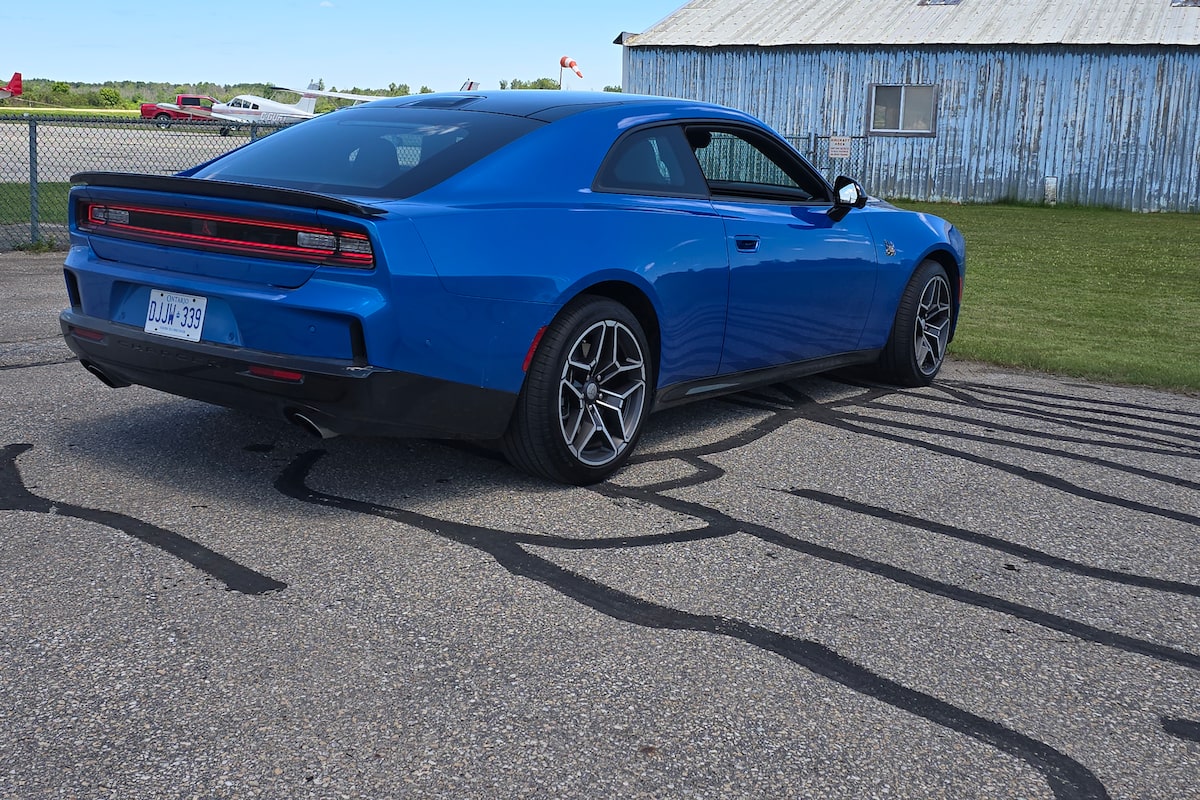
The Charger is wide and attracts attention for its sheer bulk, not the exterior design.Emily Atkins/The Globe and Mail
Loud, brawny and thirsty, the 2026 Dodge Charger Sixpack Scat Pack marks a rebirth for the brand’s gas-powered muscle cars. This internal-combustion alternative aims to capture muscle-car lovers following the poorly received rollout of the all-electric Charger Daytona. Production for both iterations is anchored at the newly retooled Stellantis facility in Windsor, Ont.
Unlike its battery-powered sibling, it has everything a traditionalist might want, and more – power, noise, surprising daily-driver comfort and a heavy dose of nostalgia, harkening back to the days when straight-line speed was king. But for some purists, this too is a disappointment. Despite its ferocious speed, its turbocharged six-cylinder engine doesn’t sound or feel like the classic V8 of old.
That legendary engine vanished when Stellantis halted Hemi V8 production at its Brampton, Ont., assembly plant in 2023. The company subsequently brought the Daytona EV to market toward the end of 2024, only for it to be widely panned while suffering early technical problems. Serving as an antidote to the Daytona’s woes, the revitalization of the traditional Charger was hailed as “a proud milestone” by Stellantis Canada president Trevor Longley during its launch.
The Scat Pack has 550 horsepower and 531 lb-ft of torque.Emily Atkins/The Globe and Mail
The front seats and dash of the Charger.Emily Atkins/The Globe and Mail
Scat Pack Chargers sit at the top of the Charger lineup across three distinct variants. The gas-powered Scat Pack and Scat Pack Plus models harness the high-output, 3.0-litre, six-cylinder Hurricane engine, while the Charger Daytona Scat Pack serves as the electric alternative. The lower-trim Charger R/T and R/T Plus utilize the standard-output Hurricane power plant. Both electric and gas-powered iterations share the same chassis and are produced on the same line at the Windsor plant. Production of the two-door Scat Pack began in December 2025, ending a three-year hiatus on gas-powered Chargers, while four-door and R/T variants ramped up early in 2026.
Half a year after production began, sales for the made-in-Canada Chargers – both gas and electric – are “moving upward,” said Bradley Horn, Stellantis product communications manager. However, he declined to comment on whether internal sales targets are being met.
Horn attributes the uptake to the car being crowned the 2026 North American Car of the Year, alongside Canadian buyers discovering “that the new, Sixpack-powered Dodge Charger delivers the muscle car performance they’re after.”
Base price for the Scat Pack Charger starts at $69,995, offering a reasonable bang for the buck. However, options add up quickly. As equipped, our tester featured $695 premium paint, a $2,495 carbon and suede package, and the $7,495 Customer Preferred Package that includes a colour driver display, GPS navigation and a head-up display. Tack on $1,495 for the glass roof and $1,995 for the 19-speaker sound system. All this inflates the price by $14,175.
Buyers fit into two main categories, Horn said – muscle-car enthusiasts and consumers looking for an SUV alternative. The latter group is attracted to the car’s standard all-wheel drive, surprising interior capacity, and fold-flat rear seats.
The rear seats of the Dodge Charger have plenty of space.Emily Atkins/The Globe and Mail
The fastback style means the rear glass lifts up, revealing a massive flat trunk.Emily Atkins/The Globe and Mail
But it’s really the first group who will appreciate the new Charger. Its engine is the twin-turbocharged Sixpack Hurricane High Output (H.O.) power plant which produces 550 horsepower and 531 lb-ft of torque. That easily eclipses the 485 horsepower and 475 lb-ft of torque generated by the previous-generation Scat Pack V8. Even better, it is about to get beefier: Dodge recently unveiled the 2027 Charger Super Bee, an even more potent Sixpack Charger that will arrive soon.
At the wheel of the Charger, the driver has a choice: apply the power gently and smoothly or engage the launch control to fling the heavy, 2,184-kilogram machine off the line for an estimated 3.9-second run to 100 kilometres an hour. Both driving styles are entertaining. However, alongside a mechanical limited-slip rear differential, a single push of a button disconnects power from the front wheels to allow for better burnouts and drifting, revealing the car’s true calling.
While the eight-speed automatic transmission is smooth and quick, it lags in manual mode, making it way more fun to simply let the car do the work. On the highway, this results in a smooth, quiet ride that feels light-years away from the harsh, loud days of old-school muscle cars.
The Charger is reasonably agile for its size, but lacks the cornering feel of a modern sports car. Navigating a twisty road takes a bit of work, and the vehicle fails to deliver the joy of surefooted acceleration out of corners. This car – if it’s not pounding out quarter-miles or drifting on a track – is a civilized highway cruiser.
The Charger attracts attention for its sheer bulk, not the exterior design, which is retro and bland. It comes in a limited array of bright, cartoony colours – such as the blinding Bludicrous of the tester. There is no mistaking its muscle car heritage.
The body style is interesting, however. As a coupe, the two passenger doors are wide and access to the rear seats is easy thanks to the power-sliding front seats. The fastback silhouette means the rear glass lifts up, revealing a massive cargo area. With the rear seats folded flat, you could easily sleep in the back, turning the Charger into a stealth camping vehicle.
Inside, the Charger is spacious, with plenty of room in the rear seats. Because the gas-powered and electric versions share the same chassis, the floor sits higher than normal to accommodate the battery, while the EV also has a transmission tunnel. While this doesn’t impair rear-seat comfort, the driver’s seating position feels uncomfortably reclined, likely because the raised floor prevents the seat from dropping lower.
This well-equipped Charger is a relatively luxurious machine. It is also refreshingly useful as a daily driver, unlike many of its muscle-car competitors. For the money, the base model is a good buy if you want a fast ride that can take you – and your companions – to interesting places all year round.
The Scat Pack has a three-litre, twin turbo, inline-six cylinder engine.Emily Atkins/The Globe and Mail
Tech specs
2026 Dodge Charger Scat Pack Plus
Base price/as tested: $69,995/$86,583 including freight and surcharges, plus taxesEngine: Three-litre twin turbo inline-six cylinderHorsepower/torque (lb-ft): Standard: 550/531Transmission/drive: Eight-speed automatic/all-wheel driveFuel consumption (litres per 100 kilometres): 14.5 city, 10 highway, 12.5 combinedAlternatives: Ford Mustang, Chevrolet Corvette, Cadillac CT5-V
Shopping for a new car? Check out the new Globe Drive Build and Price Tool to see the latest discounts, rebates and rates on new cars, trucks and SUVs. Click here to get your price.