
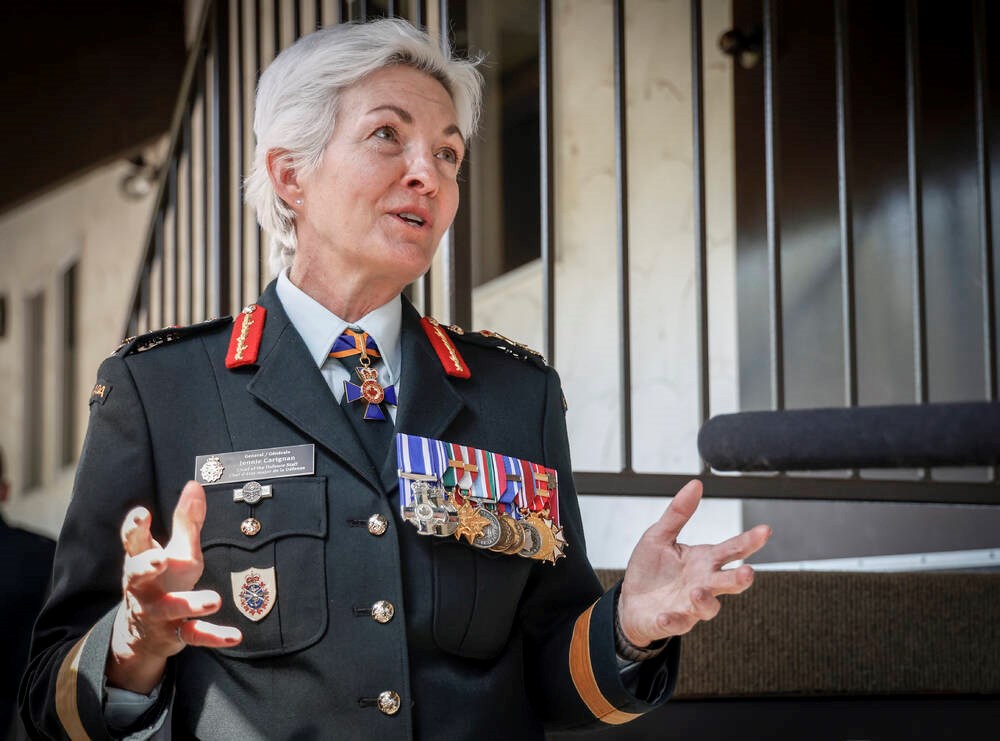
The annual Indo-Pacific Chiefs of Defence conference begins Monday at the Victoria Conference Centre and will focus on strengthening collective security.
Senior military leaders from 32 countries are expected to be in Victoria this week for talks on Indo-Pacific security issues.
The annual Indo-Pacific Chiefs of Defence conference begins Monday at the Victoria Conference Centre and will focus on strengthening collective security.
Gen. Jennie Carignan, Canada’s chief of the defence staff, and Admiral Samuel Paparo, commander of the U.S. Indo-Pacific Command, are co-hosting the three-day conference, which was first held in 1998.
Victoria police said they will be working with the Armed Forces and RCMP Protective Services on venue security.
“VicPD will be proactively monitoring public safety and supporting a safe environment for attendees and the public,” the department said in a statement.
The conference typically includes military leaders from countries such as Australia, India, Japan, New Zealand, South Korea, Brunei, Indonesia, Malaysia, Philippines, Singapore and Thailand.
Colin Chia, an associate professor of international relations at the University of Victoria, said he’s not expecting policy announcements to come out of the conference, as attendees are “not really decision-makers themselves, but really the ones who execute them.”
But political tensions will be in the air at the gathering, particularly the disagreement between the U.S. and South Korea about the Iran conflict, he said in an interview.
Earlier this month, U.S. President Donald Trump ordered the Pentagon to scale back military drills with South Korea, citing the country’s refusal to join the U.S. war against Iran and what he said was his good relationship with North Korean leader Kim Jong Un.
That fuelled anxieties among the South Korean public. Hankook Ilbo, a Seoul-based daily newspaper, blasted the decision in an editorial, calling it “absurd that the U.S. appears to treat North Korea more respectfully than its ally South Korea.”
Since the Second World War, the U.S. has been seen as the security guarantor in the region. But increasingly, “U.S. allies are really kind of questioning the commitment and credibility of the U.S., and whether they can actually rely on the U.S. for these security alliances and for these security commitments,” Chia said.
The Pacific-based aircraft carrier USS George Washington was recently redeployed from its homeport in Japan to the Middle East to relieve the aircraft carrier USS Abraham Lincoln, leaving the Pacific without a U.S. carrier presence for the first time in decades.
Chia said U.S. interceptor missiles stockpiled in the event of a war with China over Taiwan have “basically been depleted” after missiles were sent to allies in the Middle East during the Iran conflict.
Canada is not seen as a major player in the Indo-Pacific, Chia said, noting that it was left out of one Australian study, the Asia Power Index, that assessed the capabilities of Indo-Pacific countries.
But in recent years, Canada has paid more attention with outreach to the Association of Southeast Asian Nations that began under Justin Trudeau and has continued with Prime Minister Mark Carney, he said. “Clearly, the region is important for Canada’s economic interests.”
Carney has been vocal about pursuing trade deals and partnerships beyond the U.S., Canada’s largest trading partner.
He visited China, India, Australia and Japan this year as part of efforts to diversify Canada’s export partners.
Trade talks between Canada and the U.S. collapsed on Aug. 21.
But Chia said it’s very unlikely that trade tensions will affect this conference, noting that Canada’s military tends to value its U.S. relationships “much more” than its political leaders and the public.
The two militaries have been closely intertwined for decades. Carignan, the country’s top soldier, holds a degree from the U.S. Army Command and General Staff College, and Canadian military officials regularly go on exchanges with their American counterparts.