
The league that boasts basketball stars like Caitlin Clark and A’ja Wilson can overcome objections to its “The W” trademark from two Major League Baseball teams thanks largely to the diversity of sports letter logos.
At the center of the fight is the Women’s National Basketball Association’s March 2025 registration of its “The W” trademark. The Chicago Cubs and the Washington Nationals, both of which have their own registered stylized “W” marks, argue that the WNBA’s addition of “The” is the only meaningful distinction between its requested word mark and theirs.
The WNBA’s answer is due in October at the Trademark Trial and Appeal Board, barring a settlement.
The case highlights sometimes-misunderstood nuances in trademark law that play into a crowded sports landscape. The hundreds of professional and college sports letter-logos narrows the scope of protection for most individual marks — though fans are accustomed to making fine distinctions in merchandise, legal professionals say.
An article like “the” usually barely factors in a likelihood of confusion analysis, and the WNBA’s “The W” application being for a plain-word mark implies it could use any font or style. But considering the limited content and narrow protection of other “W” marks, the “The” likely would prove distinctive enough to register in this instance.
“They’re trying to argue that you can’t tell from the WNBA’s application what the visual appearance is going to be,” IP professor Stacey Dogan of Boston University School of Law said of the Cubs’ and Nationals’ opposition. “There could be something to that, but it seems to be a bit of a stretch.”
Representatives for the teams and the league didn’t respond to requests for comment.
Nuanced Distinctions
If the WNBA used a “The W” in a font that resembled any of the Nats’ W logos or the block-text “W” the Cubs use to signify a win, the offended party could sue for infringement regardless of registration, said IP attorney Mark Sommers of Finnegan, Henderson, Farabow, Garrett & Dunner.
But otherwise, consumers are adept at understanding the context of different sports letters — the color, font, product, and other clues as to the referenced team.
The public discourse tends to fixate on the notion of a team or league trying to exclusively own a letter, Sommers said.
Nuanced distinctions in the scope of those registrations — like their substantial limits on the types of branded products, marketplaces, and contexts under which the mark owner could successfully block others’ use of a letter — often get lost in the process, he said.
“It’s hard to fathom as a member of the general public that somebody can actually have proprietary rights to a single letter. But that’s only part of the analysis,” Sommers said. “This is where attorneys spontaneously combust.”
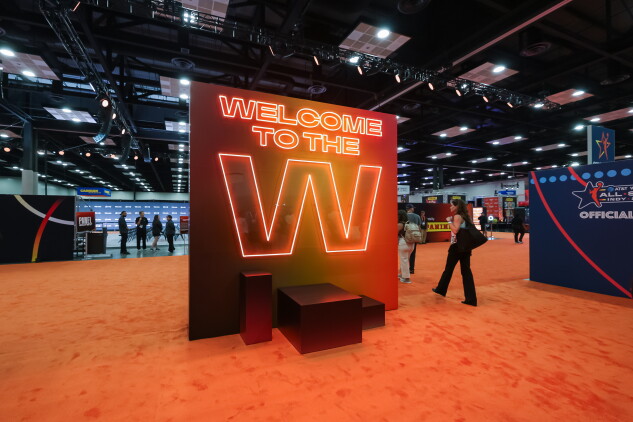
General atmosphere at WNBA Live at the Indiana Convention Center on July 17, 2025, in Indianapolis.
Photographer: Michael Hickey/Getty Images
‘Really Good Case’
“The WNBA has a really good case,” said attorney Josh Gerben of Gerben IP. The league’s use of “The” distinguishes the requested mark from the various other Ws, which should give it leverage, he said.
People also have colloquially referred to the WNBA as “The W” in a number of contexts, and the organization filed its intent-to-use application more than a year before ESPN’s docuseries “Life in the W” was released in July.
After the US Patent and Trademark Office examiner determined that no marks on the register inherently block the WNBA’s application, the agency published the mark for opposition in February, the final step before registration.
If the WNBA simply sought a “W” word mark, the application “certainly would have been rejected” by the examiner before reaching publication for opposition, Dogan said.
The Cubs and Nats filed their opposition this month after earlier seeking two deadline extensions.
The filing delay suggests the teams and the WNBA have been negotiating, with the baseball teams likely seeking binding assurances that the league won’t get too close to their logos, Gerben said. They’re still likely to settle before the TTAB weighs in, though such agreements are often complex and take time, he said.
Likely Coexistence
Sports teams routinely hash out consent and coexistence agreements, like the ones between the Green Bay Packers, University of Georgia, and Grambling University over identical oval “G” logos in different colors.
But not always, as shown by Baylor University’s pending suit against Boston University over interlocking BU logos.
The Cubs’ “W” trademark, famous within baseball for being raised on a flag at Wrigley Field after the team’s wins since the 1930s, is particularly generic-looking, further narrowing the scope of its protection, Gerben said. All of its registrations except the one for flags cover only a blue W on a white background, so beyond font, other sports merchandise using different-colored Ws would differ significantly enough not to cause an issue.
In fact, the Cubs’ trademark has more in common with a Nationals’ trademark than what the WNBA is seeking.
The Nationals — in addition to a curly W likened to Walgreens’ “W” trademark — owns a skinnier block-font “W” dating to the Washington Senators franchise that moved to the Dallas area to become the Texas Rangers in 1971. Meanwhile the Cubs, fresh off their first playoff series win since 1908, applied for their first “W” registration in 2004 — the same year the Montreal Expos began filing applications to rebrand for their move to Washington to become the Nationals.
But that never led to a conflict because major pro US sports leagues coordinate teams’ trademark activity, so the Texas Rangers simply transferred the old Senators’ “W” registration it had retained to the Expos.
With such similar marks residing even in the same league, coexistence will likely be the end result for “The W,” attorneys said.
But “anxiety” over how the WNBA will stylize its mark nevertheless prompted MLB to preemptively head off any possible similarity, Sommers said.
“The WNBA will be well counseled not to copy the appearance of other W trademarks,” he said. “The last thing they want to do is run a huge ad campaign, get sued, and get enjoined.”