
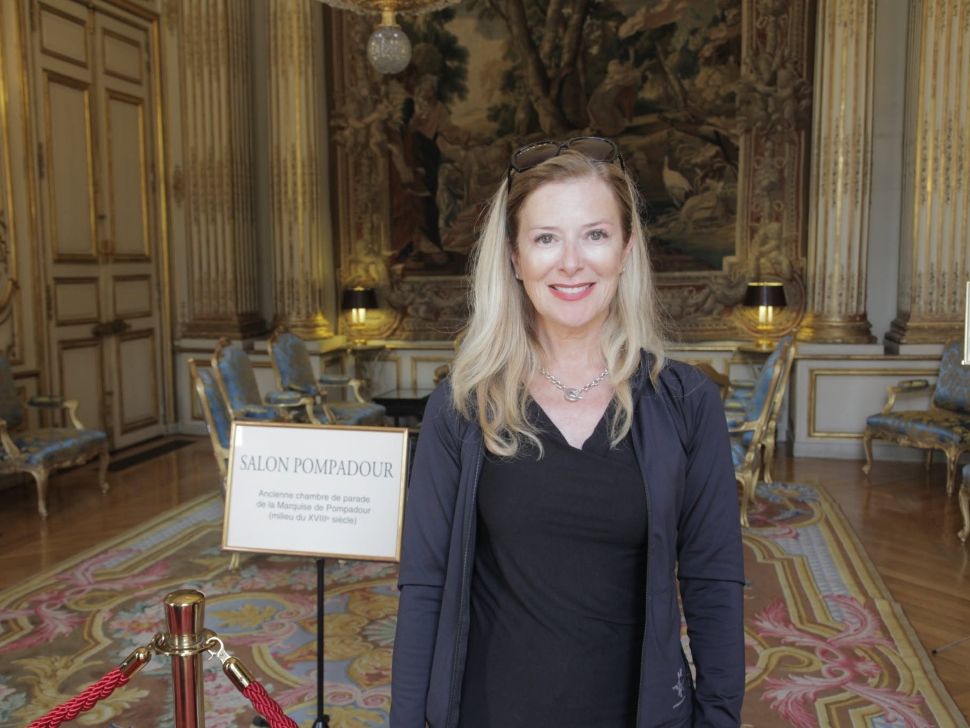
Among all the connections that Marie-Josée Poisson shares with Madame de Pompadour, one of the most influential women in 18th century France, the last name “poisson” would hardly be the one she would have chosen.
“’Poisson’ is a difficult name to bear because it means ‘fish’. It lent itself to all sorts of teasing and trouble,” she explains of her own experience with the name.
For as much trouble as Poisson has had dealing with the name herself, she learned through the writing of her latest book that Madame de Pompadour (born Jeanne Antoinette Poisson), the longtime advisor and consort to Louis XV, had it much worse. “Some intellectuals would write poems about her called Les poissonades,” she shares, “and they were absolutely horrible. They were brilliant, beautifully written, but they were scandalous. They were calling her all sorts of names.”
The kinship that Poisson found with Madame de Pompadour is laced throughout Blood Bound: Unlacing Secret Ties, a work of historical fiction that sees a modern character working in a television station (as Poisson herself has done for over a decade) uncovering a previously unknown child that Pompadour had that leads to adventure and discovery. Blood Bound has been translated into English in the month of August for Women in Translation Month.
An ‘alt-history’
In addition to being an influential figure in the royal court and in the French arts of the mid-18th century, Madame de Pompadour bore two children in her life: a son who died in infancy and a daughter who passed away at 10 years old from appendicitis.
Since very little is known about the son, Poisson took the lack of information and used it as a canvas to create Blood Bound. “My novel is what they call ‘alt-history’, meaning that you take a real history, and you add a ‘what if?’ scenario,” she explains. “So, in my case, what if the son had survived into adult life?”
Although the life as a royal courtesan might be viewed less fondly through modern eyes, Poisson points out that Madame de Pompadour’s was a position of great influence. As such, readers have noticed a feminist streak in the character that Poisson did not intentionally create in her writing, but gains through a cultural lens.
“I just wanted to show that she was actually an important historical figure, not just a puff piece in a petticoat,” says Poisson. “I think it’s important to show that women did have their place in history, even though at the time, it was not considered so.”
RELATED STORIES
An English lens
Madame de Pompadour’s story gains another perspective as Blood Bound is released in English for Women in Translation Month. Poisson worked closely with translator Flora-Lee Bendit to bring the story to life for Anglophile readers.
“To her, doing this translation was a more a matter of rewriting than of strictly translating,” says Poisson, “and I truly appreciate what she’s done.”
The change between French and English perspectives adds an historical nuance to the novel as well as the nuances of languages. Madame de Pompadour’s life and story occur at a pivotal moment in the story of Canada, where Poisson’s protagonist starts their journey in modern times to learn more about Pompadour.
“My book is set at the tipping point between the French regime – Nouvelle France – and the conquest by the British,” Poisson explains, “so I think it’s of interest both to French-speaking readers because it changed what Canada was to become, but also to English-speaking readers because it sheds a different light on things.”
Poisson will be on hand at the upcoming Winnipeg Book Festival to share more about Blood Bound: Unlacing Secret Ties. She will be on the panel called Mysteries and Crimes, which will take place at 4 p.m. on October 3 at The Forks.