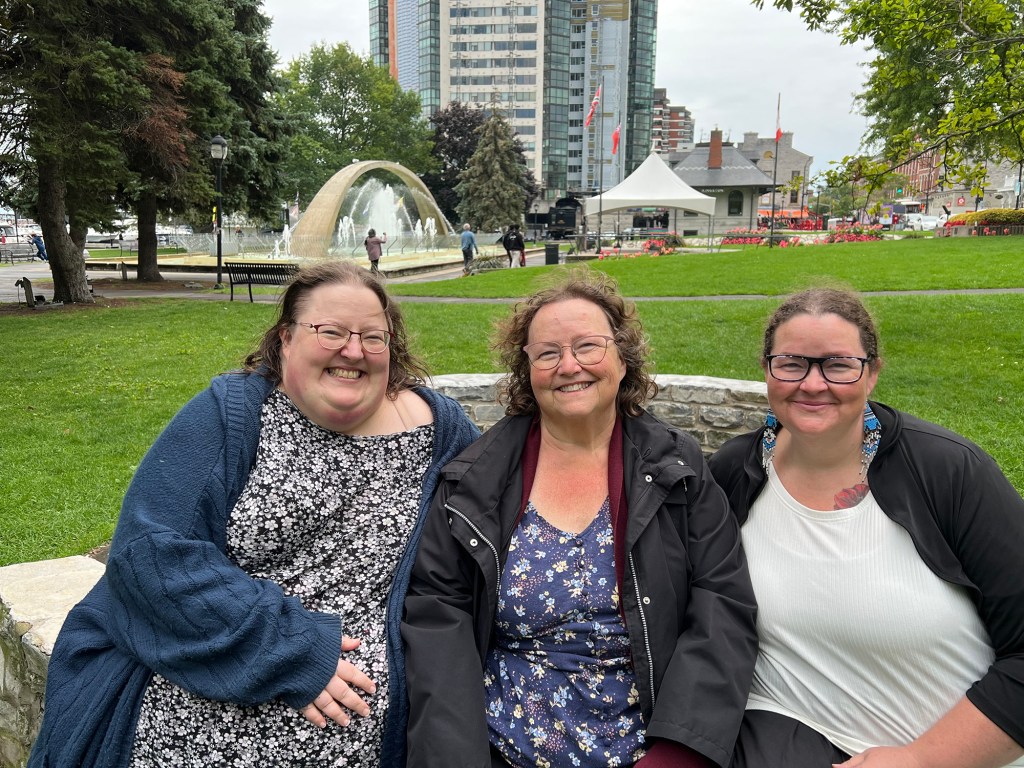
Morning rain stopped Sunday’s Katarokwi Indigenous Market in Confederation Park before it even began.
No food, no music, no ceremonial drumming, no sacred fire and no vendors — except one.
Dawn Binda, owner of Beads at First Light, travelled from Ottawa for what was supposed to be the second-last market of the season. When she arrived, she found an almost deserted waterfront.
“We got here and it was empty. There was no one. Nobody came,” Binda said.
The monthly market, organized by the City of Kingston, usually showcases Indigenous artists, artisans, musicians and food vendors. It is held on the last Sunday of each month from May through September and coincides with community-led Sacred Fires in Confederation Park.
These fires honour children who remain missing, residential school survivors and families affected by the legacy of residential schools.
The market returned this year after a one-year hiatus in 2025 that followed a change in management. It had previously been run by Tourism Kingston and the Kingston Native Centre and Language Nest before responsibility shifted to the city under Manager of Indigenous Initiatives Amber Bryant-Peller.
Editor’s Picks
By noon, the rain had eased, but all other vendors stayed home.
Binda, however, remained for the day under a tent with her mother, Diana Oelrich, and sister, Denise Oelrich, keeping warm with sweaters, blankets and each other’s company — as curious parkgoers stopped to ask where the Indigenous market had gone.
Binda’s craft is beaded earrings, which she displayed in a variety of colours and designs, including miniature red dresses and orange dresses.
“The red dress represents the missing and murdered Indigenous women and the orange ones are for Every Child Matters,” Diana Oelrich said.
The red dress has become a powerful symbol of the crisis of Missing and Murdered Indigenous Women, Girls and Two-Spirit people.
The symbolism grew from the REDress Project, an art installation created in 2010 by Métis artist Jaime Black-Morsette, who hung empty red dresses to represent the absence of those who have been lost to violence.
The project later inspired Red Dress Day, observed each year on May 5. The red dresses are intended to evoke what Black-Morsette has described as a “presence through absence,” while the colour red carries spiritual significance in many Indigenous cultures.
Binda began making earrings about eight months ago while balancing her work as a clerk with the mental health and addictions nursing team at CHEO in Ottawa.
“I’ve been with that team for two years, but I’ve been with CHEO for four years,” she said.
Although she identifies with her father’s Nlaka’pamux and Salish heritage from British Columbia, Binda said she is still waiting for a decision on her application for Indian status.
“While other relatives who put their applications in the same envelope as mine and already have their status, I’m still waiting.” she said. “It’s been three years.”
Her sister received status nearly two years ago despite the applications being submitted at the same time.
“We’d like to know,” Binda said when asked why her application has taken longer. “They have been very evasive when we inquire.”
The family’s story reflects the complexities of status registration under the Indian Act.
Denise Oelrich said previous generations in the family were affected by historic provisions that stripped many Indigenous women of status if they married non-Indigenous men.
Amendments introduced through Bill C-31 in 1985 restored status to many women and descendants, but also created the modern registration categories commonly known as Sections 6(1) and 6(2), alongside the so-called second-generation cut-off.
Under those rules, status entitlement can end after two successive generations of parenting with a non-status partner.
The afternoon also offered a rare chance for the family to spend time together. Denise Oelrich said she is only now beginning to resume normal activities after a prolonged health battle that included necrotizing fasciitis, commonly known as flesh-eating disease.
“I’ve had a lot of surgery. An enormous amount of surgery,” she said.
She spent time in intensive care, underwent a medically induced coma and remained hospitalized for about a month before beginning rehabilitation and ongoing wound care.
“It’s been an interesting couple of years,” she said.
Despite Sunday’s disappointment, there is still one more opportunity this season for residents to visit the market.
The final Katarokwi Indigenous Market is scheduled for Sept. 27 in Confederation Park, running from 10 a.m. to 4 p.m. along Kingston’s waterfront.