

Follow The Athletic’s U.S. Open coverage
Welcome to the U.S. Open briefing, where The Athletic will explain the stories behind the stories on each day of the tournament.
On Day 2, a fresh look for a returning star, a defending champion got it done and some unexpected joy for a lost tennis generation. Oh, and the best tennis GIF ever created.
Tennis, encapsulated
When the U.S.’s Emma Navarro, the No. 26 seed, and France’s Loïs Boisson returned Tuesday after their match was suspended for rain Monday, they knew it would finish. They did not know that they would become part of a moment of liquid tennis cinema.
Reaction videos, fan-cams and GIFs have become a staple of user-generated content across the sport in recent years, as fans clip up their favorite players doing funny things. But perhaps never has there been one that so purely encapsulates the maddening beauty of tennis, and the way in which agony and ecstasy so often co-exist.
Anyway. Navarro won, 7-6(6), 6-7(1), 6-3. Boisson had a break point in the final game, but lost three in a row, and so lost the match. This is what ensued — don’t forget to save it for future use.
 What do Nike’s kits say about star power?
A quick dip into the pop-up Nike store on the grounds at the U.S. Open shows vestiges of what might have been. There are two racks of clothing, front and center — one full of black, indigo and orange basketball-inspired gear, including a t-shirt that says “VAMOS!” in capital letters. The other is stocked with maroon-and-cream polos and a t-shirt that shouts “FORZA!”
For the past few years, as Carlos Alcaraz and Jannik Sinner have proven themselves the dominant forces in men’s tennis, Nike has mostly differentiated their biggest stars in the sport by assigning them different color schemes and top types at Grand Slam tournaments. Alcaraz, generally, gets brighter colors and tank tops; Sinner often gets more muted tones (or black) and polos.
At this U.S. Open, the maroon-and-cream outfit that Sinner would have donned if he hadn’t pulled out of the tournament with a knee injury looks distinct from anything other Nike athletes are wearing.
Same with Alcaraz’s brown-and-white ombre getup, which is a collaboration with rapper Travis Scott’s brand Cactus Jack and is a fresh look for the singles event, along with some custom Vapor sneakers. Alcaraz wore it for his 6-4, 6-4, 6-4 first-round win over Roman Safiullin; for his mixed doubles with Serena Williams, Alcaraz donned the black, purple and orange basketball-inspired jersey that most other Nike athletes at the U.S. Open are wearing in some variation.
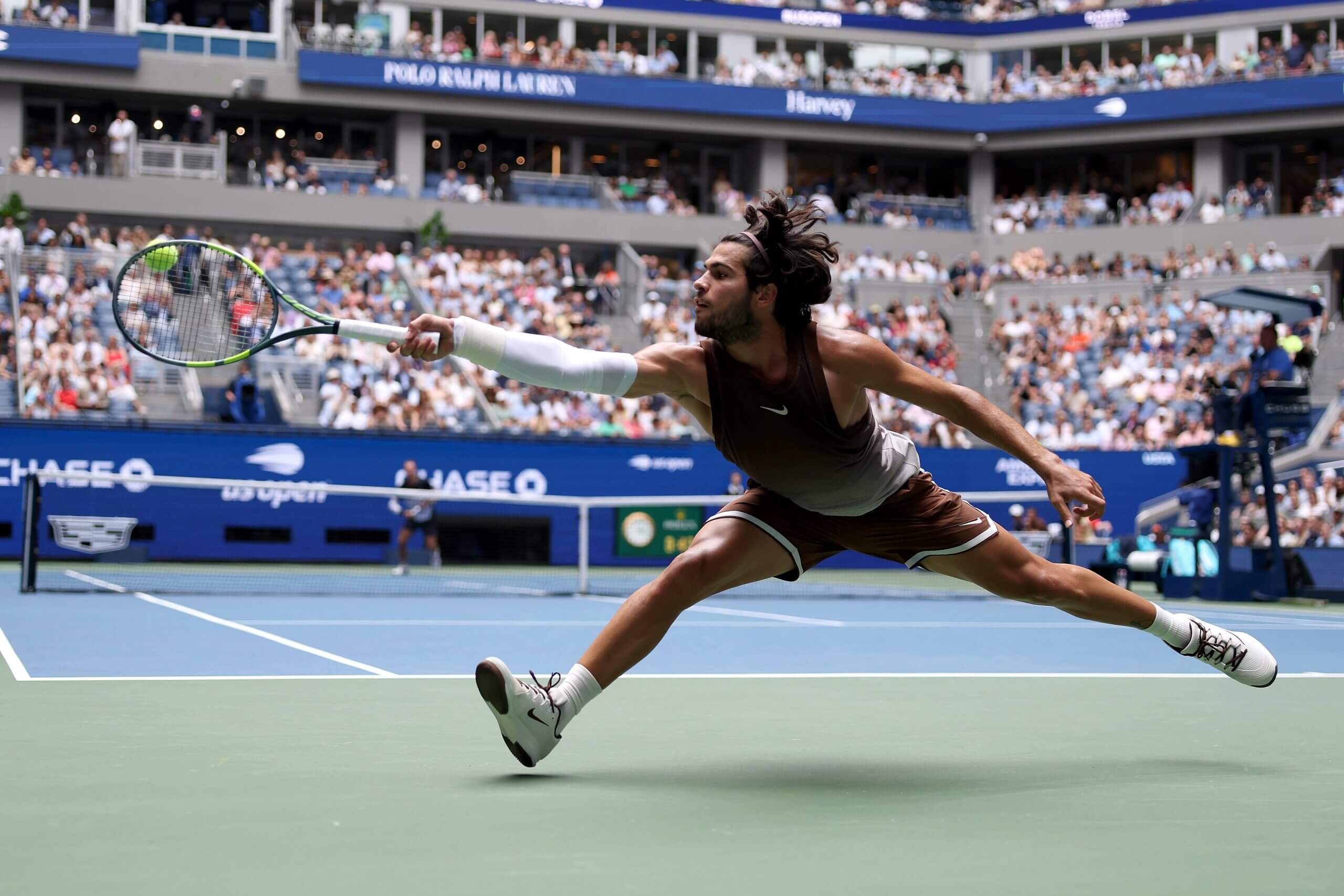
Carlos Alcaraz’s kit for his opening match was a unique look. (Al Bello / Getty Images)
Nike even celebrated Alcaraz’s return to the singles court with a hype video narrated by Scott that compared the Spaniard’s comeback from a wrist injury to playing with fire, a bullishness that stood in sharp contrast to some of the anxieties around how his wrist would shape up.
Scott, of course, was on hand in Arthur Ashe Stadium on Monday to watch his new collaborator play.
Roger Federer, Rafael Nadal, Serena Williams and Maria Sharapova helped condition tennis fans to expect their favorite stars to have their own Nike lines and logos, but those four were extraordinary in their global fame — and from Nike’s perspective, tennis accounts for such a small percent of its revenue these days that investing in custom kits can be dicey.
Sinner isn’t playing at this U.S. Open, meaning the outfit the company designed for him isn’t getting advertised on TVs across the world every other night for the next two weeks.
That’s the chance Nike takes every time it manufactures a custom kit — Naomi Osaka pays to produce her own custom, extravagant walk-on outfits, the latest of which she debuted ahead of a 7-6(6), 7-6(3) win over Anastasia Zakharova Monday. Nike still handles her match apparel. But after a few years of Lululemon, Vuori, Free People and other, more traditional sports brands creeping on Nike’s territory (hello, New Balance), the sportswear company seemed to decide this year the reward was worth the risk.
— Ava Wallace
How did Aryna Sabalenka start her title defense?
Aryna Sabalenka kicked off a very specifically themed Monday on Arthur Ashe Stadium. Call it: defending U.S. Open champions who churned through first-round wins.
Catchy, right?
On paper, Sabalenka sailed through her first-round bout 6-2, 6-4 against Camila Osorio, attacking the Colombian’s serve and overpowering her in rallies. But Sabalenka also showed a good deal of frustration throughout the match as Osorio consistently won a couple of points on each game, keeping Sabalenka from truly dominating the way she wanted to.
The 28-year-old too often made errors on her groundstrokes, clipping the net tape or sending them just long, to the point where she stepped back off of her usual aggressive position on top of the baseline in the second set just to get the ball in play, get her teeth in a rally, then move forward to attack as she usually does.
It was an edgy win, despite how straightforward it was, perhaps because Sabalenka has been struggling to find her usually sky-high level on court in the second half of the year. She has yet to win a Grand Slam title this year, and her world No. 1 ranking is on the line in New York.
There was tension in the air at Sabalenka’s post-match news conference. Even allowing for the fact that any athlete can be short in news conferences, Sabalenka seems to be working hard to shut out anything she perceives as outside pressure at this U.S. Open.
She was asked Monday about how she balances her brand responsibilities over these few weeks with focusing on tennis, a question nearly every star player gets in New York. She did not appreciate the query and responded, with some heat, asking the reporter why they assumed she wasn’t focused on her tennis.
“It’s like my hobby outside of tennis; the whole schedule we plan is all around tennis, so all of those events are not drawing me in any way,” Sabalenka said. “…I have fun. It’s like my hobby outside of my tennis schedule, and it actually gives me so much energy.”
— Ava Wallace
How did a star rebounding from a tough few months find some form?
The feel-good story of the U.S. Open Monday was Zheng Qinwen, the 2024 Olympic gold medalist from China who was top-five player and one of the brightest lights in the sport not so long ago.
Then came an elbow injury, and elbow surgery, and a rushed comeback for the China Open last year, which resulted in more time on the sidelines and inconsistent form this season. She was 11-12 at the start of U.S. Open qualifying. That’s a long way from the Australian Open finals in 2024 and that Olympic gold medal in Paris seven months later.
But Zheng ground through, surviving qualifying and winning her first-round match against another qualifier: 16-year-old Kristina Liutova. Liutova, who won the Memphis Classic in July to become the first WTA Tour champion born in the 2010s, was on a nine-match winning streak going in. She is Russian, but has grown up largely in the U.S., and intends to represent America when she becomes eligible for a green card.
In a match of many mind-bending rallies, Zheng won the day 4-6, 6-3, 6-1, and said during an interview afterwards that she is treating her tennis reclamation project as a chance to take control of her life and her career in ways she didn’t when she was first breaking through on the tour.
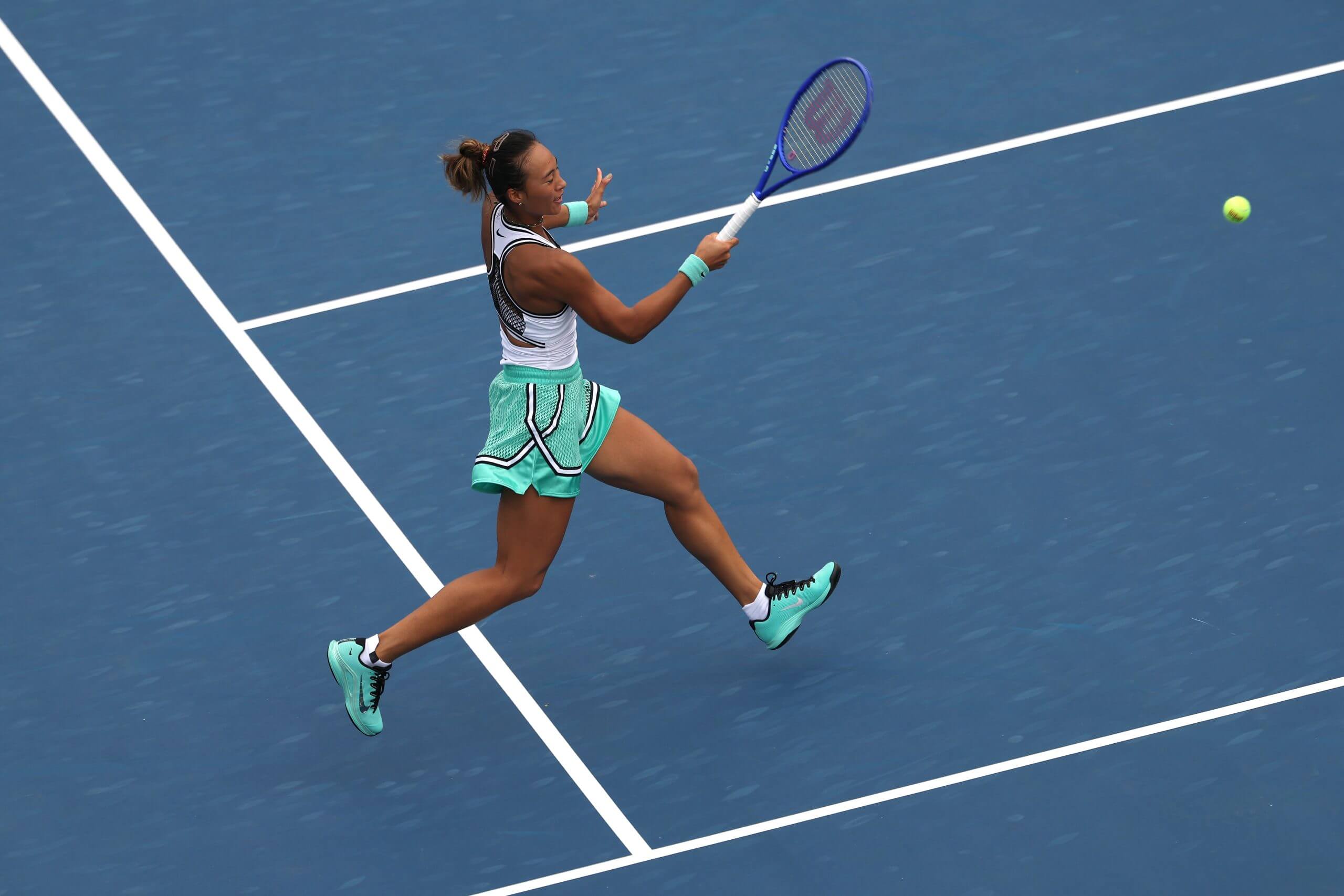
Zheng Qinwen has won four matches in a row, including three in qualifying. (Julian Finney / Getty Images)
“At the beginning I was quite new, so I’m mostly listening to my team, to my coach, to my agent, or to my parents,” she said.
“Now I know what is good for me, so I’m able to make the good decisions. Of course, sometimes not everyone accepts my decision, but I think if you want to become a great tennis player, when you have something in your head, you have to just trust yourself.”
Zheng said early on in the comeback she might have been going too easy on herself and tried to stay too positive.
“When I’m negative, when I feel that I’m not good enough, I need to go practice harder. I want to hit the ball faster; I want to hit the ball with more consistency; I want to serve better,” she said. “This hunger, it leads me to the winning process.”
What does that process look like?
“Let’s stay humble and go to work,” she said.
— Matt Futterman
And how did the men’s sandwich generation have a good day?
For Stefanos Tsitsipas and Andrey Rublev, men’s tennis has been a site of anguish for a while. Tsitsipas has carried injuries that left him wondering if his career would ever be the same, and has gone through a tumultuous coaching up-and-down with his father, Apostolos. Rublev has been questioning the future given the seeming ineffectiveness of his tennis against the likes of Carlos Alcaraz and Jannik Sinner.
The two 28-year-olds, members of the sandwich generation caught between these new two and the Big Three, went into the U.S. Open with indifference. When Tsitsipas was drawn against No. 10 seed Arthur Fils, against whom he has a 5-0 head-to-head, and when Rublev was two sets down to Finnish lucky loser Otto Virtanen, things looked to be going a familiar way.
Well, they didn’t.
Tsitsipas, the world No. 53, was a game away from a two-set deficit against Arthur Fils, one of the hottest players in the world after taking the title at the Cincinnati Open. He had not beaten a top-10 player since March. But as Tsitsipas came alive, his first serve firing, Fils, who had played just two five-set matches in 2026 due to injury, got lost in the flow management that is essential to the format.
From 6-4, 5-2 down, Tsitsipas triumphed 4-6, 7-6(3), 6-1, 6-4.
In a news conference, Fils called his own performance “ almost unprofessional.” Tsitsipas, who came close to tears in his news conference recalling how a back injury he was carrying 12 months ago left him almost unable to walk, was buoyant.
“It’s very easy to not feel confident, especially when you haven’t beaten top players in a long time. That’s why I’m very ecstatic about today. It’s an important, good victory for me, for my confidence,” he said.
“It’s one of those moments that you are able to look back on and be, like, I’ve still got the game that I’m looking for, and I still got the shots and the quality is still there.”
Rublev had reason to be buoyant too. After losing two tiebreaks, he first stormed back against Virtanen to level the match, and then saved a match point on the way to a 6-7(5), 6-7(0), 6-0, 6-2, 7-6(10-5) win.
— Matt Futterman
Other notable results on Day 2
Italy’s Matteo Berrettini defeated 2016 champion Stan Wawrinka (WC) in the Swiss’ final Grand Slam match, 7-6(4), 7-6(3), 6-0.
Wimbledon finalists and Czech compatriots Karolína Muchová (7) and Linda Nosková (6) both made safe passage. Muchová defeated Sinja Kraus of Austria 6-3, 6-0, while Nosková defeated American Katie Volynets 7-5, 6-1.
Ben Shelton (8) recovered from a nervous start against the Netherlands’ Tallon Griekspoor. The American triumphed 1-6, 6-1, 7-6(3), 6-2.
2022 champion Iga Świątek (8) knocked out China’s Wang Xiyu 6-2, 6-3.
And Frances Tiafoe (11) ended the night with a five-set win over American compatriot Martin Damm 6-4, 4-6, 3-6, 6-3, 6-4.
Shot of the day
Here’s a swoonworthy half-volley from Carlos Alcaraz against Roman Safiullin:
 Drop Shots
🕸️ Why a “Spiderman” comic has captivated U.S. Open fans on the grounds.
🤖 How an electronic line-calling error robbed a player of a point they had won.
🏙️ How two-time defending champion Sabalenka found her empire state of mind.
🎟️ And why tickets, a source of angst for fans, can also be one for the stars.
Up next: First round continues
🎾 Women’s singles: Thea Frodin (WC) vs. Elena Rybakina (2)
11 a.m. ET on ESPN Unlimited
Frodin is best-known in tennis for being Serena Williams’ double in the biographical film “King Richard”. Against Rybakina, who is vying for world No. 1 at this event, she may have a realistic chance of an upset. Rybakina injured her left leg at the Cincinnati Open against Iga Świątek and will be under pressure; Frodin is playing at home with freedom.
🎾 Men’s singles: Arthur Fery vs. Lorenzo Musetti (13)
~ 1:30 p.m. ET on ESPN Unlimited
One of the toughest first-round matches in the draw pits Wimbledon semifinalist Arthur Fery against a resurgent Lorenzo Musetti, who is finding form after a protracted spell of injuries. Fery backed up his run at the All England Club as a wild card by reaching the Winston-Salem Open final last weekend, and should be able to test Musetti’s artful game.
🎾 Women’s singles: Zeynep Sönmez vs. Coco Gauff (4)
7 p.m. ET on ESPN, ESPN Unlimited
Coco Gauff returns to the U.S. Open 12 months after baring her vulnerabilities on her serve and forehand to the world. She is in a much more consistent place now, playing front-foot tennis more readily, but she will face similar pressure dynamics to Rybakina when she faces Sönmez, the rising Turkish talent who may have a diaspora fanbase cheering her on.
🎾 Women’s singles: Mary Stoiana (Q) vs. Alex Eala (17)
~ 10 p.m. ET on ESPN, ESPN Unlimited
Alex Eala will be playing away against American qualifier Mary Stoiana, but it will probably feel 50-50 or even like she is at home. Eala, whose Wimbledon win over Świątek, and D.C. Open title a fortnight later, have announced her to the wider sports world, will have Filipino fans waiting all day and night to see her. Expect a phenomenal atmosphere to end the night on Louis Armstrong Stadium.
U.S. Open 2026 women’s bracketU.S. Open 2026 men’s bracket
Tell us what you noticed on the second day…