
When Victor Wembanyama stretched from behind the hoop to throw down a dunk that maybe only he alone can pull off, it was a good reminder of where he finds himself entering his fourth NBA season. It came in Sunday’s FIBA World Cup qualifier, as the national team the 22-year-old now captains slammed the door in crunch time on a Sweden team that had France on the ropes all night.
This was the kind of play that first sparked the fascination with the face of the San Antonio Spurs — and now, perhaps, the entire sport.
Victor Wembanyama continues to amaze, amaze, amaze. 👽#FIBAWC | #StepItUp pic.twitter.com/P2v9cwNl4K
— FIBA Basketball World Cup 🏆 (@FIBAWC) August 30, 2026
But now, the lore of Wemby goes beyond his on-court activity. Last NBA season was also a transformation for Wembanyama’s public persona. He became a thought leader, a meme factory or an enemy, depending on who watched. Stop a New Yorker for their thoughts on the young phenom, and the answer will probably contain some combination of “He’s incredible!” and/or “Screw him.” He is widely adored but has his detractors, as most greats do.
But the friction isn’t just in the U.S. Wembanyama has caught some flak from French right-wing commentators for his outspokenness, particularly when he was one of the first NBA players to speak out about the killing of Minneapolis protester Alex Pretti by federal immigration agents in January.
“Every day, I wake up and see the news, and I’m horrified,” he said in January. “I think that it’s crazy that some people might make it seem or make it sound like it’s acceptable, like the murder of civilians is acceptable.”
That prompted a response from French columnist Juliette Briens, who went on national radio station RMC’s program “Estelle Midi” to slam him for taking a stand, according to Le Parisien. National teammate Guerschon Yabusele came to Wembanyama’s defense, but the moment became a flashpoint that showed Wembanyama was entering the broader societal conversation in France.
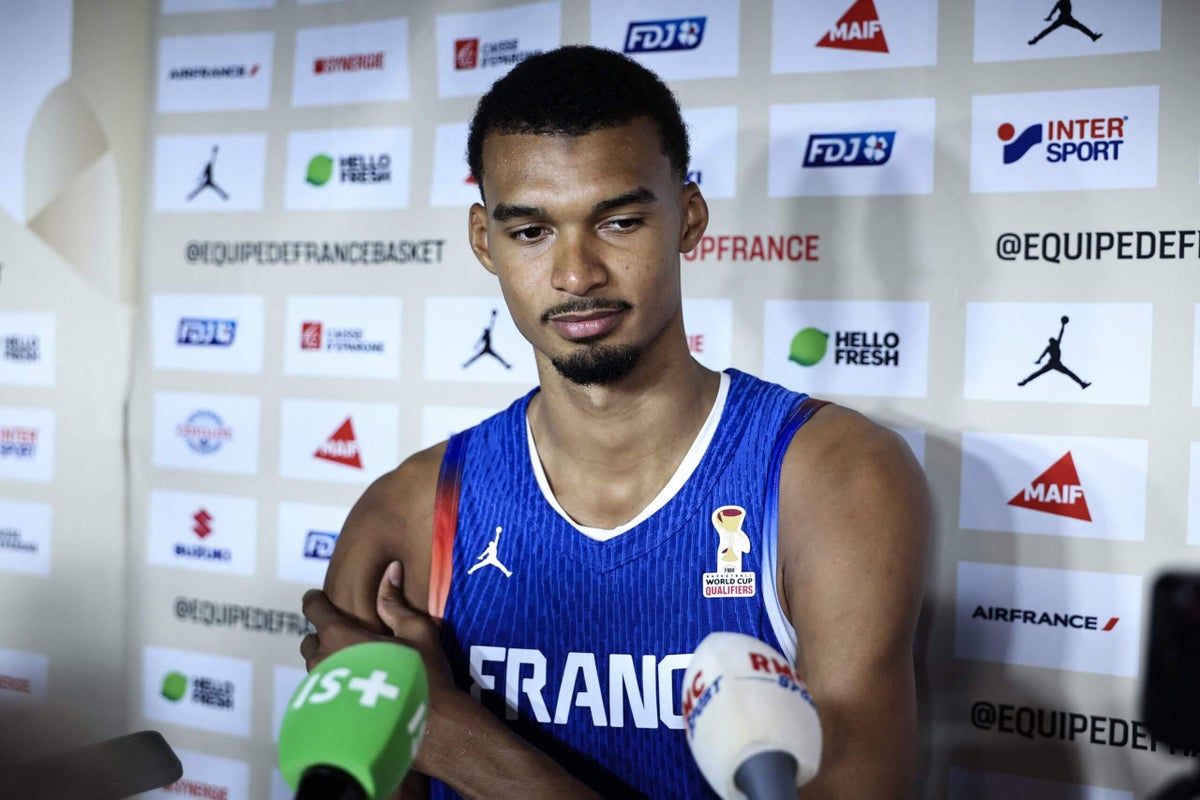
So when Wembanyama returned to his home country last month as a player with the national team and faced the broader French media, the questions began to stray from basketball. That produced a subtle but important moment that foreshadowed the direction of Wembanyama’s career and place in global sports.
Last week, Wembanyama was asked for his thoughts on the 2027 French presidential election, in which right-wing Rassemblement National (RN) — formerly known as the National Front — party leader Marine Le Pen leads the polls to succeed Emmanuel Macron.
“As the years go by, I have fewer and fewer filters, and I’m less and less afraid to say what I think,” Wembanyama said in French to reporters last week. “I haven’t looked into the presidential election closely enough, but I’m not afraid to share my opinion, either. I’m not afraid of upsetting people.”
In June 2024, Wembanyama was one of several French athletes — including footballers Kylian Mbappé and Marcus Thuram — who spoke out against the RN in the elections taking place just before the Paris Olympics.
“Of course, political choices are personal, but for me, it is important to take a distance from extremes, which are not the direction to take for a country like ours,” Wembanyama told reporters then.
But there is a stark difference between the Wembanyama of today and the one of 2024. Before the Olympics, he was an emerging face in French sports rather than a household name. That appears to be changing fast, and it certainly will if he begins to speak up ahead of the 2027 election. Meanwhile, his presence has already taken off in the U.S., as he is one of the NBA’s biggest stars and, as of this summer, a signature athlete with Nike.
Wembanyama is no longer the next big thing. He’s a face of two massive institutions. His decision to wade into politics, or to speak his mind about anything off the court, comes with even more responsibility.
The chain of events tends to start with a transcendent athlete bringing something new to the sport that piques the public’s curiosity. Then, that athlete starts to reveal more of themselves as bigger media crowds bring in a wider range of topics and types of reporters. Once an athlete like Wembanyama shows he is willing to take on a topic in the political or social justice arena, it can open a door to him becoming a sounding board for general news items, such as a presidential election.
The inside story of how Wemby hand-picked the Spurs cheer section
Jared Weiss
Wembanyama wants to build something, though it’s not yet clear what that will be. In an interview with The Athletic last season about founding San Antonio’s Jackals supporters club, he said that while the pursuit of championships and sports greatness is what speaks to his instincts regarding him building a legacy, there is more he wants to do beyond just his first grand project in San Antonio.
“It’s the locomotive of my life and my direction. But there’s many things I want to do, various ambitious things,” Wembanyama said. “Some secret projects. Some that are becoming public as time passes more and more, because they’re getting realized.”
He helped build the Jackals, which became a community organization in the city. He hosts Hoop Gambit, an annual chess-plus-basketball tournament in France, which was played in his former pro basketball home of Nanterre, as well as in his hometown of Le Chesnay-Rocquencourt. Small steps. So, where will it lead?
Perhaps the French election could provide an indication of the type of public figure Wembanyama wants to be.
He didn’t say much this time around because, as he often acknowledges, he doesn’t know enough to speak publicly on it. But he said that there will be a time when he is ready to speak out. His decision to stand firm on his freedom of expression indicates that the bigger checks and exposure flying his way will not change how he uses his platform. Or, at least, he doesn’t intend for that to happen.
Time will tell. But he showed that he is not afraid to not care about what people think of him.
He revealed that in last year’s playoffs, when an elbow to the Minnesota Timberwolves’ Naz Reid, a shove of the New York Knicks’ Jalen Brunson and other rough plays made him persona non grata in several corners of the NBA world. He displayed it many times in news conferences this past season, when he criticized unethical basketball, vowed to bring competition back to the NBA All-Star Game and campaigned for himself to win MVP. Even the way he wondered aloud during the finals if the Spurs’ inexperience could help them avoid feeling the pressure of the moment was brashly naive.
He paid the price in the result of that series, but his candor appeared unassuming.
He has grown comfortable with the idea that being a superstar, a true superstar, means that haters are simply part of the job.
“There’s a quote — I can’t remember who said it — but it goes something like, ‘I know not everyone likes me, and when I see who doesn’t like me, I ask myself whether that really bothers me,’” Wembanyama said last week in French, quoting “Dikkenek,” a French comedy film. “For me, there are certain values that guide me and that I’m completely comfortable with. I wouldn’t even call it taking a stand. I’d simply call it giving my opinion, because I don’t support any particular political figure or party.
“However, there are things that I find problematic, and when I see them, I have no problem speaking up about them.”
A consistent theme in Wembanyama’s public presence is his proclivity for speaking his mind unfiltered. He talks with a directness and stream of consciousness that have led to fascinating insights, controversial moments and enlightening vulnerability. He has shown a willingness to process his opinions and emotions out in the open, in a way that is quite foreign to the modern athlete archetype. He gives questions significant thought, often pausing for a while before answering, and methodically pieces together his responses.
Most athletes in his position don’t show their processing. They are swift and sharp in how they speak. The vulnerability is hidden behind years of media training and experience.
Wembanyama is already at the point of his career where he can no longer exceed expectations. Even his best, even the best we’ve seen, will just be what he’s supposed to do. The pressure to crush it every time one steps on the court or in front of a mic can push powerful people back into their shell.
Will that become Wembanyama? Or will every answer remain an adventure?
Take him at his word. The bigger he gets, the less he’ll worry about what people think.