
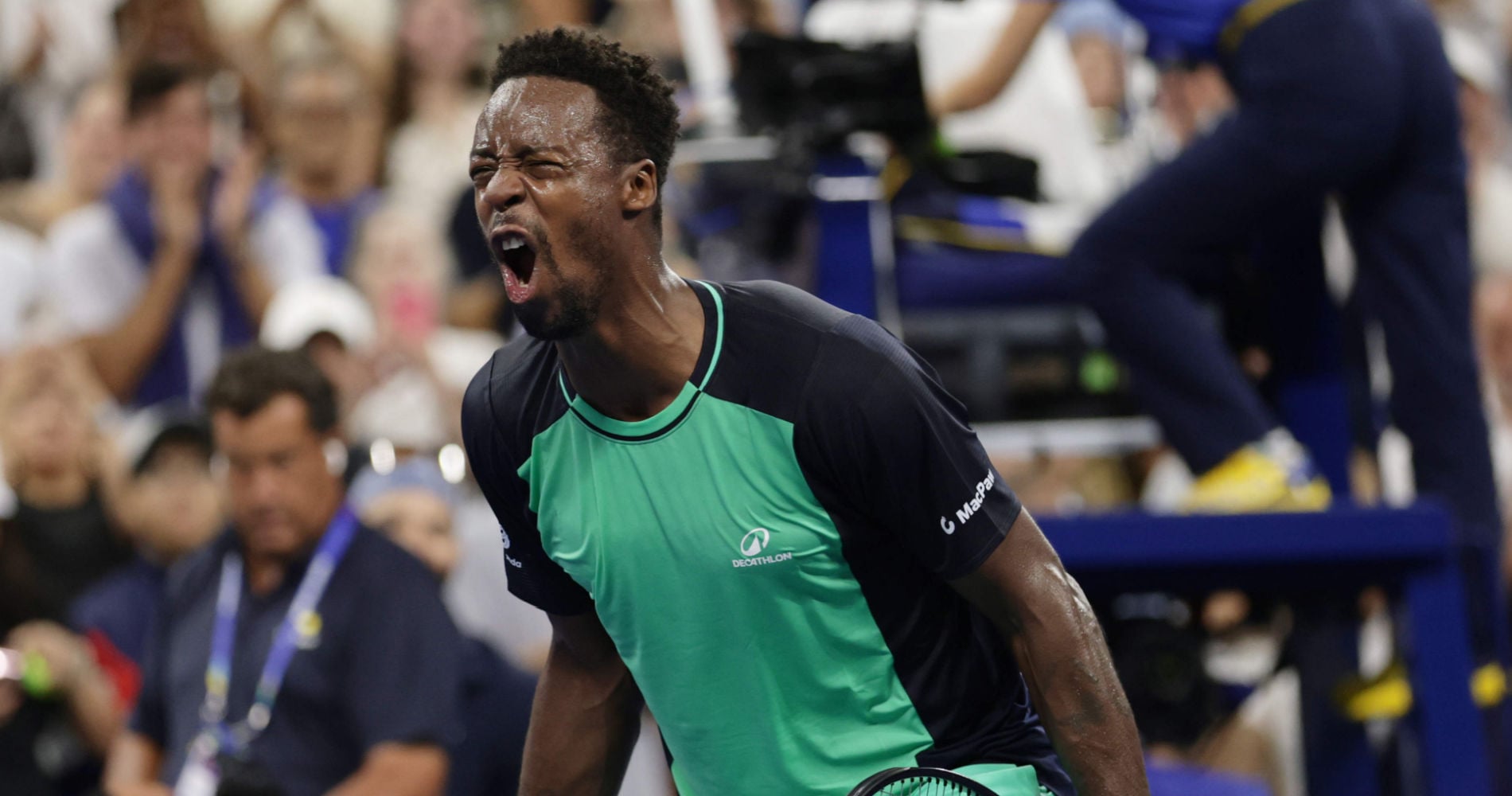
He is the oldest man to win a singles match here since Jimmy Connors beat Jaime Oncins on 2 September 1992. Connors was also 40 that day, and it was also his birthday. In the last four decades, only those two men have won a match at this tournament after turning 40, and both did it on the day itself.
Monfils plays Learner Tien, the No. 14 seed, in the second round, and the two have already met this summer. Tien beat him 6-3, 0-6, 6-3 in the second round of the Montreal Masters 1000 in August, in what was Monfils’ last appearance at that tournament.
The crowd sang Happy Birthday to him afterwards, his wife Elina Svitolina, the No. 9 seed, singing along from the stands. Eric Butorac, the tournament director, arrived in the press room with a cake and a joke about having feared he would be presenting something else. “I was a little worried we would have a retirement ceremony,” Butorac said, “but you played such good tennis, clearly that’s not going to happen tonight.”
Nothing about the tennis was ceremonial
Monfils’ own account of the match was almost aggressively technical, and it contained no reference to the occasion at all.
“A slow start, slow start, but I felt like I had a lot of break points, so I was not so much worried about the next set,” he said. “It was more like for me to move better my legs. I knew that I was striking well the ball during the week, so it was a matter of time. When the momentum shift, I could hold the momentum.”
He was precise about the mechanism. His first-serve percentage was average (57% in, 79% of point won), but a strong second serve (54% of points own) let him take more risk on the first, and his rhythm followed. Then came the part that decided it.
“Somehow I felt like for a little while he was pressure, because he couldn’t pass me,” Monfils said. “And this feeling is exactly where I can be in cruise control.”
The one moment that was not about efficiency came at 1-0 in the fourth set, a break up and two sets to one ahead, when he jumped and slapped a forehand winner, a shot only a handful of players on tour go for, and one that carries no obvious logic at 40. Asked why, he gave the only answer of the night that sounded like a farewell.
“Two sets to one, a break up, happy; why not?” he said. “I won’t hit many more, to be honest. Yes, it’s harder, but somehow it produce more happiness, more joy for me. I’m here to also enjoy myself. There’s not many time, and it was the right moment, so why not to try?”
The last man standing from a group of four
On Saturday, Novak Djokovic sat in this building and named the men who had started out with him at this tournament two decades ago. “I’ve seen it somewhere there’s like three, four of us that played I think back in 2006,” Djokovic said. “I think it was Wawrinka, Monfils could be, and Cilic.”
Four days later, Monfils is the only one of them left in the draw. Marin Cilic withdrew with an injury before the tournament began. Djokovic lost his opening match to Mariano Navone on Sunday night, in tears at 1-3 in the fifth, and revealed afterwards that vomiting and cramping have affected almost every match he has played this year. Stan Wawrinka lost two tiebreak sets to Matteo Berrettini on Monday and then a third 6-0, in the final US Open of his own career.
Monfils, the oldest of the group to win, is also the only one who came in without a ranking to protect. He was granted a wild card, and he has spent his last season playing so few tournaments that competing at all has become a technical problem.
“Very hard, very hard,” he said of that balance. “To have enough good practice with great player, to have enough confidence to match up those guys, because those guy, of course, they play week after week after week. I felt like it’s been a really long U.S. tour, to be honest, but good in the same time, because I could stay and practice every day with top player. Then find back this great striking, find back this confidence.”
Monfils would not let the night become a monument
On Saturday, asked twice what his legacy would be, Monfils declined both times. “I don’t really know, to be honest,” he said then. “Time will tell.” Asked what he would like it to be: “Whatever it is.” He was no more willing on Tuesday. Invited to rank the birthday against every other of his life, he did not choose this one.
“I won’t lie to you, my best birthday was with my family when I couldn’t come here, playing,” Monfils said. “Tonight was, of course, special. Special number, 40, playing a good match, so it was special. But I think my best birthday was back with my family. That definitely was the best one. But this one, let’s say, I will put it in the top 10.”