

Listen to this article
Estimated 4 minutes
The audio version of this article is generated by AI-based technology. Mispronunciations can occur. We are working with our partners to continually review and improve the results.
Artificial intelligence is being tested as a tool to help detect people who linger in Montreal’s Metro stations near closing time — and not everyone is on board with it.
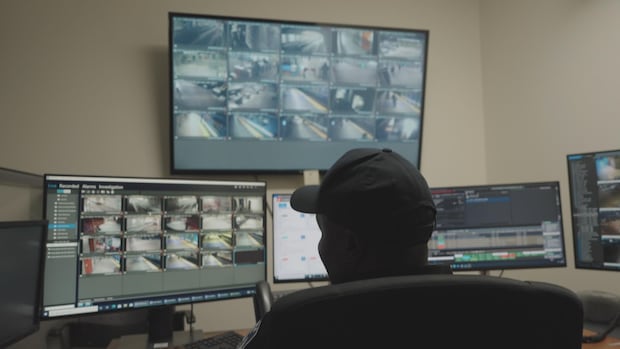
Since January, the Société de transport de Montréal (STM) has been using AI to analyze surveillance camera footage at Papineau and Place-Saint-Henri Metro stations using a system developed by Lipslogics, a Montreal-based startup.
The public transit authority explained the AI system detects people moving then sends a notification one hour before the Metro closes, alerting special constables who can then intervene and escort people out of the affected stations.
The STM says that in 2025 alone, 11,000 people had to be escorted to station exits to allow its staff to close the Metro. Construction crews do work within the stations at night.
“So it’s crucial to find more efficient ways to work and close stations more quickly to avoid delays in our work, which result in financial penalties from contractors,” explained STM spokesperson Renaud Martel-Théorêt in an emailed statement to CBC News.
The Papineau and Place-Saint-Henri stations were chosen as the testing sites, according to the STM, in part because special constables often have to escort people there at closing time.
Montreal’s public transit agency has once again extended a ban on loitering in Metro stations, saying the policy makes the network safer for commuters.
In April, the STM once again extended its ban on loitering in Metro stations. The move-along order, which requires people in the network to be actively travelling, remains in effect until April 30, 2027.
Some argue this AI use ‘goes too far’
Sébastien Gambs, who holds the Canada Research Chair in Privacy-Friendly Analysis and Ethics of Big Data and is a computer science professor at the Université du Québec à Montréal (UQAM), believes there should be more transparency around the project.
He says that includes signs warning people as they enter the affected stations “that beyond the classic surveillance cameras, a new system is being tested.”
Gambs also raised the possibility of facial data being collected from thousands of passengers every day without their consent.
The STM tells CBC that “no facial recognition is performed,” and the system is “not linked to a database that could identify individuals.” It says data is transmitted only on STM servers, and video recordings are “deleted after five to 10 days.”
That isn’t enough to reassure Gambs, who remains concerned about potential privacy and security issues surrounding this type of data system.
WATCH | STM says it wants to make its operations more efficient: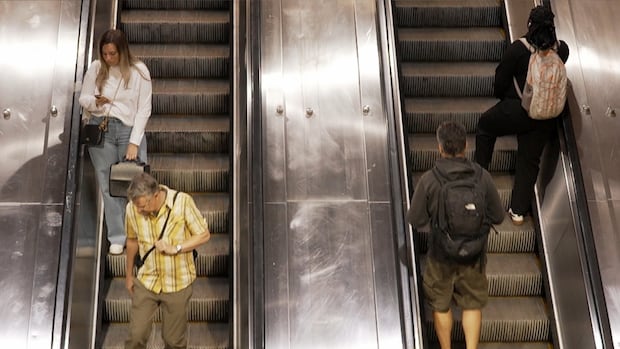
STM testing AI to flag people lingering at some Metro stations near closing time
Montreal’s public transit authority says the AI system is meant to detect human shapes captured by its surveillance cameras and flag them to special constables, who can then escort people out. The STM says the system will start being tested at five Metro stations in the coming weeks.
The Ligue des droits et libertés (LDL) has expressed reservations about the technology as well. The Quebec human rights group believes that using AI to detect loiterers in the Metro “goes too far.”
“What’s to stop the software from being used at times other than closing hours simply to expel homeless people from the Metro?” asked Dominique Peschard, a member of the LDL’s Committee on Population Surveillance, Artificial Intelligence and Human Rights.
He added that this sort of system could also lead to discriminatory targeting based on “the way people dress, move around and look.”
Last month, the STM paid Lipslogics roughly $100,000 to support the completion of its proof of concept through October. After that, if the STM decides to move forward with the AI solution, it says “communications will be deployed” in the stations where it’s being used.
It’s not the first time the city’s transit authority has turned to AI. In 2024, the STM partnered with researchers from the Center for Suicide Intervention (CRISE) to develop an artificial intelligence system as part of the public transit authority’s suicide prevention strategy.
As part of that project, closed circuit television feeds from the Metro were scanned by AI to try and identify warning signs that a person may be in distress; the aim was to then use that knowledge to quickly deploy preventive safety responses.
The STM is also currently examining the possibility of using a chatbot to respond to customers’ trip requests, and says it’s open to exploring other avenues that allow their service to be more efficient and cost-effective.
“Our efforts in this regard will always be conducted with consideration,” said Martel-Théorêt, “and measures taken to mitigate risks related to privacy and cybersecurity.”