
With Canada-U.S. trade tensions showing no sign of letting up, the federal government should invest in infrastructure to support agriculture and other producing sectors say two policy analysts.
“Our ports, our bridges, our roads, don’t all add up to a strategy,” said Jay Khosla. “The Port of Vancouver is the one that comes to mind in particular.”
Khosla is executive vice president of strategy and policy with the Public Policy Forum, an independent think tank. Yiota Kokkinos is a senior executive advisor for energy for the forum.
They said there may be no perfect play for Canada in this trade war, but it’s an opportunity for Canada to get its house and strengthen the capacity of producing industries like agriculture.
The federal government has made much of diversifying exports to trading partners other than the U.S. However, that could be tough without investment in infrastructure.
The Port of Vancouver is one of Canada’s busiest hubs for agri-food exports being shipped abroad, handling 40 per cent of Canada’s non-North American trade.
While the port has increased its volume in recent years, Khosla said it’s still “one of the most inefficient ports in the world right now.
Read Also

Underused economic sectors
In a 2025 report, the Public Policy Forum identified the need for improvement across several key areas to further Canadian trade.
“It predated all of this tariff activity, and it predated Carney as he came in,” Khosla said. “Our argument at the time was that Canada is just literally not doing enough to take advantage of its economic sectors.”
“The producing sectors are the ones that matter,” he added, “agriculture, forestry, energy, mining, etc.”
The report identified areas of focus including:
Getting domestic priorities in order, including interprovincial trade
Diversifying export markets to the fullest extent, including Asia and European Union
Preserving Canada’s relationship with the U.S.
Khosla said the current government is already headed in the recommended direction on some files.
“Our outcomes that we were seeking were actually kind of what Carney’s chasing,” he said. “A: think about boosting investment in the country, and B: think about getting stuff done, meaning major projects, and then use those to diversify market access.”
Carney and the current administration have already made moves toward strengthening non-U.S. trade, including in Qatar, China and the Indo-Pacific.
More work is still necessary to ensure supports are deployed effectively, however.
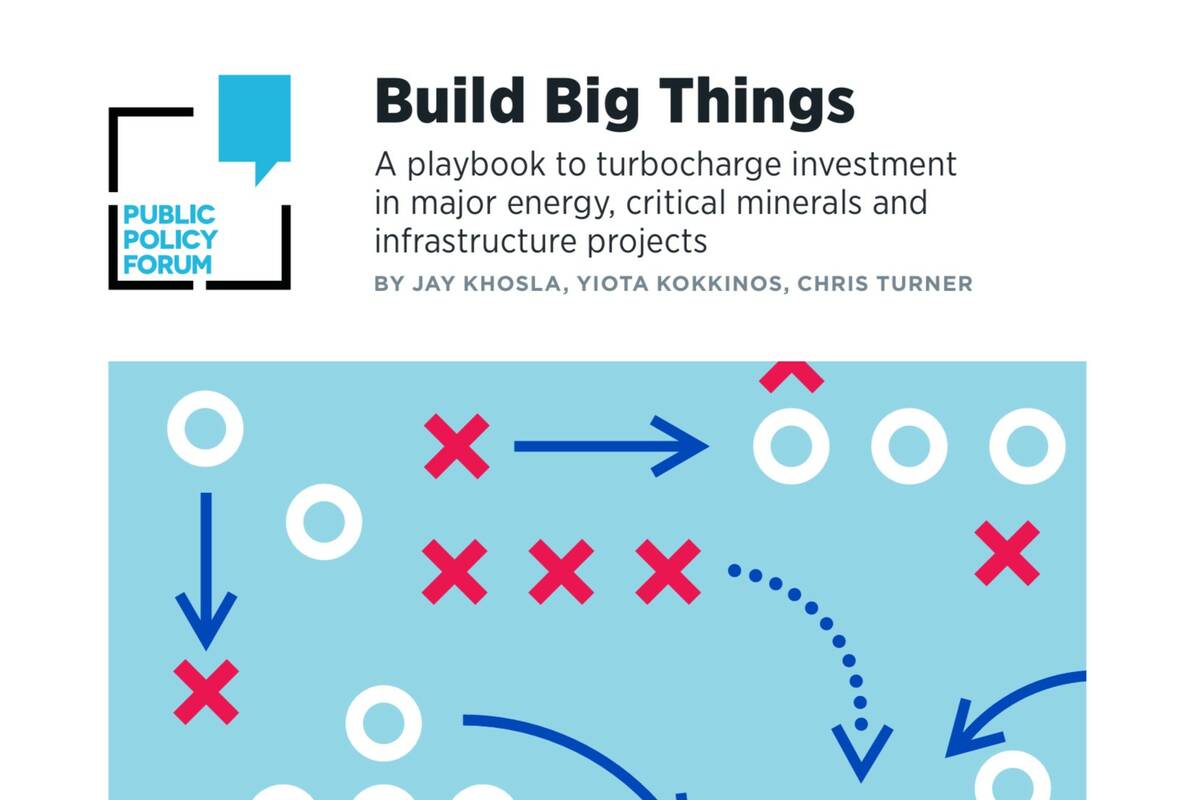
The cover of the Build Big Things report from the Public Policy Forum, released in May 2025, which focuses on investment in energy, critical minerals and infrastructure projects.
Photo:
Public Policy Forum/screenshot
Effective deployment of investment
The 2025 federal budget set a goal to “enable” $1 trillion in investment over five years. Khosla said for this investment to bring results, the government must do sub-sectoral analyses and determine where the money will be best used.
“Where is that investment going to go? How is it going to get monetized? How are we going to work on deal flow? And deal flow means projects, how are we going to make profits for other countries?”
“Over two decades now, we’ve not been able to do that, and so we’ve got to get deep under the hood, and that could easily mean investments in agriculture too,” he said.
This could be supported by other goals, like a set target on GDP per capita.
“They’ve set a target to double their exports, but it’s not clear exactly where and how that’s going to happen,” Khosla added.
The age of free trade may be over
The implotion of U.S.-Canada trade talks has also further jeopardized the possibility of a renewed Canada-U.S.-Mexico Agreement (CUSMA).
When it comes to the implication of August’s trade debacle for the future of North American free trade, Kokkinos said there are two key points to consider.
“One, these negotiations weren’t CUSMA negotiations, right?” she said.
The negotiations had to do with a slew of threatened U.S. tariffs, not the trade deal itself.
The other lesson is a bit more troubling. Reports have suggested the U.S. made demands of Canada that included having more say over future trade deals and retaining the ability to re-instate previous tariffs.
It would have been hard for Canada to give up that control over its own trade, Kokkinos said.
What we can learn from this failed deal and the discussions around it, Kokkinos said, is that the era of Canada-U.S. free trade may be at an end.
“Philosophically, it goes against what (the Trump) administration is about,” she said.
Despite this, Khosla said the two countries’ economies will likely continue to be intertwined, mostly out of necessity.
“In spite of governments having these difficulties amongst each other and aggressive actions, the supply chains and the markets are functioning, and they always will,” he said.
“Whether it be agriculture, whether it be mining, whether it be energy, whether it be even forestry, you know, we’ve got a long-standing dispute there. But at the end of the day, it still works.”
Working together below the federal level
Despite the factured relationship between Ottawa and Washington, Khosla suggested governments at the sub-national level could still try to keep relationships alive. This could mean talks between provincial premiers and state governors, particularly those whose economies and supply chains are closely linked through exports like energy.
“Ninety-nine per cent of the natural gas they use comes from Canada,” Khosla said of the U.S. “Eighty-five per cent of U.S. electricity imports come from Canada. We power the island of Manhattan; we should be proud of that.”
Khosla added that Saskatchewan Premier Scott Moe has been doing more than almost any other province on trade diversification, “working the international game like nobody else’s business.”