

Listen to this article
Estimated 4 minutes
The audio version of this article is generated by AI-based technology. Mispronunciations can occur. We are working with our partners to continually review and improve the results.
At the end of August, the N.W.T. Species at Risk Committee announced a new addition to the territory’s endangered species list.
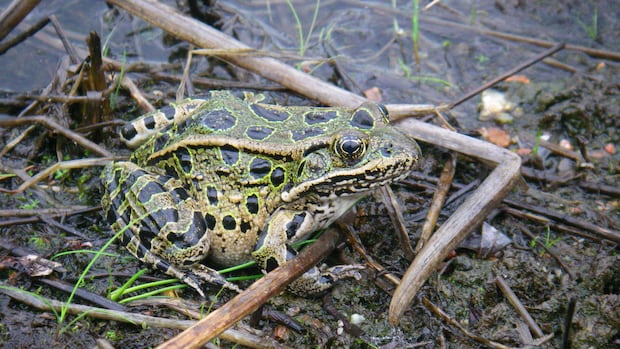
The northern leopard frog can be found in the Slave, Taltson, Tethul and Tazin rivers, all in the South Slave Region of the Northwest Territories. It’s not clear how many there are in the wild, with a population estimated between 2,500 and 10,000.
This year, authorities determined the threats to the small frog could be disastrous to the population in the coming decades.
Biologist Joanne Wilson spoke to the CBC’s Shannon Scott on The Trailbreaker about the frog, and the odds stacked against it.
This interview has been edited for length and clarity
What does it take for a creature to be added to the endangered species list?
The status of endangered is the highest level of risk that a species can have under our territorial Species at Risk Act. It means there’s a risk that the species could be gone from the Northwest Territories in our lifetime. An assessment is done by the Species at Risk Committee. They review all the best available information to assess how the species is doing and what is the risk to the species. They assess the status as endangered and then a decision is made by the management authorities to change the status of the species to endangered on the legal list.
Tell us about the northern leopard frog.
They’re green, they have distinct dark spots with white or light halos around the spots. They’re at the very northern edge of their range where they occur in the territory, and that’s only in a pretty small area. They’re part of a small population of northern leopard frogs that includes the very northeastern part of Alberta and also northern Saskatchewan. That population seems to be somewhat isolated from the rest of the range of northern leopard frogs in North America. They seem to be somewhat genetically distinct from the other northern leopard frogs. Because of that, they’re quite a vulnerable population.
Why does that make them more vulnerable?
When the population is small and has a restricted range, any sort of threat or negative impact can have a large effect on the population. The fact that there isn’t a lot of connectivity between these frogs and those further south means if something were to happen, it would be difficult to replace them. They’re genetically distinct, but they have low genetic diversity as well, and that can also make a population more vulnerable to things like disease outbreaks, for example.
Was there a key piece of information that pushed this frog towards being listed as endangered over threatened?
Some of the things that were new compared to last time is more knowledge about the genetics and the isolated nature of the population, because of some genetic work that had happened. Information on declines of frogs, as well as their consideration of the threats, was informed by some more recent events like wildfire and drought that have been happening in the range of those frogs.
Does development on the rivers the frogs live in threaten them?
There can be impacts to amphibian habitats from human disturbance like hydroelectric power. The proposed expansion project [at the Taltson hydro dam] was one of the factors that the committee identified as a potential concern for northern leopard frogs.
Does it buy the frog any extra protections?
The listing under our Species at Risk Act for the N.W.T. does not confer any automatic protections, but what it does is it raises the profile of the species for consideration in things like environmental assessment and review.
LISTEN | Biologist Joanna Wilson’s full interview on the northern leopard frog:
The Trailbreaker10:23Northern leopard frog on the endangered species list
The organization in charge of tracking biodiversity in the Northwest Territories says a certain frog has been added to the endangered species list. Joanna Wilson, a biologist with the territory, told the CBC’s Shannon Scott about the northern leopard frog and the threats it faces.