
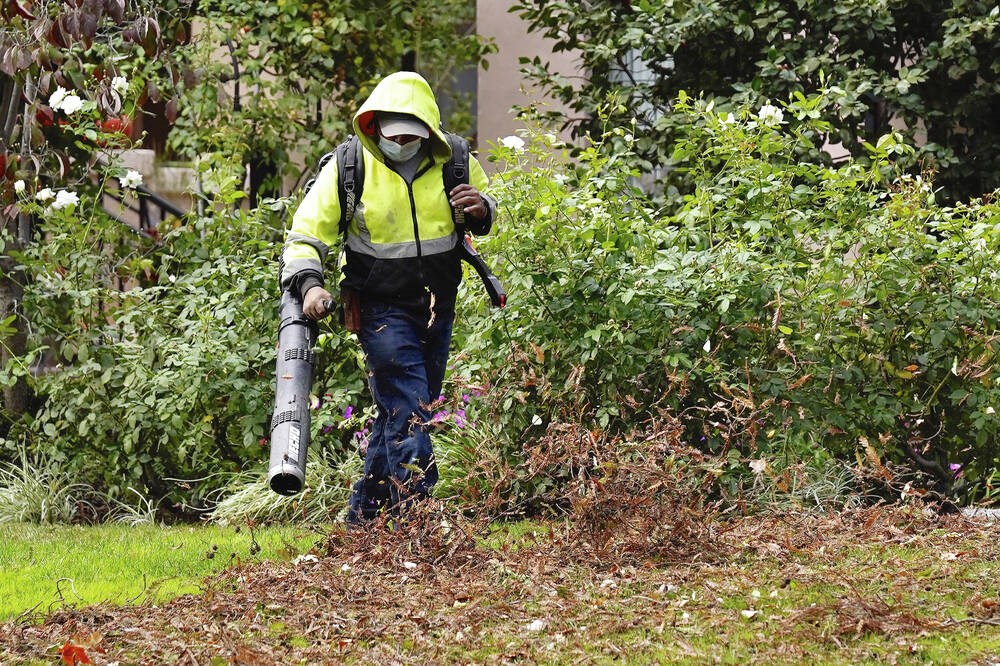
The change would be part of an overhaul of the city’s noise bylaw that also includes new noise limits for stationary vehicles.
Users of gas-powered leaf blowers have been put on notice — their days are numbered in the City of Victoria.
Victoria council on Thursday asked staff to start the process to phase out use of gas-powered leaf blowers in the city as part of an overhaul of the noise bylaw.
Coun. Jeremy Caradonna, who suggested the motion, said it could be years before the ban is in effect, as the timeline for the phase-out is up to city staff.
He said the city does not have environmental regulatory authority, so the phase-out has to be based on noise issues. “We do know that for many years now there’s been alternatives to gas blowers that are quieter, namely the electric ones.”
The ban would apply to all gas-powered leaf blowers — residential, commercial and those currently used by the City of Victoria.
He noted that Oak Bay introduced a bylaw in 2022 that would see a gradual phase-out of gas-powered blowers by this year. “I think that there is a sufficient rationale to move in this direction,” Caradonna added.
Coun. Dave Thompson agreed, adding: “This can’t be a surprise to anyone at this point.”
That Oak Bay phase-out is now on hold, however, after district council voted in June to consider it as part of a broader climate action plan.
In an interview, Oak Bay Mayor Kevin Murdoch said the pause came down to “limits on the district’s ability to regulate environmental matters and our own parks department determination that commercial-grade electric equipment has still not caught up.”
The district does, however, include limits on leaf-blower use in its noise bylaw — they can only be used between 8 a.m. and 8 p.m. on weekdays and between 9 a.m. and 5 p.m. on weekends.
The plan to ban gas-powered leaf blowers in Victoria was just one of a series of tweaks city staff will be making in overhauling a noise bylaw that has not been changed in 23 years.
Proposed changes include banning outside amplification after 10 p.m. around commercial properties, including bars and music venues, and new noise rules for stationary vehicles that affect amplified sound or the vehicle itself if it can be heard at a distance of five metres.
In the construction sector, the new bylaw will define “loud work” as that which registers above the 85 dBA decibel level. Commercial construction will continue to be limited to between 7 a.m. and 7 p.m. on weekdays, but on Saturdays, it will now be allowed between 9 a.m. and 7 p.m. rather than 10 a.m. and 7 p.m. Construction work is prohibited on Sundays and statutory holidays.
“Quiet work” will be permitted at all hours if it doesn’t disturb anyone.
There will be exemptions for city construction work and noise-exemption permits will be available with conditions for commercial builders.
WorkSafeBC says regular exposure to sounds louder than 85 dBA can cause permanent hearing loss. A dump truck typically emits noise of between 84-88 dBA, a belt sander can range from 93-104 dBA and a jackhammer can range from 100-115 dBA.
Other changes include establishing decibel limits for heating and cooling systems and the addition of leaf blowers and chainsaws to the definition of power equipment.
Power equipment will not have decibel limits, but its use will only be permitted between 8 a.m. and 8 p.m. on weekdays and between 9 a.m. and 5 p.m. on weekends and holidays.
City staff had recommended allowing waste collection to start earlier at 6 a.m. and continue until 7 p.m. on weekdays, and to start at 9 a.m. and continue until 7 p.m. on weekends, but council shot that down.
Instead, garbage-collection hours will continue to be 6:30 a.m. to 8 p.m. on weekdays in all areas of the city except what’s known as the activity districts — Ogden Point, Point Hope Shipyard, Rock Bay’s industrial land and Island Farms’ Blanshard property, where the hours are 6 a.m. to 8 p.m. On weekends and holidays, garbage will continue to be collected between 10 a.m. and 8 p.m.
The changes proposed by staff also include looking at ways to reduce noise conflicts from waste collection in residential neighbourhoods, improving educational material, including a dedicated web page for the new noise bylaw, and evaluating the city’s land-use policies to improve sound reduction in future developments.
Council also asked staff to explore increasing the penalties for anyone breaching the new bylaw when it is adopted.
“I think people will abide by it if they know that it’s not just a cost of doing business,” said Coun. Stephen Hammond.
The new bylaw is expected to return to council for approval once it’s drafted.