
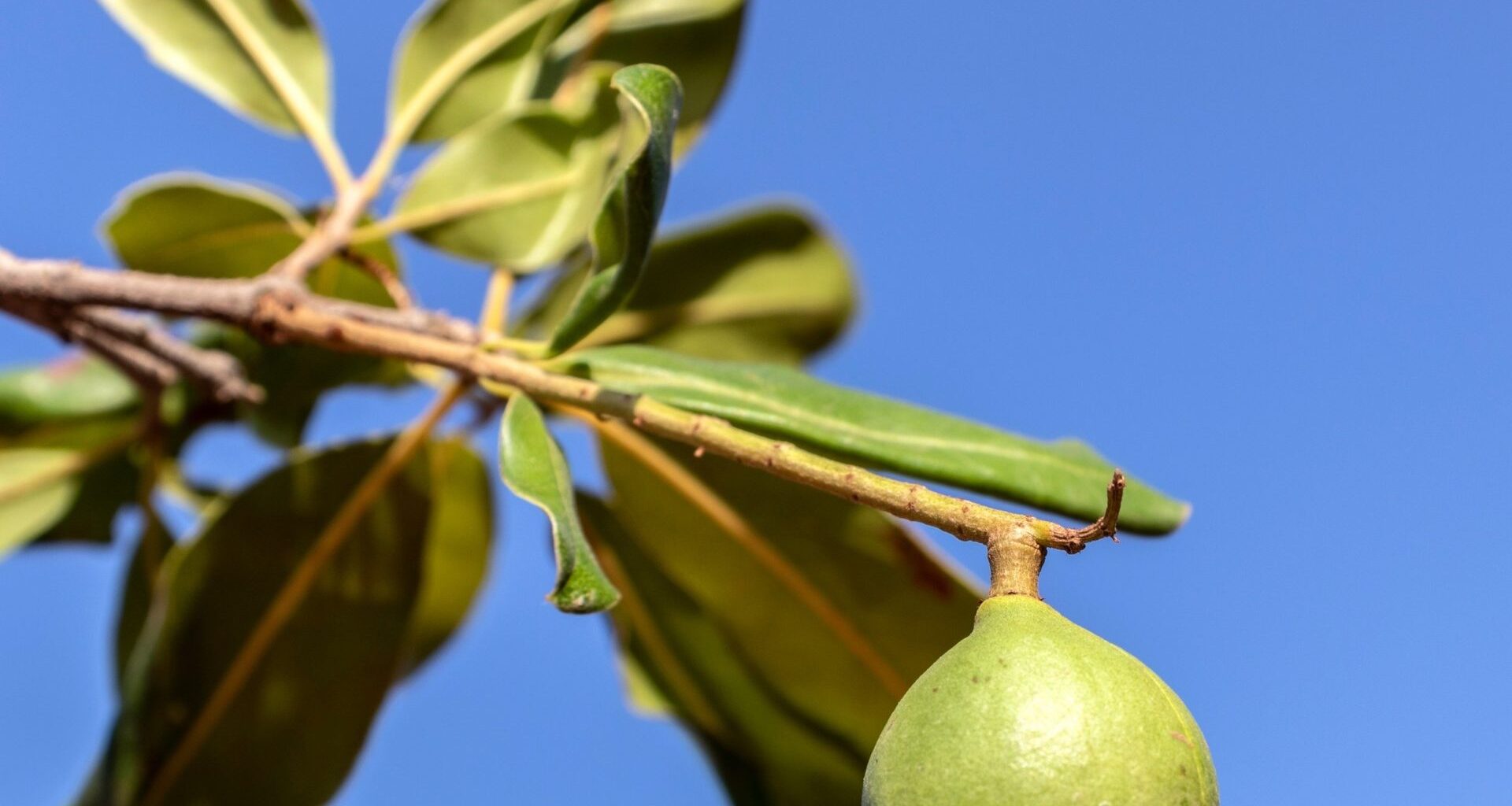
Bats and nearby natural habitats may help macadamia farms reduce insect damage while supporting stronger yields and wildlife.
Macadamia nuts are expensive to grow, and farmers can lose part of their crop when insects damage the kernels.
That makes pest control important not only for farms, but also for the quality and cost of the food that eventually reaches stores.
Most farms rely partly on pesticides to protect crops.
But birds and bats also eat insects, raising a simple question: can keeping more natural habitat around farms help these animals do some of that work?
Why pest control matters
Macadamia trees in South Africa are attacked by insects such as stink bugs and moths. These pests can damage the edible kernel inside the shell, lowering the quality of the harvested nuts.
Natural pest control could therefore have practical value.
If wild animals eat crop pests, they may help farmers protect more high-quality food while reducing some of the pressure to depend on chemical control.
Researchers wanted to see how much birds and bats actually mattered in working macadamia orchards. They also wanted to know whether nearby natural vegetation changed the help these animals provided.
Farms with different landscapes
The team worked on 10 macadamia farms in Limpopo Province, South Africa. The farms ranged from about 2,395 to 4,364 feet (730 to 1,330 meters) above sea level.
Around each farm, the researchers measured natural habitat within about 0.62 mile (1 kilometer). This included native forest, bush, shrubland, and grassland.
Some farms had much more natural vegetation around them than others. That gave the team a chance to compare farms surrounded mostly by agriculture with farms that still had large areas of natural habitat nearby.
They also compared trees near natural vegetation with trees about 164 feet (50 meters) farther into the orchard. This helped show whether the edge of an orchard worked differently from its center.
Keeping wildlife away
The researchers selected eight trees on each farm, giving them 80 trees in total. They grouped the trees into pairs and covered half of them with large mesh cages.
The cages stopped birds and bats from reaching the trees. Small creatures, including insect pests, pollinators, and small insect-eating animals, could still pass through the mesh.
The uncovered trees stayed open to wildlife. By comparing nuts from covered and uncovered trees, the team could see what changed when larger animals could no longer hunt around the macadamias.
From January through May 2021, the researchers collected nuts every week or two. They cracked them open and checked whether the kernels were healthy, damaged, or immature.
Nuts suffered more damage
The difference was clear. On trees that birds and bats could reach, the estimated chance of insect damage was about 6.2%.
On the covered trees, it rose to about 10.7%. That equals a relative increase of around 70%.
For farmers, that difference matters because damaged kernels can lower the quality of the crop.
The finding suggests that wild animals visiting orchards can provide a useful service that may otherwise be easy to overlook.
However, the cages kept birds and bats away at the same time. The experiment cannot show exactly how much of the improvement came from birds and how much came from bats.
Bats stood out most
The team also watched birds and recorded bats to see which animals were most closely linked with lower pest damage.
They recorded 2,028 individual birds from 111 species. Seventy-one of those species ate insects or had mixed diets that could include insects.
Bats were tracked through their high-frequency echolocation calls, which they use to move through the dark and find prey. The researchers identified 16 bat species.
More bat activity was linked with less insect damage. Bird numbers, however, did not show a clear connection with the amount of damage found in the nuts.
Why bats may matter
The bat effect was strongest on farms with less natural habitat around them.
The authors suggest that these farm landscapes may contain more pest insects for bats to hunt, but they did not directly test that explanation.
Many important macadamia pests are active at night. That could give night-feeding bats an advantage when hunting some of the insects that damage the crop.
Still, the comparison has limits. Birds were counted as individual animals, while bat activity was measured from recorded calls, so the two groups were not measured in the same way.
The result therefore does not mean that one bat does more work than one bird. It means that farms with more bat activity tended to have less insect damage.
Natural habitat helped farms
The amount of natural habitat around farms was also linked with macadamia production.
Yield increased as natural habitat cover rose and reached its highest estimated level at around 60%.
Yield then fell somewhat when natural habitat became even more common.
But farms with about 80% natural habitat still had an average yield around three times higher than farms with about 20%.
The authors suggest that natural areas may help by supporting pollinators, which are insects that move pollen between flowers and help plants produce nuts.
At very high levels of natural habitat, animals such as monkeys may also take more nuts from trees.
Those possible explanations were not directly tested in this work. The 60% figure should therefore not be treated as a perfect target for every macadamia farm.
Birds used different spaces
Natural habitat also changed the bird community. More birds were found where the surrounding landscape contained more natural vegetation.
Birds that could eat insects were especially common near orchard edges. The average number was about 10.0 at edges compared with 6.3 in orchard centers.
The kinds of birds changed too. Species that prefer dense vegetation and trees were more common near natural habitat, while birds that prefer open areas were more common farther inside the orchards.
This shows why keeping patches of natural vegetation may matter beyond pest control. Working farms can also provide space for wildlife, especially when natural areas remain nearby.
Important limits remain
The landscape part of the work involved only 10 farms, so the patterns may not look exactly the same in every macadamia-growing region.
Bat monitoring was also incomplete. The team detected 16 species, even though 44 species are known from the wider area.
The cages created another problem. They kept pest-eating birds and bats away, but they also stopped larger animals such as monkeys from taking nuts, which could partly hide an effect on total yield.
The paper also gives conflicting information about whether bat diversity increased with natural habitat. That result is less certain than the much clearer link between bat activity and insect damage.
Nature can help farming
Lead author Dr. Mina Anders is from the Department of Crop Sciences at the University of Göttingen.
She said natural areas can support animals that are useful to agriculture.
“Natural habitats are valuable refuges and support beneficial organisms that provide pollination and pest control, which in turn is good for agricultural production and for farmers,” Dr. Anders said.
“It is therefore essential that natural habitats and their conservation are incorporated into the planning of agricultural land.”
The results do not show that bats alone caused the full drop in damaged nuts, or that every farm needs exactly the same amount of natural habitat.
They do show that keeping wildlife and natural vegetation in farming landscapes can be connected with better nut quality, fewer insect problems, and stronger crop production.
The study is published in the journal Agriculture, Ecosystems and Environment.
—–
Like what you read? Subscribe to our newsletter for engaging articles, exclusive content, and the latest updates.
Check us out on EarthSnap, a free app brought to you by Eric Ralls and Earth.com.
—–