
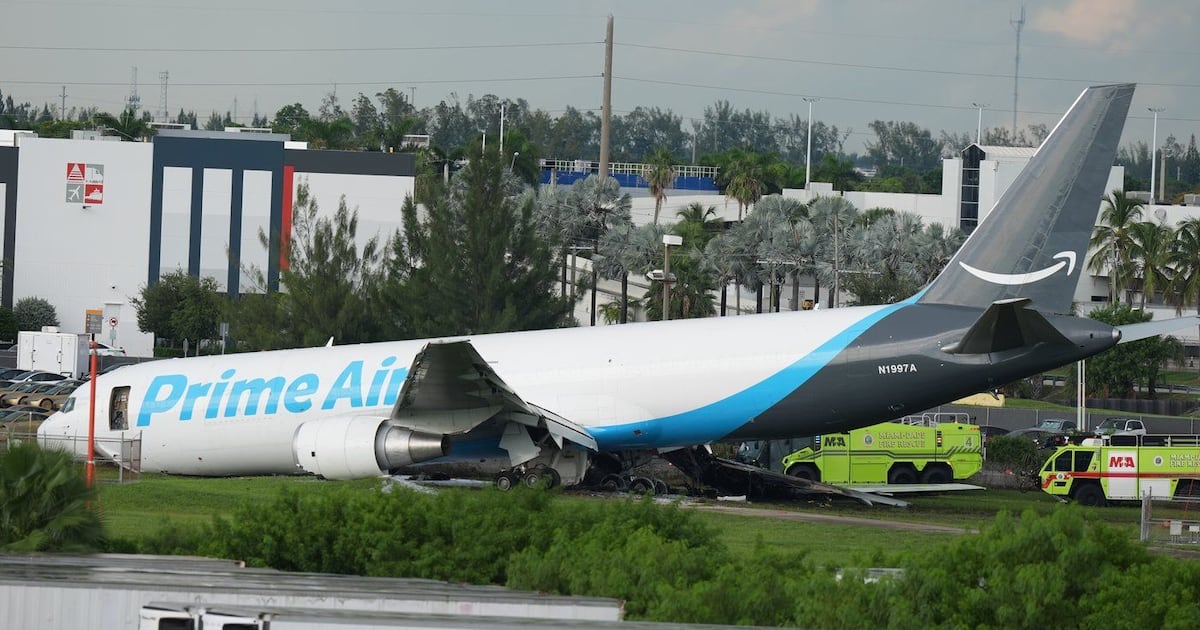
An investigation is ongoing after an Amazon Prime cargo plane crashed at Miami airport, killing five and leaving more injured.
At least five people are dead after an Amazon cargo aircraft overran the runway during a landing at Miami International Airport on Sunday afternoon, striking multiple vehicles and sending a thick black plume of smoke into the air as it caught fire.
Five others were injured in the crash, Miami-Dade Fire Rescue Chief Raied “Ray” Jadallah said during a news conference Sunday evening. Three are in critical condition and were taken to a trauma centre, while two others were taken to a local hospital, he said.
Several victims were trapped in the vehicles that were hit by the plane and had to be extricated, Jadallah said.
“Guys, the plane’s on fire. Plane’s on fire. Put your game faces on,” a first responder said in a radio call recorded by Broadcastify.
Responders also said the pilots had been removed from the plane and were being treated.
There is no apparent threat to public safety at this time, Miami-Dade Sheriff Rosie Cordero-Stutz said during the news conference.
More than 60 “units arrived to find an airplane that had caught on fire as a result of this crash, with heavy flames and smoke showing,” an X post from Miami-Dade Fire Rescue says.
It’s not clear why the plane was unable to stop. The Boeing 767 was going nearly 130 miles per hour when it left the usable portion of the runway, according to data from tracking site Flightradar24.
A review of air traffic control audio by CNN shows the pilots did not declare an emergency before the landing.
The U.S. National Transportation Safety Board and U.S. Federal Aviation Administration will investigate. A team of NTSB investigators is on its way to the scene of the crash and will work to determine a probable cause.
“We’re heartbroken to learn that five people lost their lives in today’s incident at Miami International Airport,” Kelly Nantel, an Amazon spokesperson, said in a statement to CNN. “Our deepest sympathies go out to the families, loved ones, and all those affected by this devastating loss.”
“The airplane, which was operated by 21 Air, was attempting to land when this incident occurred,” the statement continues. “We’re working closely with local authorities and officials to learn more and will cooperate fully with any investigation.”
The 32-year-old Boeing 767 was flying from San Juan, Puerto Rico, and landed on runway 30, which is more than 9,000 feet long, according to FAA data.
Inspection crews reported there were no aircraft parts or debris found on the runway, but the plane damaged navigational equipment when it left the pavement.
A ground stop for planes flying to the airport was lifted around 5 p.m. ET, but flights headed there will continue to be delayed into Monday due to the disabled aircraft on the runway, according to the FAA.
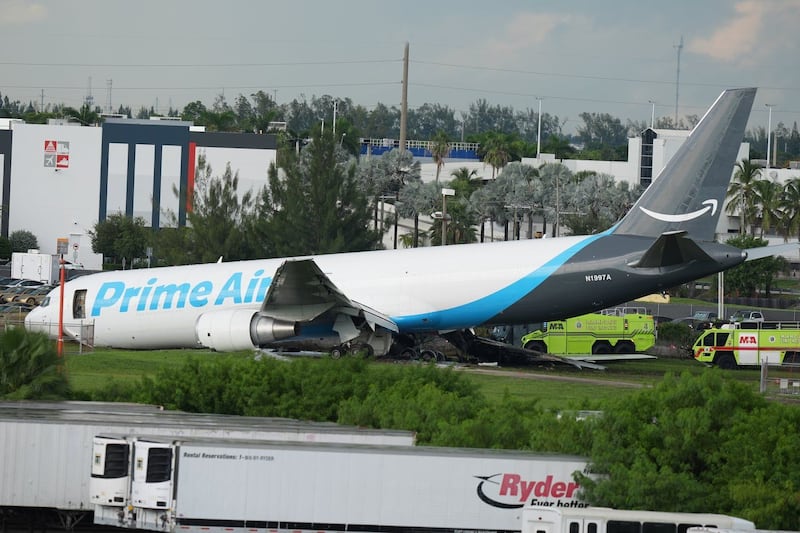 Amazon cargo plane An Amazon cargo plane sits at the Miami International Airport (MIA) after it overshot the runway, Sunday, Sept. 6, 2026. (AP Photo/David Fischer)
The FAA said the 21 Air flight overran the runway around 2 p.m. local time.
The airline is a cargo carrier with an operations centre in Miami that performs flights for companies like Amazon and DHL using Boeing 767 aircraft.
CNN has reached out to 21 Air for comment.
The Amazon Air cargo aircraft was one of more than 250 that the e-commerce giant operates daily to ship customer packages.
Amazon Air operates a fleet of more than 100 cargo aircraft, including the Boeing 737 and 767 and the Airbus A330. Cargo shipments may include anything from general merchandise, like a company’s flower bouquet orders, to dry ice, perishable medicines, parcels, fish, fruit and other goods.
Runway excursions – when airplanes go off the runway – are the No. 1 incident involving airplanes worldwide, according to data from the International Air Transport Association.
The runways at Miami International, like many airports, have a designated safety area that serves as a buffer in case excursions occur.
CNN’s Sarah Dewberry and Nayeli Jaramillo-Plata contributed to this report
Amanda Musa, Pete Muntean and Aaron Cooper, CNN